
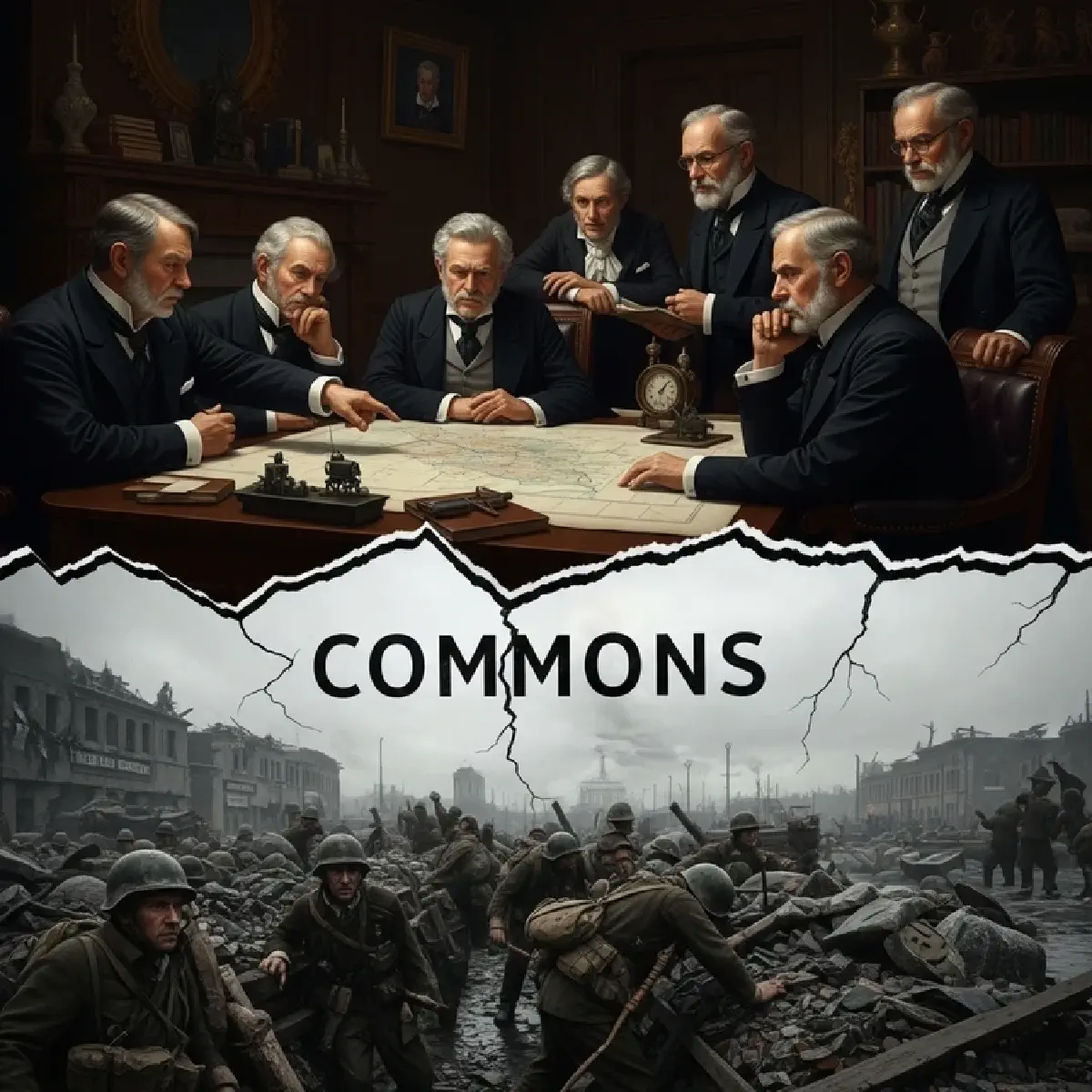
Key Takeaways
- Rational Actor Model: The Gambler's Formula, developed by economist Kjell Hausken, provides a structured framework for evaluating the decision to go to war based on human, economic, and influence factors.
- Incentive Divergence: The model highlights the misalignment between decision-makers and the broader population, where leaders may prioritize influence over human and economic costs borne by society.
- Cognitive Biases: Psychological factors such as optimism bias and psychic numbing distort leaders' perceptions of war costs and benefits, leading to suboptimal decisions.
- Dual-Calculus Framework: The refined model introduces parameters like the Accountability Attenuator and Perceived Strategic Advantage Multiplier to better explain why wars are initiated despite high costs.
- Structural Analysis of War: This approach shifts the focus from individual rationality to systemic incentive structures, providing insights into the recurring nature of catastrophic war decisions.
The Measured Elegance of a Formal Model#
In 2016, economist Kjell Hausken published a methodical formalization in the International Journal of Conflict Management. It represented a deliberate attempt to subject the complexity of war to the discipline of cost-benefit analysis. His model, $u_i = \alpha_H(H_G - H_L) + \alpha_E(E_G - E_L) + (1 - \alpha_H - \alpha_E)(I_G - I_L)$, posited that any strategic actor—a state, a leadership group, a faction—could rationally evaluate war through the systematic weighting of three core value domains: Human lives, Economic value, and Influence. Assign appropriate preference weights ($\alpha$), estimate potential gains ($G$) and losses ($L$), and if the net sum proves positive, warfare emerges as a logical policy choice.
The formulation carries intellectual appeal. It promises a structured framework for statecraft, an analytical mechanism to pierce through rhetorical justifications with quantitative assessment. For a moment, the historical enigmas—the profound miscalculations of 1914 or 2003—appear tractable. If decision-makers could be equipped with accurate data and coherent preference structures, perhaps optimal choices could be reliably derived.
This promise, while foundational, is necessarily incomplete. Hausken’s equation serves not as a prescriptive solution, but as a diagnostic benchmark. Its very parsimony illuminates the consequential socio-political realities it must, by design, omit. It assumes a unitary, rational actor ($i$) optimizing for a coherent entity. It operationalizes the value of human life as a stable, statistical construct. It presupposes gains and losses accruing to a single, integrated ledger. Historical analysis robustly contradicts these assumptions. The decision to initiate armed conflict is not made by a monolithic nation, but by specific individuals or coalitions employing a calculus in which the most severe potential costs are often externalized. By commencing with Hausken’s rationalist baseline, we can identify the precise junctures where it fails to capture empirical reality, thereby constructing a more nuanced theoretical model—a strategic calculus—that seeks not to advocate for optimal decisions, but to explain the systemic origins of suboptimal ones.
Thesis: Formalizing the Logic of Strategic Miscalculation#
This analysis delineates the systematic development of a mathematical model for conflict initiation, progressing from Hausken’s rational-actor foundation to a refined “Dual-Calculus Framework.” Each successive modification is motivated by a historical and psychological factor absent from the original formulation: the fundamental incentive divergence between the political-military decision-makers and the broader populace that bears the primary costs. The finalized model introduces two pivotal parameters—the Accountability Attenuator (O) and the Perceived Strategic Advantage Multiplier (ρA)—that transmute the equation from a normative tool for choice optimization into a diagnostic engine for analyzing institutional failure. This intellectual progression demonstrates that to comprehend the etiology of war, we must cease modeling states as unitary actors and begin modeling the fractured, often misaligned, incentive structures operating within their political systems. The resulting mathematics does not generate superior decision-makers; it illuminates the structural conditions under which existing decision-making apparatuses recurrently select catastrophic pathways.
Constructing the Strategic Calculus: From Unitary Theory to Incentive Divergence#
Foundation: The Normative Baseline – Hausken’s Rational Actor Framework#
Kjell Hausken’s 2016 model establishes an indispensable, analytically rigorous foundation. It mandates specificity in a domain frequently characterized by rhetorical ambiguity. Its architectural components are methodically constructed:
1. The Tripartite Value Taxonomy: The segregation into Human ($H$), Economic ($E$), and Influence ($I$) value establishes a comprehensive analytical framework. A conflict might secure petroleum resources ($E_G$) while degrading diplomatic standing ($I_L$). It could hypothetically preserve future lives by removing a regime ($H_G$) while expending lives in the operational process ($H_L$).
2. The Subjective Weighting Protocol ($\alpha$): This constitutes the model’s core innovation, formally incorporating subjectivity. A humanitarian organization might rationally set $\alpha_H \approx 1$, exclusively privileging human outcomes. A mercantilist state might assign $\alpha_E = 0.8$, prioritizing resource acquisition. A geopolitically ambitious actor might maximize $\alpha_I$, seeking transformational influence.
3. Dynamic and Probabilistic Extensions: Hausken’s framework extends beyond static analysis. It incorporates temporal dynamics ($T$ periods) with a discount factor ($\delta$), evaluating whether deferred benefits justify immediate expenditures. It integrates risk preference ($\beta$), acknowledging that a risk-acceptant autocrat ($\beta < 0$) will undertake gambles a risk-averse democracy would reject. The model even accommodates multiple stakeholders, aggregating their divergent preference weights.
The model’s illustrative application to the Iraq War is analytically revealing. Employing estimated parameters—$6 trillion in economic loss ($E_L$), postulated gains in unilateral influence ($I_G$)—Hausken demonstrates the exquisite sensitivity of the net outcome to the assigned weights. If Influence is highly valued, the war can be rationalized as net-beneficial. If Human life is the paramount metric, it registers as a profound loss.
The Structural Limitation Emerges: The model proficiently addresses “Was this conflict rational given a specific set of axiomatic priorities?” It cannot resolve the more politically salient question: “Whose priorities are institutionally determinant, and through what mechanisms?” It presumes the decision-maker’s $\alpha$ weights apply to costs and benefits internalized by a singular entity. This represents a logically coherent but empirically problematic world.
The Crucible of Empirical and Behavioral Science: Pressuring the Unitary Assumption#
Two interdisciplinary perspectives destabilize Hausken’s unitary actor premise. The first is historical political sociology. Scrutinize the composition of any war cabinet—London in August 1914, Washington in March 2003. The individuals authorizing force are typically demographically, economically, and socially distinct from the cohorts who will execute it. They are older, wealthier, and insulated by institutional position and social class. The “cost” of a soldier’s life is not an intimate loss but a statistical parameter, a variable $H_L$ to be optimized. Conversely, the “benefit” of strategic influence ($I_G$) is intimately salient—it defines professional legacy, political viability, and historical standing.
The second is cognitive and behavioral psychology. Human cognition does not process costs and benefits neutrally. “Optimism bias” systematically elevates perceived success probabilities. “Psychic numbing” renders the marginal disutility of large casualty counts less than linearly proportional—it effectively logarithmically compresses the $H_L$ variable. “Hyperbolic discounting” ensures a politician facing an electoral cycle ($\delta$ low) will dramatically undervalue long-term nation-building costs ($E_L, I_L$ projected far into the future).
These forces do not generate random noise; they produce systemic, directional distortion. They do not merely perturb Hausken’s variables; they structurally corrupt the equation’s application within the decisive actor’s cognitive and institutional framework. The leader’s strategic calculation is not a mildly imprecise approximation of a societal calculation. It is a substantively different calculation governed by divergent incentive structures.
The Cascade of Theoretical Modifications: Architecting the Dual-Calculus Framework#
The tension between parsimonious theory and complex reality necessitates sequential theoretical modifications, each enhancing the model’s explanatory fidelity.
Modification 1: Disaggregating the Actor (The Principal-Agent Schism)
The primary and most critical revision is to reject the singular $u_i$. We must model two concurrent, yet distinct, utility functions:
- Elite Decision Utility ($U_E$): The strategic calculus of the decisive coalition (senior political leadership, high command, core economic beneficiaries).
- Public Burden Utility ($U_C$): The experiential calculus of the military personnel, taxpayers, and civilian populations who absorb the primary costs.
Immediately, the preference weights ($\alpha$) diverge. For elites, $\alpha_I^E$ (weight on Influence) is often paramount—conflict concerns legacy, credibility, and geopolitical repositioning. $\alpha_H^{E,public}$ (the weight they assign to public human life) is typically calibrated to a technocratic “Value of Statistical Life” (VSL). For the public, $\alpha_H^C$ approaches a lexicographic priority when applied to kin and community; the cost is experienced as profound trauma, not a financial metric. Their $\alpha_I^C$ is frequently negligible—abstract “influence” gains provide scant consolation for personal loss.
Modification 2: Operationalizing the Accountability Attenuator (O) – The Institutional Insulation Parameter
This represents the pivotal conceptual advancement. Empirical observation confirms that elites seldom personally internalize the losses they sanction. The insulating mechanism is the degree of political accountability—or its institutional absence.
We formally define O, the Accountability Attenuator, where $0 \le O \le 1$.
- $O \rightarrow 1$: High accountability. Elites bear direct, significant consequences from public costs (e.g., conscription of their kin, punitive wealth taxation for war financing, decisive electoral punishment for failure).
- $O \rightarrow 0$: Low accountability. Elites are substantially insulated. Public costs generate minimal personal or professional repercussions.
We consequently model the Elite’s Effective Decision Utility ($U_E^*$) not as an isolated $U_E$, but as:
$U_E^* = \text{Elite-Perceived Gains} - O \cdot \text{Public Costs}$
Expressed within Hausken’s taxonomy:
$U_E^* = [\alpha_I^E I_G + \alpha_E^E E_G^E] - O \cdot [\alpha_H^{E,pub} H_L^C + \alpha_E^{E,pub} E_L^C]$
The critical implication: The cost term in the elite’s calculus is the public’s burden, discounted by their own institutional insulation. If $O$ approximates zero (characteristic of autocracies, or democracies during periods of nationalist fervor and muted opposition), the entire second term—the human and economic toll—effectively vanishes from their optimization function. This formalizes the “moral hazard” inherent in discretionary war-making, providing mathematical structure to the core insight of interest divergence.
Modification 3: Modeling Overconfidence and Opportunism (The ρA Composite Parameter)
The original critique identified “greed” and “power asymmetry” as key catalysts. Mathematically, this manifests as a distortion in the perceived gain function. We capture this with two interrelated parameters:
- ρ (Rho): The subjective probability of military-political success. This parameter is vulnerable to cognitive biases (optimism, groupthink, informational filtering). In 1914, $\rho$ was universally assessed as near 1.
- A (Asymmetry Coefficient): A multiplier ($A \ge 1$) applied to potential gains, representing the perceived strategic opportunity or “window of advantage” when confronting a relatively weaker adversary. The greater the perceived power disparity, the more it inflates the subjective value of anticipated spoils ($I_G, E_G$).
These combine into a composite gain-side multiplier: ρA. This creates a permissive condition for conflict. A high asymmetry coefficient ($A$) renders war appear materially lucrative. An inflated success probability ($ρ$) renders it seem operationally straightforward. This amplified perception of gain (ρA $\cdot$ Gains) then confronts heavily attenuated costs ($O \cdot$ Costs). The equilibrium tilts toward aggression with destabilizing ease.
Modification 4: Non-Linear Cost Structures – Formalizing the Disproportionate “Brunt”
Finally, we address the qualitative nature of the public’s burden. For elites employing a VSL, costs scale linearly: 20,000 casualties cost 20,000 × VSL. For the populace, the socio-political cost is non-linear. Initial losses register as a national tragedy. Mass casualties represent a foundational societal trauma, a crisis of political legitimacy, and intergenerational psychological damage.
We therefore model the Public’s Burden ($U_C$) with a cost function $f(H_L^C)$, where $f$ could be quadratic ($(H_L^C)^2$) or exhibit another convex form. This explains the empirically observed phenomenon where public support for military engagements frequently collapses non-linearly after crossing a perceptual casualty threshold—a dynamic unpredicted by linear cost models. The “brunt” is not merely additive; it compounds.
The Integrated Model: The Dual-Calculus Decision Framework#
Synthesizing these modifications yields the finalized Dual-Calculus Model. It consists of two simultaneous equations and a systemic decision rule.
1. The Elite’s Strategic Decision Function:
$$U_E^* = \rho A \cdot (\alpha_I^E I_G + \alpha_E^E E_G^E) - O \cdot (\alpha_H^{E,pub} H_L^C + \alpha_E^{E,pub} E_L^C)$$
2. The Public’s Experienced Welfare Function:
$$U_C = \rho_C \cdot (\alpha_E^C E_G^C) - f(H_L^C)$$
(Where $\rho_C$ is the public’s frequently more pessimistic success estimate, and $f$ is a convex cost function.)
3. The Systemic War-Initiation Rule:
IF $U_E^* > 0$ AND $O < O_{critical}$ THEN WAR.
The critical oversight threshold ($O_{critical}$) represents the minimum level of institutional accountability required for public preferences (via legislatures, media, civil society) to veto a leadership decision. If operational accountability $O$ falls below this threshold, a positive elite utility $U_E^*$ is sufficient to trigger hostilities.
This framework is fundamentally diagnostic, not prescriptive. To analyze a historical or prospective conflict, we estimate its parametric configuration:
- Was ρ substantially inflated by bias? (WWI, Iraq 2003)
- Was O institutionally negligible? (Autocratic regimes, democracies during security panics)
- Was A significantly >1, enabling opportunistic aggression? (Asymmetric conflicts initiated by major powers)
- Was the divergence between $\alpha^E$ and $\alpha^C$ particularly severe? (A near-universal feature of discretionary wars)
Historical case studies achieve analytical clarity through this lens. The Iraq War emerges from a parametric state of high ρA (cognitive overconfidence combined with unipolar power status) and depressed $O$ (post-9/11 political deference). WWI is characterized by high ρ, high A, and $O \approx 0$ within aristocratic governing structures. WWII for the Allies represents the limiting case where $O \rightarrow 1$—existential threat forced an alignment of elite and public fates—simplifying the calculus to one of collective survival.
The following is a plot visualizing the Dual-Calculus Model (DCM), mapping the decision space with annotations for historical conflicts.
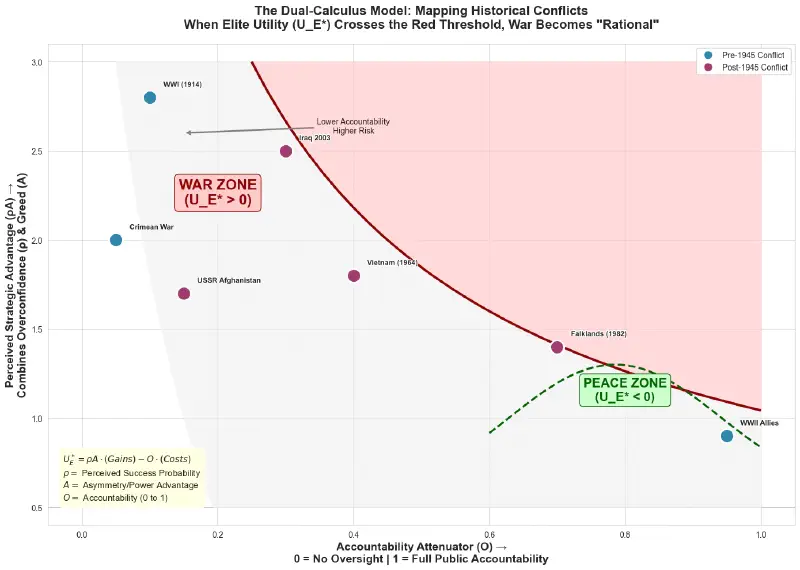
For a dynamic visualization, see the accompanying interactive model here.
The Dual-Calculus Framework reveals that the paramount systemic risk is not a leader with idiosyncratic preferences, but a governance structure where the decision-maker’s utility function is institutionally decoupled from the consequences of their choices. It identifies accountability—the parameter O—not military capability, as the central variable in the strategic stability equation. The ultimate, sobering implication is that mitigating catastrophic war may depend less on cultivating wisdom in individual leaders and more on deliberately engineering political and institutional systems that elevate O, compelling leaders to optimize not for a narrow set of political and personal gains, but against the convex, societal cost function of the body politic they are entrusted to lead. The mathematics, in the end, provides not a formula for better gambling, but a blueprint for redesigning the casino.
References#
Allison, G. T. (1971). Essence of decision: Explaining the Cuban Missile Crisis. Scott, Foresman and Co.
Appelbaum, B. (2011, February 16). As U.S. agencies put more value on a life, businesses fret. The New York Times. https://www.nytimes.com/2011/02/17/business/economy/17regulation.html
Bentham, J. (1789). An introduction to the principles of morals and legislation. T. Payne.
Berman, E., Shapiro, J. N., & Felter, J. H. (2011). Can hearts and minds be bought? The economics of counterinsurgency in Iraq. Journal of Political Economy, 119(4), 766–819. https://doi.org/10.1086/661983
Borcherding, K., Eppel, T., & von Winterfeldt, D. (1991). Comparison of weighting judgments in multiattribute utility measurement. Management Science, 37(12), 1603–1619.
Boulding, K. E. (1989). Three faces of power. SAGE Publications.
Bueno de Mesquita, B. (1980). An expected utility theory of international conflict: An exploratory study. American Political Science Review, 74(1), 917–931.
Bueno de Mesquita, B. (1981). The war trap. Yale University Press.
Bueno de Mesquita, B. (1988). Expected utility theory and the study of international conflict. Journal of Interdisciplinary History, 18(4), 629–652.
Bueno de Mesquita, B. (1989). The contribution of expected-utility theory to the study of international conflict. In M. I. Midlarsky (Ed.), Handbook of war studies (pp. 143–169). University of Michigan Press.
Burnham, G., Lafta, R., Doocy, S., & Roberts, L. (2006). Mortality after the 2003 invasion of Iraq: A cross-sectional cluster sample survey. The Lancet, 368(9545), 1421–1428. https://doi.org/10.1016/S0140-6736(06)69491-9
Burton, J., & Azar, E. A. (1986). International conflict resolution: Theory and practice. Wheatsheaf Books.
Caputo, A. (2013). A literature review of cognitive biases in negotiation processes. International Journal of Conflict Management, 24(4), 374–398.
Cederman, L.-E. (2003). Modeling the size of wars: From billiard balls to sandpiles. American Political Science Review, 97(1), 135–150.
Christie, D. J., & Montiel, C. J. (2013). Contributions of psychology to war and peace. American Psychologist, 68(7), 502–513.
Clausewitz, C. von. (1832). On war. Princeton University Press.
Collier, P., & Sambanis, N. (Eds.). (2002). Understanding civil war: A new agenda [Special issue]. Journal of Conflict Resolution, 46(1), 3–12.
Dolfsma, W., & Kesting, S. (2013). Interdisciplinary economics: Kenneth E. Boulding’s engagement in the sciences. Routledge.
Duursma, A. (2014). A current literature review of international mediation. International Journal of Conflict Management, 25(1), 81–98.
Epstein, J. M. (1985). The calculus of conventional war: Dynamic analysis without Lanchester theory. The Brookings Institution.
Fearon, J. D. (2003). Ethnic and cultural diversity by country. Journal of Economic Growth, 8(2), 195–222.
Fearon, J. D., & Laitin, D. D. (2003). Ethnicity, insurgency, and civil war. American Political Science Review, 97(1), 75–90.
Findlay, R. (1996). Towards a model of territorial expansion and the limits of empire. In M. R. Garfinkel & S. Skaperdas (Eds.), The political economy of conflict and appropriation (pp. 41–56). Cambridge University Press.
Gunderson, G. (1974). The origin of the American Civil War. Journal of Economic History, 34(4), 915–950.
Hausken, K. (1996a). Ethics and efficiency in organizations. International Journal of Social Economics, 23(9), 15–40.
Hausken, K. (1996b). Self-interest and sympathy in economic behavior. International Journal of Social Economics, 23(7), 4–24.
Hausken, K. (1997). Game-theoretic and behavioral negotiation theory. Group Decision and Negotiation, 6(6), 509–527.
Hausken, K. (2016). A cost-benefit analysis of terrorist attacks. Defence and Peace Economics. https://doi.org/10.1080/10242694.2016.1158440
Hausken, K. (2016). Cost-benefit analysis of war. International Journal of Conflict Management, 27(4), 454–469. https://doi.org/10.1108/IJCMA-04-2015-0023
Hausken, K., & Moxnes, J. F. (2002). Stochastic conditional and unconditional warfare. European Journal of Operational Research, 140(1), 61–87.
Higgs, R. (2012). Delusions of power: New explorations of the state, war, and economy. Independent Institute.
Ho, A. (2014). The economic benefits of war outweigh the costs. The Marshall Society. http://marshallsociety.com/blog/1413673200/the-economic-benefits-of-war-outweigh-the-costs
Intriligator, M. D., & Brito, D. L. (1984). Can arms races lead to the outbreak of war? Journal of Conflict Resolution, 28(1), 63–84.
Jervis, R. (1976). Deterrence, the spiral model, and intentions of the adversary. In Perception and misperception in international politics (pp. 58–113). Princeton University Press.
Kanazawa, S. (2009). Evolutionary psychological foundations of civil wars. Journal of Politics, 71(1), 25–34.
Kant, I. (1785). Groundwork of the metaphysics of morals (M. Gregor & J. Timmermann, Eds.). Cambridge University Press.
Keeney, R., & Raiffa, H. (1976). Decisions with multiple objectives: Preferences and value tradeoffs. Wiley.
Kingsbury, K. (2008, May 20). The value of a human life: $129,000. Time. http://content.time.com/time/health/article/0,8599,1808049,00.html
Kovac, J. (2013). Science, ethics and war: A pacifist’s perspective. Science and Engineering Ethics, 19(2), 449–460.
Kuran, T. (1989). Sparks and prairie fires: A theory of unanticipated political revolution. Public Choice, 61(1), 41–74.
Lanchester, F. W. (1916). Aircraft in warfare: The dawn of the fourth arm. Tiptree, Constable and Co.
Lepingwell, J. W. R. (1987). The laws of combat? Lanchester reexamined. International Security, 12(1), 89–134.
Lutz, C., & Crawford, N. C. (2013). Costs of war. Watson Institute for International Studies, Brown University. https://watson.brown.edu/costsofwar/
McDonald, M. M., Navarrete, C. D., & Van Vugt, M. (2012). Evolution and the psychology of intergroup conflict: The male warrior hypothesis. Philosophical Transactions of the Royal Society B: Biological Sciences, 367(1589), 670–679.
McGuire, M. C. (1992). The new strategic environment and economic factors in the future of nuclear defense. In W. Isard & C. H. Anderton (Eds.), Economics of arms reduction and the peace process (pp. 221–243). North-Holland.
Malesevic, S. (2008). The sociology of new wars? Assessing the causes and objectives of contemporary violent conflicts. International Political Sociology, 2(2), 97–112.
Malesevic, S. (2014). Is war becoming obsolete? A sociological analysis. Sociological Review, 62(1), 65–86.
Markwell, D. (2006). John Maynard Keynes and international relations: Economic paths to war and peace. Oxford University Press.
Pigou, A. C. (1921). The political economy of war. Macmillan.
Raymond, J. (2008, June 16). War spending weighs down our ‘genuine progress.’ HuffPost. https://www.huffpost.com/entry/war-spending-weighs-down_b_133484
Richardson, L. F. (1939). Generalized foreign politics. British Journal of Psychology Monograph Supplements, 23(7), 1–91.
Robbins, L. (1939). The economic causes of war. Jonathan Cape.
Roberts, L., Lafta, R., Garfield, R., Khudhairi, J., & Burnham, G. (2004). Mortality before and after the 2003 invasion of Iraq: Cluster sample survey. The Lancet, 364(9448), 1857–1864. https://doi.org/10.1016/S0140-6736(04)17441-2
Roxborough, I. (1999). The persistence of war as a sociological problem. International Sociology, 14(4), 491–500.
Sharman, J. C. (2015). War, selection, and micro-states: Economic and sociological perspectives on the international system. European Journal of International Relations, 21(1), 194–214.
Smith, N. (2013, March 27). The Iraq War: A cost-benefit analysis. Noahpinion. http://noahpinionblog.blogspot.com/2013/03/the-iraq-war-cost-benefit-analysis.html
Stiglitz, J. E., & Bilmes, L. J. (2010, September 5). The true cost of the Iraq war: $3 trillion and beyond. The Washington Post. https://www.washingtonpost.com/wp-dyn/content/article/2010/09/03/AR2010090302200.html
Sturm, T. (2012). The “rationality wars” in psychology: Where they are and where they could go. Inquiry, 55(1), 66–81.
Trotta, D. (2013, March 14). Iraq war costs U.S. more than $2 trillion: Study. Reuters. https://www.reuters.com/article/us-iraq-war-anniversary-idUSBRE92D0PG20130314
Tzu, S. (-320). The art of war (S. B. Griffith, Trans.). Oxford University Press.
Usher, D. (1989). The dynastic cycle and the stationary state. American Economic Review, 79(5), 1031–1044.
Viscusi, W. K. (1993). The value of risks to life and health. Journal of Economic Literature, 31(4), 1912–1946.
Viscusi, W. K., & Aldy, J. E. (2003). The value of a statistical life: A critical review of market estimates throughout the world. Journal of Risk and Uncertainty, 27(1), 5–76.
Vukovic, S. (2014). International mediation as a distinct form of conflict management. International Journal of Conflict Management, 25(1), 61–80.
Wall, J. A., Stark, J. B., & Standifer, R. L. (2001). Mediation: A current review and theory development. Journal of Conflict Resolution, 45(3), 370–391.
Walzer, M. (1977). Just and unjust wars: A moral argument with historical illustrations. Basic Books.
Weingast, B. R., Shepsle, K. A., & Johnsen, C. (1981). The political economy of benefits and costs: A neoclassical approach to distributive politics. Journal of Political Economy, 89(4), 642–664.
Wittman, D. (1979). How a war ends: A rational model approach. Journal of Conflict Resolution, 23(4), 743–763.
Wolfson, M., Gutierrez, S., Traynor, J., & Smith, R. (1992). Competing optima in the Gulf War. In W. Isard & C. H. Anderton (Eds.), Economics of arms reduction and the peace process (pp. 245–264). North-Holland.
Yakovlev, P. (2007). Arms trade, military spending, and economic growth. Defence and Peace Economics, 18(4), 317–338.