In 1903, an American missionary named Sidney Gulick published a book called Evolution of the Japanese. Gulick had lived in Japan for twenty-five years, mastered the language, and taught at Japanese universities. He was a serious observer. He found the Japanese to be, in his words, possessed of “lightness of heart, freedom from all anxiety for the future, living chiefly for the present.” He noted their “quite intolerable personal independence” — this from a man who returned to the United States to campaign for racial equality on behalf of Asian Americans. The Japanese, he concluded, were simply not oriented toward the disciplined accumulation of the Protestant work ethic.
Twenty-five years later, Japan began building the industrial base that would make it the world’s second-largest economy. Sixty years after Gulick’s book, Japanese workers were logging longer hours than anyone else in the developed world and saving at rates that astonished economists. The culture, apparently, had changed completely. Or perhaps the observation had been wrong from the start.
Key Insights#
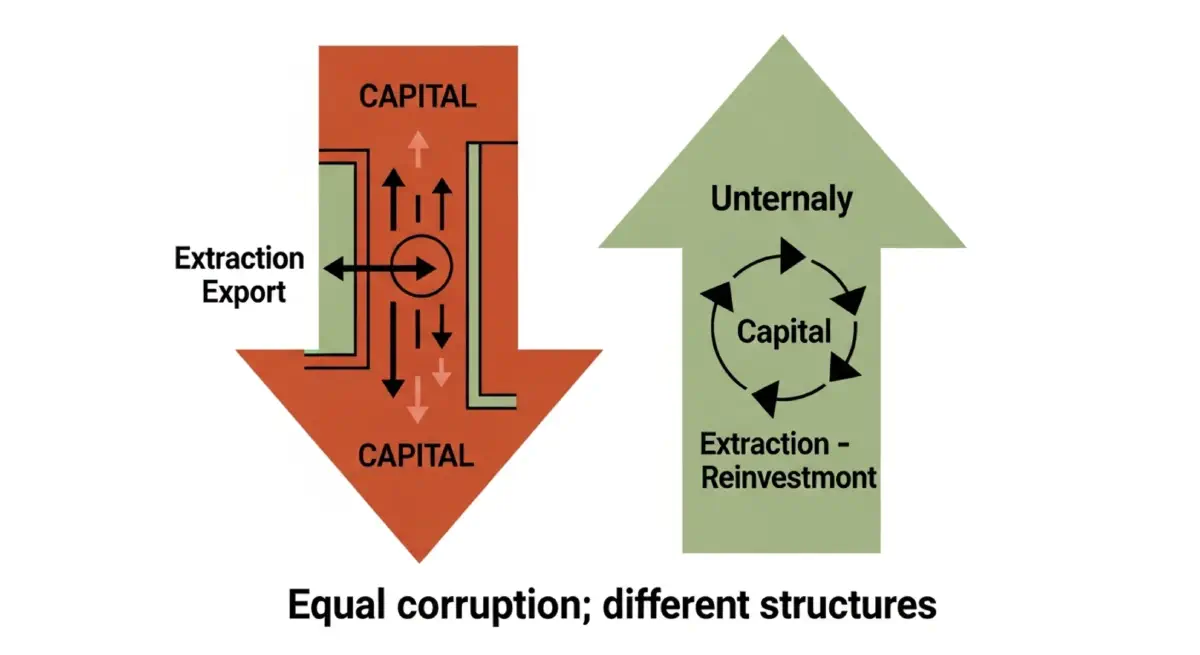
- Indonesia under Suharto sustained higher per capita theft than Zaire under Mobutu and yet grew at triple Zaire’s rate over the same period; the critical difference was not the amount stolen but where the money went — Indonesian corrupt proceeds stayed in the country and were reinvested, Zaire’s were exported to Switzerland.
- Most of today’s rich countries successfully industrialized under conditions of spectacular corruption: in the 19th-century United States, not a single federal bureaucrat was appointed through competitive process until the 1883 Pendleton Act, a period when the US was among the world’s fastest-growing economies.
- The Japanese were routinely described by Western observers in the early 20th century as lazy, excessively emotional, light-hearted, and constitutionally indifferent to the passage of time — the precise cultural characteristics attributed today to African and Latin American societies as explanations for their underdevelopment.
- Germans in the early 19th century were characterized by the British as indolent, slow-witted, unable to cooperate, and dishonest — the last quality manifested in systematic trademark counterfeiting that led Britain to revise its trademark law in 1862 specifically to prevent German fraud.
- Japanese workers struck more days per worker than British or French workers between 1955 and 1964; the famous “company loyalty” culture emerged not from Confucian genetics but from the institutional arrangements of lifetime employment and company welfare schemes introduced in the postwar period.
- Korea’s ratio of engineering and science graduates to humanities graduates shifted from 0.6:1 to 1:1 between the 1960s and early 1980s through deliberate educational investment combined with industrialization — not through cultural exhortation alone.
- Cultural explanations for development outcomes are almost invariably constructed after the fact: Confucianism was cited as an obstacle to East Asian development before the East Asian miracle, and as its cause afterward; the same analytical inversion will likely occur with respect to India’s Hindu culture as its economy continues to develop.
Corruption: the variable that explains nothing by itself#
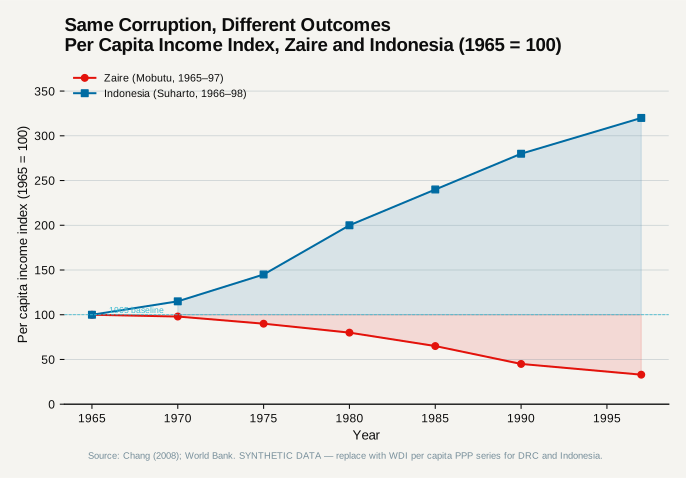
Zaire and Indonesia in 1961 were similarly positioned. Zaire had a per capita income of $67; Indonesia had $49. Both came under the rule of military strongmen in the mid-1960s. By the numbers, Indonesia should have fared worse. Mobutu Sese Seko stole an estimated $5 billion during his 32-year rule — roughly 4.5 times Zaire’s national income at the time of his accession. Mohamed Suharto stole an estimated $15–35 billion — call it $25 billion as the midpoint, roughly 5.2 times Indonesia’s equivalent baseline. By corruption-to-baseline ratio, Indonesia was the worse case.
Zaire’s per capita income in 1997, when Mobutu was deposed, was one-third of its 1965 level. Indonesia’s had more than tripled during Suharto’s tenure.
Figure 1: The horizontal axis spans 1965–1997; the vertical axis shows a per capita income index (1965 = 100). The two lines diverge monotonically: Zaire falls from 100 to approximately 33, losing two-thirds of real per capita income over thirty years; Indonesia rises from 100 to approximately 320, tripling real per capita income. The visual gap establishes that corruption level is an insufficient predictor of development outcome, and directs attention toward whether stolen money is reinvested domestically or exported.
The Zaire-Indonesia contrast is not evidence that corruption is benign. It is evidence that the economic consequences of corruption depend on factors that the word “corruption” itself does not capture: whether stolen money is reinvested in the domestic economy or exported, whether the pattern of bribing allocates licences to efficient or inefficient producers, whether the regulatory capacity of the state is adequate to prevent the corruption from compounding into broader institutional failure.
The Bad Samaritans’ invocation of corruption as an explanation for development failure also has an inconvenient historical dimension. In the 19th-century United States — a period of exceptionally rapid growth — not a single federal bureaucrat was appointed through competitive merit-based process until the Pendleton Act of 1883. Elections involved turning ineligible immigrants into instant citizens who could vote, conducted, as the New York Tribune reported in 1868, with the speed of a Cincinnati slaughterhouse. Theodore Roosevelt complained that New York assemblymen sold their votes openly. None of this prevented the United States from being one of the world’s fastest-growing economies.
The behavioral traits change with the economy#
In the early 19th century, the British thought the Germans were indolent, dishonest, emotionally unstable, individually brilliant but unable to cooperate, and characterized by such poor public infrastructure that a Viceroy of India found German roads more treacherous than Indian ones. These observations were made by serious travellers with extended German experience. The behaviors they described were real. What they misidentified was the cause.
Poor countries have a different relationship to time, because in slowly changing economies there is little reason to plan far ahead — the opportunities and shocks that require forward planning are absent. Poor countries have higher rates of apparent dishonesty, because poverty reduces the cost of ethical compromise and weak law enforcement reduces its risk. Poor countries produce workers who appear lazy to observers from industrialized economies, because the absence of factory discipline and the absence of industrial time-keeping produce behaviors that look, from outside, like indolence. These are not cultural traits in the sense of values transmitted through generations and resistant to change. They are behavioral adaptations to economic conditions — and they change, quickly, when the conditions change.
Sidney Gulick, the American missionary who observed Japanese laziness in 1903, also noted something he found contradictory: Japanese factory workers appeared highly industrious. The contradiction resolved itself as the economy industrialized. The workers in the new factories had acquired industrial time-keeping because the factory required it; the farmers and carpenters had not, because their work did not. “Korean time” — the once-widespread practice of arriving an hour or more late for appointments without apology — was common twenty years ago and has now essentially disappeared, along with the phrase that described it. The culture changed in a decade, as the pace of economic life accelerated.
Post-hoc justifications dressed as explanations#
The pattern is consistent enough to constitute a rule: cultural explanations for development outcomes are constructed after the fact, using 20/20 hindsight, to explain outcomes that were in fact produced by structural and policy conditions. Before the East Asian miracle, Confucianism was frequently cited as an obstacle to development: its rigid hierarchy, disdain for commerce, and preference for scholarly over practical knowledge made it unsuited to industrial capitalism. After the miracle, Confucianism was reinterpreted as its cause: the emphasis on hard work, education, deference to authority, and group cohesion had produced exactly the conditions capitalism required. The raw material was the same; the interpretation followed the outcome.
The same inversion is now occurring with India. The “Hindu rate of growth” was a term used for decades to describe the country’s slow development — implying that Hindu culture was incompatible with rapid accumulation. As India’s growth accelerated in the 1980s and 1990s, commentary shifted toward discovering which elements of Hindu culture were responsible for the new dynamism. The analysis will likely be completed, with full scholarly apparatus, just as the next generation of economists is explaining why a different culture was actually the obstacle all along.
Conclusion#
If behavioral patterns attributed to culture disappear within a decade or two of economic development, they were never cultural in the analytically meaningful sense — they were consequences of underdevelopment wearing the costume of its cause. The persistence of cultural explanation in development discourse tells us more about the sociology of expertise than about the economies being explained.