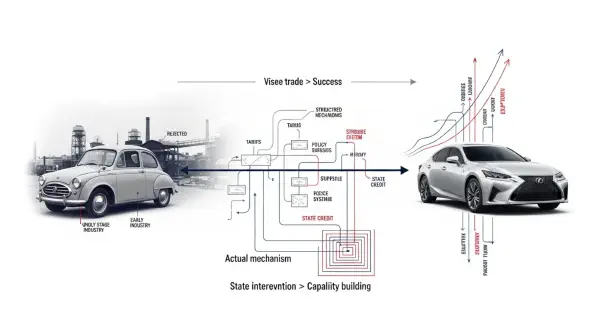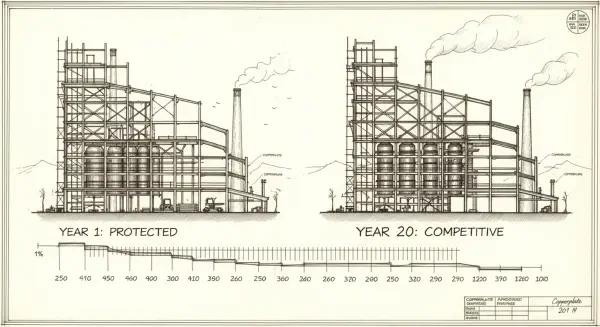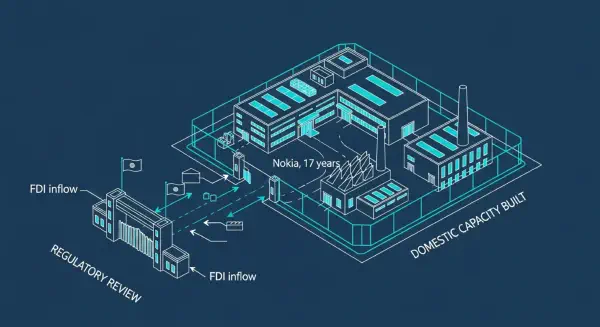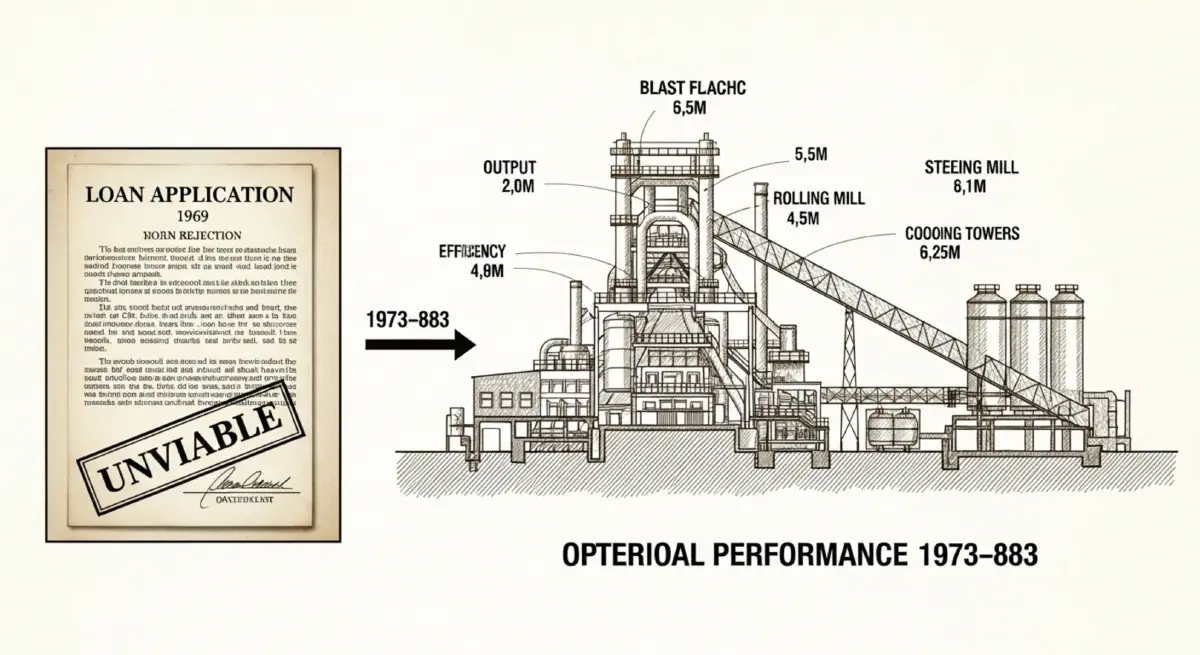
In the late 1960s, the Korean government applied to the World Bank for a loan to build the country’s first modern steel mill. The Bank refused. Its analysts assessed the project as economically nonviable: Korea exported fish, cheap garments, wigs, and plywood. It possessed no deposits of either of the two essential raw materials — iron ore or coking coal. The Cold War prevented it from importing them from nearby China; they would have to come from Australia, adding cost to every ton of steel produced. To cap the implausibility, the government proposed to run the mill as a state-owned enterprise. The Bank’s verdict was essentially: this cannot work.
Within ten years of starting production in 1973, POSCO — Pohang Iron and Steel Company — was one of the most efficient steel producers on the planet. Today it is the world’s third largest. The World Bank has since cited POSCO as a model of industrial development. The loan it refused to provide was eventually financed by Japanese banks.
Key Insights#
- POSCO, the Korean state-owned steel company that became one of the world’s most efficient producers within a decade of its founding in 1973, was explicitly rejected as unviable by the World Bank when the Korean government applied for a construction loan — Korea had no iron ore, no coking coal, and proposed to run the venture as an SOE.
- The principal-agent problem — the core theoretical argument against SOEs — applies with equal force to any large private firm with dispersed share ownership; the critical divide is between concentrated and dispersed ownership, not between state and private ownership.
- Singapore’s SOE sector, controlled by Temasek Holdings and comprising Singapore Airlines, semiconductor firms, shipbuilding, and banking, is twice the size of Korea’s as a share of national output and has never recorded a financial loss across its flagship airline’s 35-year history.
- Taiwan maintained an SOE sector accounting for over 16% of national output through the 1960s and 1970s; even after its 1996 “privatization” programme, the government retained controlling stakes averaging 35.5% and appointed 60% of directors.
- France’s technological transformation after 1945 — into a leader in aerospace, rail, nuclear power, and telecommunications — was led by state-owned firms including Renault, Alcatel, Thomson, Elf Aquitaine, and Rhône-Poulenc, all of which became world-class enterprises before their eventual privatization.
- The “soft budget constraint” problem — the ability of SOEs to secure government rescue if they face bankruptcy — is not unique to state ownership; private firms that are politically important or employ large numbers of workers receive comparable treatment, as illustrated by Chrysler (rescued by the Reagan administration), the entire Swedish shipbuilding industry (nationalized by Sweden’s first right-wing government in 44 years), and the Chilean banking sector (rescued by the Pinochet government in 1982).
- Privatization in developing countries has frequently produced corrupt transfers of public assets to politically connected buyers, followed by private monopolies that replicate or exceed the inefficiencies of the SOEs they replaced.
The theoretical case against SOEs has a hole in it#
The argument against state-owned enterprises is, on its surface, compelling. It runs like this: citizens collectively own public enterprises but have neither the incentive nor the ability to monitor the managers hired to run them. The managers, knowing this, have no strong incentive to maximize efficiency. Individual citizens cannot overcome this problem because any gains from extra monitoring are shared by everyone while the costs fall only on whoever does the monitoring — the classic free-rider trap. Result: systematic under-performance relative to private enterprises, whose owners have a direct financial stake in their managers’ performance.
This is a real problem. But it is also, in almost identical form, the problem faced by any large private-sector firm with dispersed share ownership. When General Motors or Deutsche Bank is run by hired managers whose pay is nominally linked to performance but whose specific decisions cannot easily be monitored by millions of small shareholders, the principal-agent and free-rider problems do not disappear. They merely change costume. The critical institutional divide is not between state ownership and private ownership — it is between concentrated ownership (where the owner can effectively monitor management) and dispersed ownership (where effective monitoring is structurally difficult). Most large corporations in most economies have dispersed ownership.
The “soft budget constraint” — the ability of state enterprises to obtain government rescue when facing losses — is equally non-unique. The Reagan administration rescued Chrysler. Sweden’s first right-wing government in 44 years nationalized the country’s shipbuilding industry to prevent its collapse. The Pinochet government of Chile — which had seized power explicitly in the name of defending the free market — nationalized the entire Chilean banking sector following the 1982 financial crisis produced by its own premature financial liberalization. Private firms that are large enough to be politically important are not meaningfully subject to hard budget constraints.
Success stories that no one advertises#
Singapore Airlines is consistently rated among the world’s finest carriers. It has never in its 35-year history recorded a financial loss. It is 57% owned by Temasek Holdings, whose sole shareholder is Singapore’s Ministry of Finance. The broader ecosystem of government-linked companies that Temasek controls — operating in semiconductors, shipbuilding, banking, and engineering — represents an SOE sector twice the size of Korea’s as a share of national output. Singapore is frequently cited as a model of globalization and private enterprise. The fact that its most celebrated company is state-owned is rarely mentioned in those citations.
Figure 1: The horizontal axis shows SOE output as a percentage of national income; the vertical axis lists six countries ranked from highest to lowest. Singapore and Taiwan, both frequently cited as examples of market-led development, have the largest state enterprise sectors. Korea, another “market miracle,” is substantially larger than France, which is commonly characterized as the interventionist economy. Argentina and the Philippines, often cited as examples of over-extended states, have among the smallest SOE sectors in the group. The visual contradiction — the largest state sectors are in the celebrated market economies — is the primary analytical function of this figure.
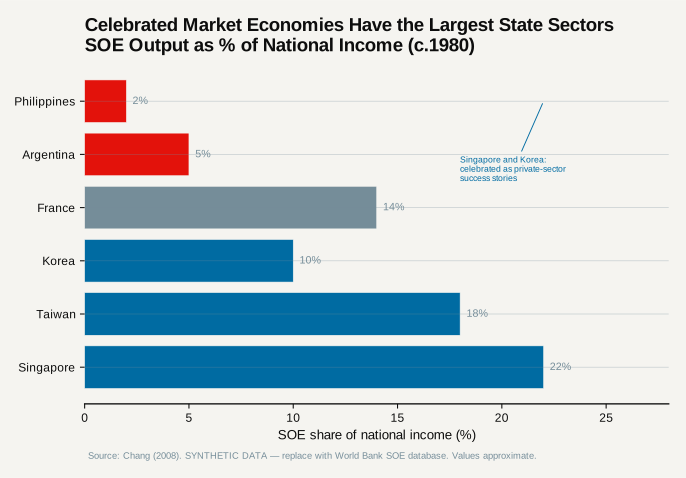
Taiwan’s official economic ideology, derived from Sun Yat-Sen, holds that key industries should be owned by the state. Accordingly, Taiwan’s SOE sector accounted for over 16% of national output through the peak decades of its development. Even after the privatization programme of 1996, the government retained controlling stakes in the enterprises sold, averaging 35.5%, and appointed 60% of their board directors. The “privatization” was more accurately a partial transfer of ownership with sustained government oversight.
France, between 1945 and the 1980s, achieved a transformation from a technologically conservative economy into a leader in aerospace, railways, nuclear power, and telecommunications — led by state-owned firms. Renault, Alcatel, Thomson, Elf Aquitaine, and Rhône-Poulenc were all public enterprises that became world-class before their privatization. The same pattern applies to Finland (forestry, steel, chemicals, engineering), Austria, Norway, and Italy through the same period.
Why privatization so often goes wrong#
Privatization is the appropriate response to some SOE problems in some contexts. When an SOE operates in a competitive industry, has no natural monopoly characteristics, and the government has sufficient regulatory capacity to supervise the privatized firm, the case for transferring ownership is genuine. The problem is that privatizations have frequently violated every one of these conditions.
Selling a natural monopoly — a water system, a railway network — without a functioning regulatory framework simply replaces a politically constrained public monopoly with an unconstrained private one. In Cochabamba, Bolivia, the sale of the water system to the American company Bechtel in 1999 immediately tripled water rates, producing riots and rapid re-nationalization. In Manila, a French-Filipino consortium that had been praised by the World Bank as a privatization success story walked away from its contract when the regulator declined to approve yet another tariff increase.
The corruption problem is particularly acute. A government that cannot prevent corruption in its SOEs does not acquire that capacity when it privatizes. It acquires instead a one-time opportunity for corrupt officials to transfer public assets to political allies at below-market prices — which is what occurred across post-communist Russia and in numerous developing country privatization programmes during the 1990s.
Conclusion#
The question is not whether state-owned enterprises can outperform private ones in all circumstances — they cannot — but whether the categorical prescription to privatize is supported by the empirical record. It is not. The pragmatic principle articulated by Deng Xiaoping — it does not matter whether the cat is black or white as long as it catches mice — is a more reliable guide to SOE policy than the ideological one.