In 1980, the comedy troupe Monty Python recorded a song called “The Finland Song.” Finland, they sang, was sadly neglected and often ignored. What the Python team did not know was that Finland had been pursuing this obscurity deliberately. Under laws introduced in the 1930s, any enterprise with more than 20% foreign ownership was classified, with Scandinavian directness, as “dangerous.” General liberalization did not come until 1993. For over half a century, Finland had been one of the most aggressively anti-foreign-investment countries in the world.
By the late 1990s, Finland had become something of a globalization icon. Nokia, its mobile phone company, was the world’s largest. A country that had barred foreign capital had produced the most globally celebrated example of technology-driven development in Europe. The Bad Samaritans, for once, had no obvious answer.
Key Insights#
- Finland officially classified enterprises with more than 20% foreign ownership as “dangerous” under laws introduced in the 1930s; it maintained severe restrictions on FDI until 1993, and its celebrated Nokia-era success was built on the domestic technological capabilities those restrictions preserved.
- Japan received less FDI as a proportion of total national investment than any non-communist country outside the communist bloc, yet became the world’s second-largest economy through a strategy of technology licensing, performance requirements, and domestic capability development.
- The United States in the 19th century — the world’s largest recipient of foreign capital — simultaneously maintained strict regulations on foreign ownership in banking, natural resources, and infrastructure, demonstrating that high FDI inflows and tight FDI regulation are not mutually exclusive.
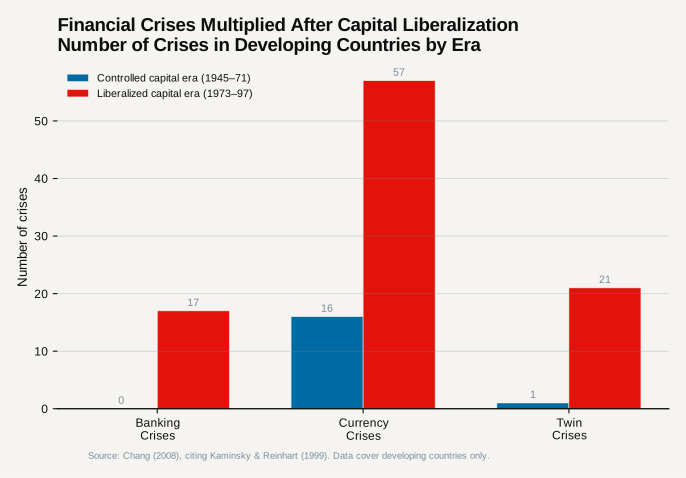
- Between 1945 and 1971, when global capital flows were controlled, developing countries experienced no banking crises, 16 currency crises, and 1 twin crisis; between 1973 and 1997, after liberalization, they experienced 17 banking crises, 57 currency crises, and 21 twin crises.
- Nokia spent 17 years losing money in its electronics division before achieving profitability; had Finland liberalized FDI early, foreign investors would have forced the parent company to kill the division — eliminating the business that subsequently made Finland a global technology leader.
- The TNCs that provide the FDI that developing countries are encouraged to attract tend not to transfer their most strategically valuable activities — research and development, core engineering, brand ownership — outside their home countries, creating a long-run capability ceiling for host economies.
- The WTO’s TRIMS (Trade-Related Investment Measures) agreement has banned key regulatory instruments — local content requirements, export requirements, foreign exchange balancing — that the most successful FDI-receiving countries historically used to maximize development benefits from foreign investment.
The crises multiplied as the controls came down#
Between 1945 and 1971, during which time global capital flows were tightly controlled by most countries, developing countries experienced no banking crises at all. They suffered sixteen currency crises and one twin crisis — a simultaneous banking and currency failure — over the entire twenty-six year period. Between 1973 and 1997, following the progressive liberalization of capital accounts across the developing world, there were seventeen banking crises, fifty-seven currency crises, and twenty-one twin crises.
Figure 1: The horizontal axis shows three crisis types (banking, currency, twin); the vertical axis shows count. The paired bars reveal a dramatic increase in all three categories after capital account liberalization: banking crises from 0 to 17, currency crises from 16 to 57, and twin crises from 1 to 21. The near-zero baseline in the controlled era (notably, zero banking crises) establishes that frequent financial crises are not an inherent feature of developing economies but a consequence of a specific institutional arrangement.
The mechanism is not difficult to identify. Financial markets in developing countries are tiny relative to the amounts of international capital that cross borders daily. The Indian stock market, the largest in the developing world, is less than one-thirtieth the size of the US market. Ghana’s stock market is worth 0.006% of the US market. Capital flows that represent a marginal reallocation from the perspective of a large institutional investor represent a flood that can overwhelm an entire national financial system. When investor sentiment reverses — and in financial markets it tends to reverse suddenly and collectively — the resulting outflow can destroy currencies, banking systems, and years of accumulated development in a matter of weeks. The Asian crisis of 1997 produced precisely this outcome in economies that the same international institutions had been citing as models of openness the previous year.
The Mother Teresa of capital was not quite what it seemed#
Foreign direct investment — actual equity ownership in productive enterprises — is categorically different from portfolio flows or bank loans. It is more stable, and it genuinely does transfer organizational and technical knowledge to host economies in ways that short-term financial flows do not. The former British EU commissioner Sir Leon Brittan once called FDI a source of “extra capital, increased productivity, additional employment, effective competition, technology transfer, and managerial know-how” all in one package. The Chilean economist Gabriel Palma, more drily, called it “the Mother Teresa of foreign capital.”
But the Mother Teresa comparison contains an implicit critique. Teresa was famously not what her admirers claimed. FDI has genuine short-run benefits: it brings capital, it brings organization, it often brings better technology than domestic firms possess. The problem is the long run. TNCs, when they establish subsidiaries in developing countries, do not as a rule transfer their most strategically valuable activities. Research and development, core engineering competence, brand management, and product design tend to stay in the home country. This creates what might be called a capability ceiling: the TNC subsidiary can be made more efficient, but it cannot ultimately compete at the frontier activities that generate the highest returns, because those activities are not on offer.
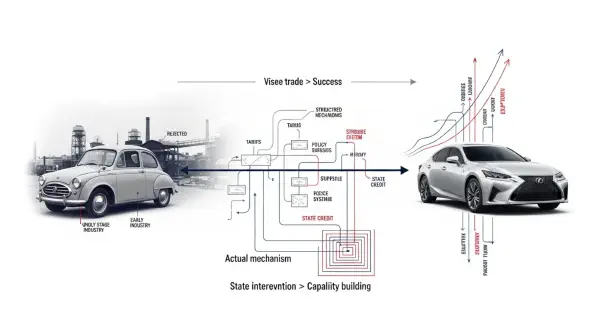
To return to the Toyota example from earlier in the series: had Japan liberalized FDI in its automobile industry in the 1960s, Toyota would not be producing the Lexus today. It would have been acquired by an American manufacturer and converted into a valued but secondary subsidiary doing assembly work — which is a good outcome in the short run and a permanent constraint in the long run.
Finland spent 17 years learning the lesson the hard way#
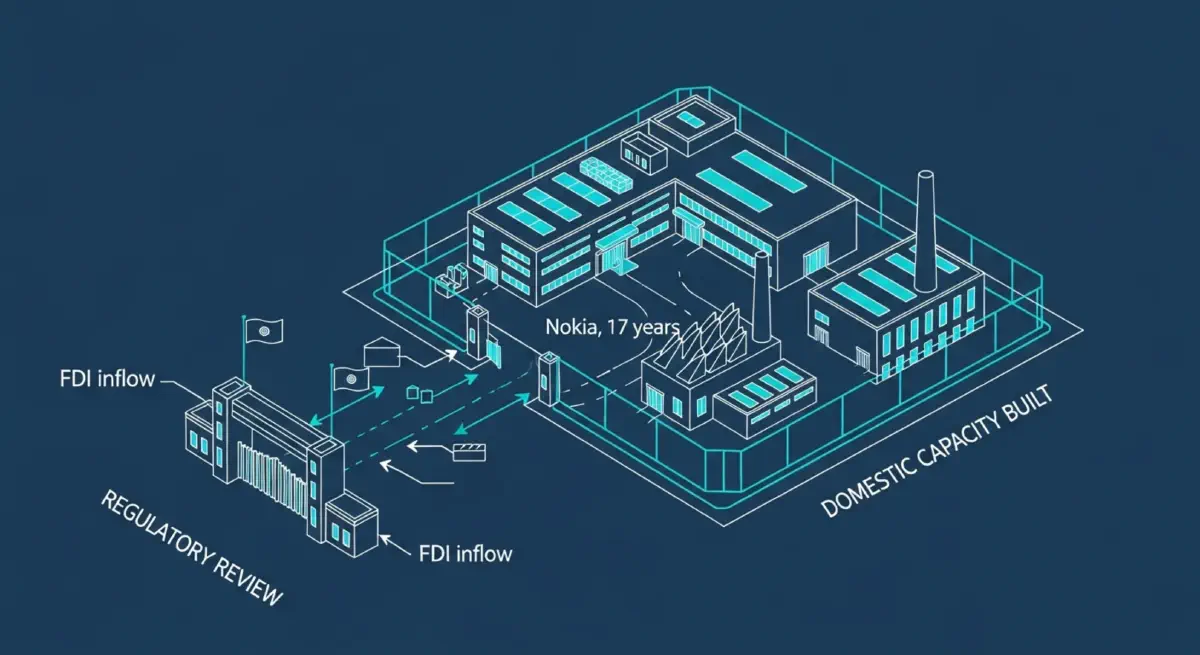
Nokia started its electronics subsidiary in the 1960s, when Finland was restricting foreign ownership by law. The electronics business lost money for seventeen years. If the company had been subject to the discipline of public equity markets or had faced competition from a well-capitalized TNC operating freely in the Finnish market, the division would have been killed. The institutional patience that allowed Nokia to survive seventeen unprofitable years was itself a product of Finland’s restricted capital market — limited foreign shareholding meant limited pressure for short-term returns.
By the time Finland liberalized FDI in 1993, Nokia was already globally competitive. The country then reaped the rewards of openness from a position of domestic strength. The sequence matters entirely. Liberalizing first would not have produced Nokia; it would have produced a well-run subsidiary of a Swedish or German electronics firm. The Finnish experience is not an argument against FDI. It is an argument against FDI before domestic capabilities are adequate to maintain independence in the most productive activities.
The United States quietly wrote the rulebook#
The most instructive case, partly because it is so thoroughly forgotten, is the 19th-century United States. The US was the world’s largest importer of foreign capital throughout the 19th and early 20th centuries. It was also one of the most aggressive regulators of foreign investment in the world. Non-resident shareholders could not vote in national bank elections. Federal law prohibited foreign ownership of land in territories. State governments taxed foreign companies more heavily than domestic ones. New York State banned foreign bank branches. In 1832, Andrew Jackson — today a hero of American free-market mythology — refused to renew the licence of the quasi-central bank partly on the grounds that its foreign ownership share (30%) was dangerously high.
Despite this, or partly because of it, the United States was the world’s fastest-growing economy throughout the 19th century. The combination of high manufacturing tariffs and selective FDI restriction created the space for American industrial firms to develop capabilities that neither British technology imports nor British capital would have preserved if allowed to operate freely. The ladder was climbed behind walls. The walls came down when they were no longer needed.
Conclusion#
FDI is a genuinely useful tool for economic development — but only when introduced as part of a long-term strategy that preserves the space for domestic firms to eventually match or exceed the capabilities of foreign investors. The countries that used it best were precisely those that regulated it most carefully.