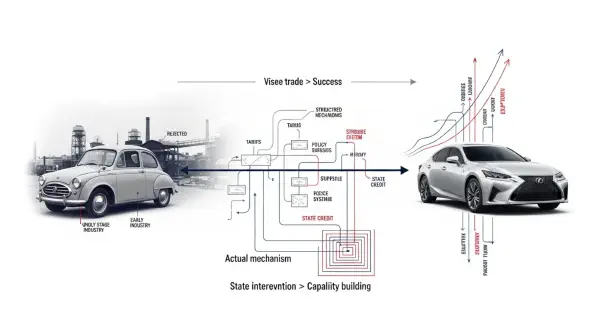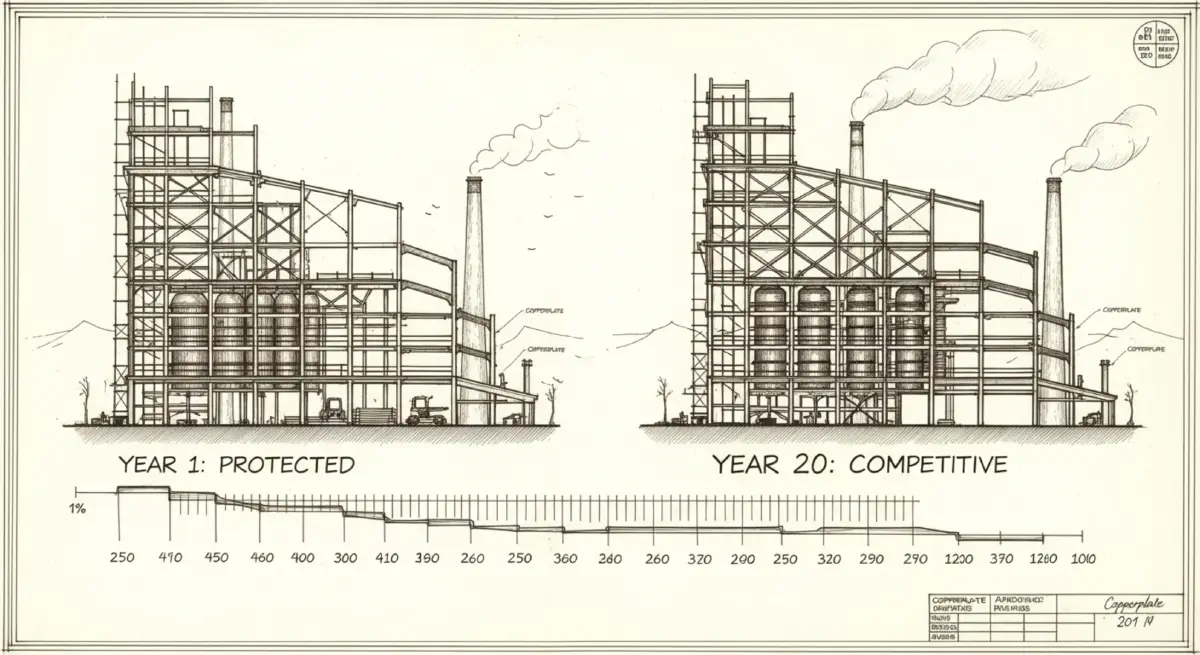
In 1955, a small automobile company in a ruined country made its first cars by assembling parts imported almost entirely from abroad. The country’s main exports were still fish and seaweed. The company had no original engineering capacity, no export market, and no prospect of competing internationally for at least a generation. A free-trade economist, applying the standard logic of comparative advantage, would have recommended that the country stick to what it was good at — primary products, low-cost assembly, perhaps textiles. The economist would have been describing the real situation accurately. The government ignored the advice anyway. Forty years later, Hyundai was one of the ten largest automakers in the world.
The standard rebuttal is that this is the exception. It is not. It is the rule — for every country that has successfully industrialized.
Key Insights#
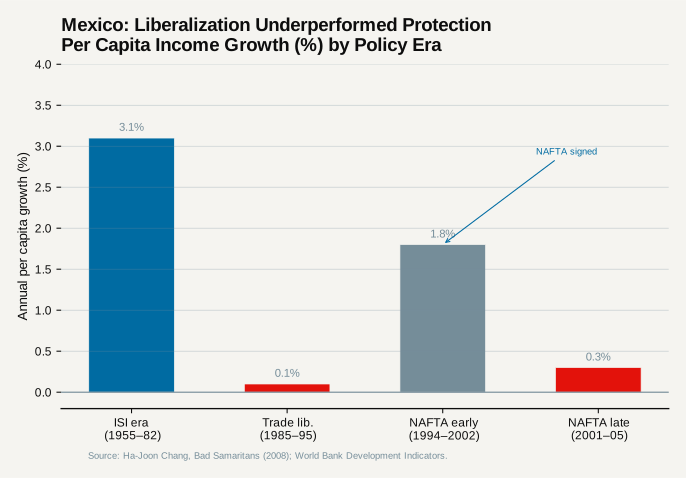
- Mexico’s per capita income grew at 3.1% annually during the “bad old days” of import substitution industrialization; after NAFTA and extensive trade liberalization, it grew at 1.8% (1994–2002) and then collapsed to 0.3% per year in 2001–05 — despite bordering the world’s largest market.
- The standard free-trade argument rests on the assumption of “perfect factor mobility” — that capital and labour released from declining industries will be immediately re-absorbed by expanding ones; this assumption is empirically false in developing countries where the welfare state is weak or absent.
- In Ivory Coast, tariff cuts of 40% in 1986 caused the chemical, textile, shoe, and automobile industries to virtually collapse; in Zimbabwe, trade liberalization in 1990 caused unemployment to jump from 10% to 20%.
- Free trade theory correctly identifies the efficient allocation of existing capabilities but cannot account for the acquisition of new capabilities — it is a theory for those who accept the status quo, not for those who want to change it.
- Trade liberalization has reduced tariff revenues in low-income countries by amounts that IMF research confirms were less than 30% replaced by other taxes, forcing cuts in education, health, and infrastructure spending.
- The infant industry argument is not a rejection of trade — Korea’s export success and its heavy infant industry protection coexisted throughout its development period — but a claim that capability-building requires temporary insulation from competition before it is viable.
- South Korea and North Korea illustrate the essential role of trade in development: North Korea’s self-sufficiency has left it technologically frozen in the 1940s, while South Korea’s selective engagement with international trade and technology enabled its transformation.
The theory works, within its own confined assumptions#
The free-trade argument is not wrong. It is, as the Cambridge economist Willem Buiter once put it with characteristic confidence, “all there.” Comparative advantage theory correctly establishes that, at any given moment, countries gain from specializing in activities where they have relative efficiency advantages and trading for the rest. This is a genuine insight. Within its stated confines — existing technologies, given factor endowments, mobile resources — the theory is coherent.
The problem is that economic development is precisely the business of changing existing technologies, altering factor endowments, and acquiring new capabilities. The theory that describes optimal behaviour given those things cannot serve as a guide to acquiring them. To apply free-trade logic to a developing country trying to build an industrial base is like advising a six-year-old to quit school and get a job on the grounds that economically productive adults do not spend their days learning under parental supervision. The advice is technically consistent with the observation. It is also catastrophic in its consequences.
The deeper technical problem is the assumption of “perfect factor mobility” — the notion that workers and machines released from a bankrupt textile mill can be immediately absorbed by a growing semiconductor industry. This assumption is theoretically necessary for the clean conclusions of comparative advantage theory and empirically implausible in almost every real economy. The Full Monty, the 1997 British film about six unemployed Sheffield steelworkers who become male strippers, is not a documentary about market adjustment. It is a parable about what happens when adjustment costs are real and compensation mechanisms are absent.
Mexico is the stress test, and it failed#
If free trade is particularly beneficial for developing countries, Mexico is the country where this should have been most visible. It borders the largest market in the world. It has a large diaspora providing business networks in the United States. Its workforce is reasonably educated relative to its income level. It has decent physical infrastructure. It had, since 1995, the most comprehensive free trade agreement in the developing world — NAFTA.
During the 1960s and 1970s, when Mexico was pursuing import substitution industrialization, protecting its industries and subsidizing its producers, its per capita income grew at 3.1% per year. During the 1980s, when it began trade liberalization, it grew at 0.1%. Between 1994 and 2002, in the early NAFTA years — the figure most frequently cited by the agreement’s supporters — it managed 1.8%. Between 2001 and 2005, it grew at 0.3% per year, a total increase in living standards of less than 2% over five years.
Figure 1: The horizontal axis shows four policy periods in Mexico from the 1950s to 2005; the vertical axis shows annual per capita GDP growth as a percentage. The relationship is non-monotonic: growth was highest (3.1%) during the import substitution industrialization period, collapsed to 0.1% during the transition decade, partially recovered to 1.8% in the early NAFTA years, and then fell to 0.3% in 2001–05. The sage bar (ISI era) against the rust bars (liberalization periods) provides visual confirmation of the post’s central claim: that trade liberalization in Mexico produced growth outcomes consistently and significantly below those of the protected era.
The defenders of NAFTA argue that Mexico would have done even worse without it. This is possible but untestable, and it does not explain why performance under the free-trade regime has been so consistently inferior to performance under the protected one.
The compensation doesn’t happen#
Free-trade economists have a standard response to these outcomes: trade liberalization creates winners and losers, but the winners gain more than the losers lose, so the winners can compensate the losers and still come out ahead. This is the “compensation principle,” and it is technically accurate as a statement about aggregate surplus under certain assumptions. It is not a description of what actually occurs.
In practice, the adjustment costs fall on specific people — the workers in the bankrupt industries — while the gains are distributed across the consuming population as marginally lower prices. No mechanism automatically transfers the gains to the losers. In developed countries, the welfare state performs a partial version of this function: unemployment insurance, retraining programmes, health coverage. These systems are expensive and imperfect, but they exist. In most developing countries, they are absent. The IMF’s own research found that, in low-income countries with limited alternative tax capacity, less than 30% of the tariff revenue lost to trade liberalization was replaced by other sources. This gap translated directly into cuts in public services. Trade liberalization, in other words, did not merely destroy jobs in manufacturing — it also reduced government revenue, which reduced education and infrastructure spending, which damaged long-term growth.
Trade matters; free trade is a different claim#
None of this implies that developing countries should be sealed off from international trade. North Korea illustrates the opposite extreme. It chose technological self-sufficiency, suppressed trade and technology imports, and produced, with considerable ingenuity, a synthetic fibre called Vinalon from limestone. The rest of the world did not adopt Vinalon because it is uncomfortable. North Korea’s technological trajectory froze somewhere in the 1950s. South Korea, which engaged aggressively with international markets — exporting to earn foreign exchange to buy better technology — became one of the most technologically dynamic economies on Earth.
The difference between the two Koreas is not a proof that free trade works. It is a proof that trade works — that international exchange of goods and technology is essential for development. What Korea practised was not free trade. It was selective, strategic, infant-industry-protecting, government-directed trade. Protection was used to create the capability; exports were used to test and refine it. The protection was always meant to be temporary, calibrated to the pace of capability-building. When Korean industries could compete internationally, protection was withdrawn. When they could not, it was maintained. The result was not a free market. It was a successful development strategy.
Conclusion#
Free trade is the right policy for a country that has already acquired the capabilities to compete at the frontier — not for a country that is trying to build them. That the theory cannot distinguish between these two situations is not a minor limitation; it is the central failure of free-trade economics as a guide to development policy.