Free Trade: Fact or Fiction?
Key Insights#
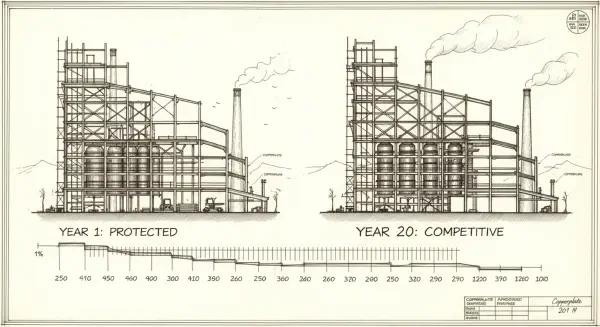
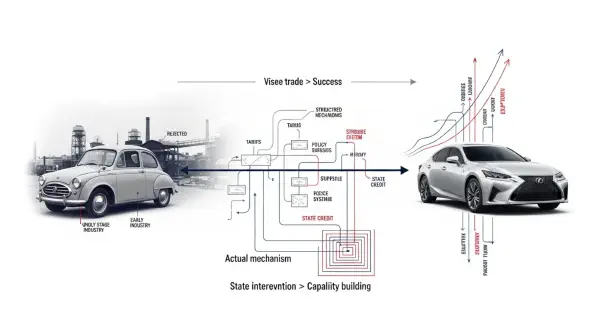
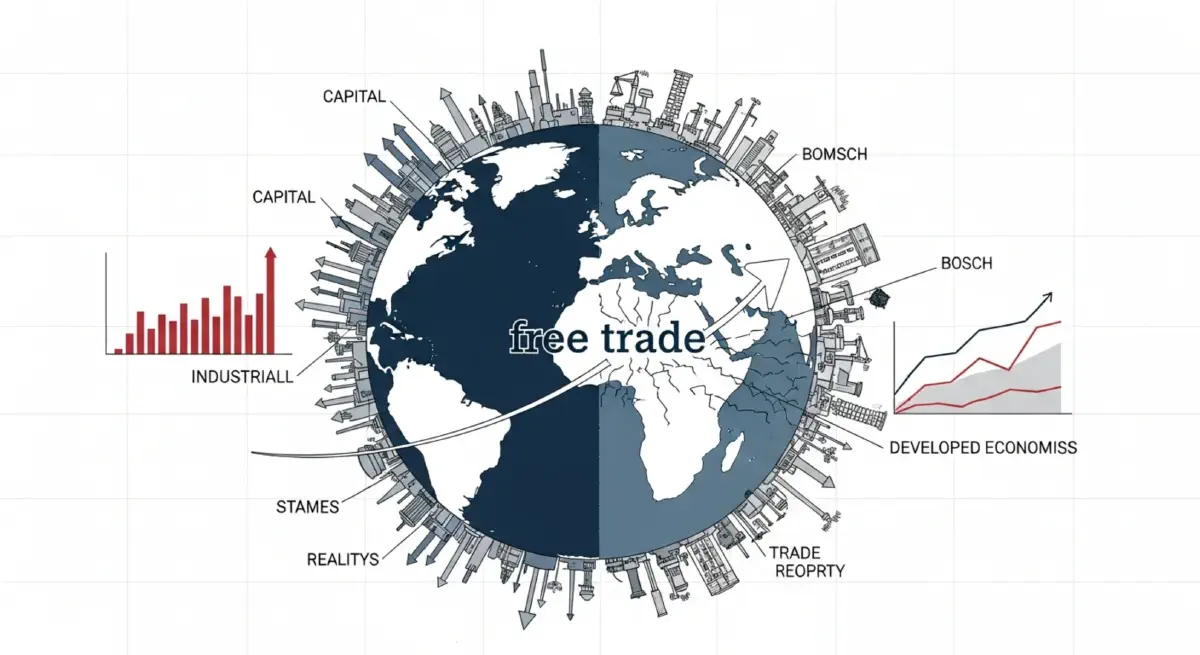
Every country now classified as rich achieved its industrial ascendancy through deliberate state protection, subsidies, and government direction — not free trade — and adopted free-market advocacy only after that ascendancy was secured.
Developing countries grew at 3.0% per capita annually during the “bad old days” of import substitution industrialization (1960–80) and at roughly half that rate (1.7%) after adopting neo-liberal reforms — the opposite of what the official history predicts.
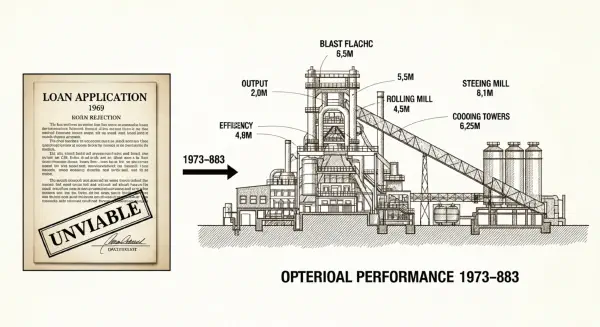
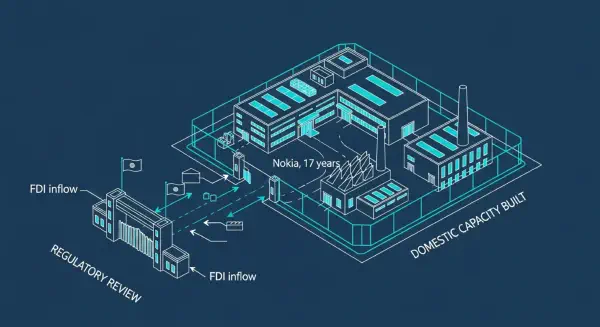
Free trade theory correctly describes efficient allocation of existing productive capabilities but cannot account for the acquisition of new ones; exposing industries to full international competition before they have built those capabilities destroys them rather than developing them.
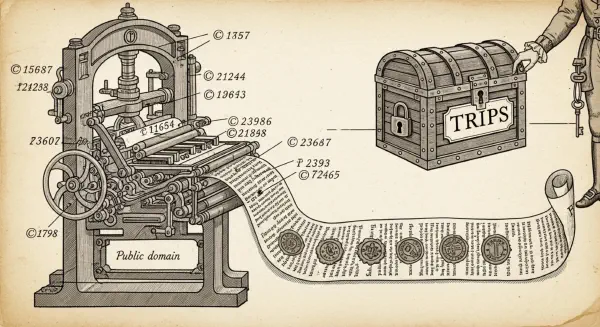
The TRIPS intellectual property agreement functions primarily as a rent-extraction mechanism, transferring an estimated $45 billion annually from developing to rich countries — precisely mirroring the pattern by which today’s rich countries “borrowed” foreign technologies freely while building their own industrial bases.
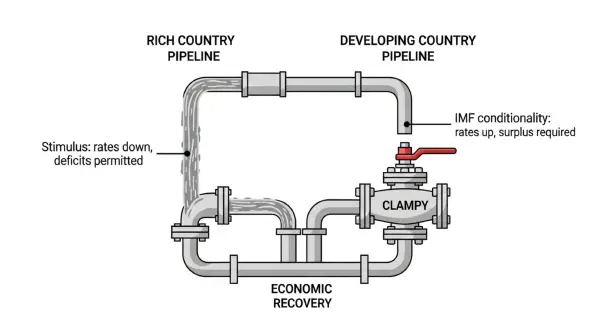
IMF macroeconomic conditionality applies contractionary policy to developing countries in crisis while rich countries facing identical circumstances consistently use deficit spending and low interest rates — a double standard not explained by economic theory.
The behavioral traits routinely attributed to culture as causes of underdevelopment — short time horizons, indolence, emotional decision-making, distrust — were attributed by contemporary observers to Germans, Japanese, and Koreans before those countries industrialized, and disappeared as they did so, confirming they are consequences of underdevelopment rather than causes.
The Bad Samaritans are not primarily cynical actors kicking the ladder deliberately; most recommend free-market orthodoxy in the honest but mistaken belief that their own countries developed through it — historical amnesia, not conspiracy, is the dominant mechanism.
References#
- Bairoch, P. (1993). Economics and world history: Myths and paradoxes. University of Chicago Press.
- Bhagwati, J. (2004). In defense of globalization. Oxford University Press.
- Bruno, M., & Easterly, W. (1998). Inflation crises and long-run growth. Journal of Monetary Economics, 41(1), 3–26. https://doi.org/10.1016/S0304-3932(97)00063-9
- Chang, H.-J. (2008). Bad Samaritans: The myth of free trade and the secret history of capitalism. Bloomsbury Press.
- Defoe, D. (1728). A plan of the English commerce. Charles Rivington.
- Fischer, S. (1996). Why are central banks pursuing long-run price stability? In Achieving price stability (pp. 7–34). Federal Reserve Bank of Kansas City.
- Friedman, T. L. (1999). The Lexus and the olive tree. Farrar, Straus and Giroux.
- Galbraith, J. K. (1958). The affluent society. Houghton Mifflin.
- Gulick, S. L. (1903). Evolution of the Japanese. Fleming H. Revell Company.
- Hamilton, A. (1791). Report on the subject of manufactures. United States Treasury Department.
- Huntington, S. P. (1996). The clash of civilizations and the remaking of world order. Simon & Schuster.
- International Monetary Fund. (1997). Korea: Request for stand-by arrangement. IMF Country Report.
- International Monetary Fund. (2005). Dealing with the revenue consequences of trade reform. IMF Fiscal Affairs Department.
- Jaffe, A. B., & Lerner, J. (2004). Innovation and its discontents: How our broken patent system is endangering innovation and progress, and what to do about it. Princeton University Press.
- Kaminsky, G. L., & Reinhart, C. M. (1999). The twin crises: The causes of banking and balance-of-payments problems. American Economic Review, 89(3), 473–500. https://doi.org/10.1257/aer.89.3.473
- Keynes, J. M. (1936). The general theory of employment, interest and money. Macmillan.
- Kornai, J. (1980). Economics of shortage. North-Holland.
- Landes, D. S. (1998). The wealth and poverty of nations: Why some are so rich and some so poor. W. W. Norton.
- List, F. (1841). The national system of political economy (S. S. Lloyd, Trans., 1885). Longmans, Green, and Company.
- Maddison, A. (2001). The world economy: A millennial perspective. OECD Development Centre.
- Nield, R. (2002). Public corruption: The dark side of social evolution. Anthem Press.
- Ricardo, D. (1817). On the principles of political economy and taxation. John Murray.
- Rodrik, D. (1998). Who needs capital-account convertibility? Essays in International Finance, 207, 55–65.
- Singh, A. (1994). Openness and the market friendly approach to development: Learning the right lessons from development experience. World Development, 22(12), 1811–1823. https://doi.org/10.1016/0305-750X(94)90182-1
- Stiglitz, J. E. (2002). Globalization and its discontents. W. W. Norton.
- UNCTAD. (2006). World investment report 2006: FDI from developing and transition economies. United Nations.
- Weber, M. (1904). Die protestantische Ethik und der Geist des Kapitalismus [The Protestant ethic and the spirit of capitalism] (T. Parsons, Trans., 1930). Scribner.
- Williams, E. E. (1896). Made in Germany. William Heinemann.
- World Bank. (2002). Global economic prospects and the developing countries. World Bank.
- World Trade Organization. (1994). Agreement on trade-related aspects of intellectual property rights (TRIPS). WTO Secretariat.
- World Trade Organization. (1995). The results of the Uruguay Round of multilateral trade negotiations. WTO Secretariat.