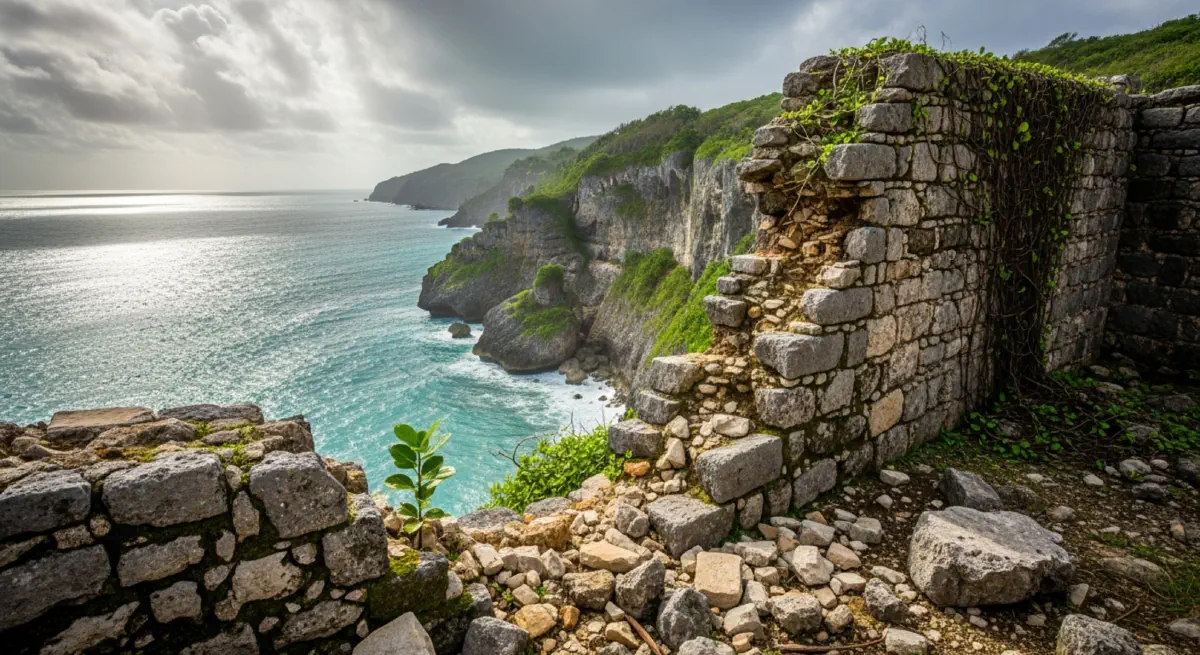
The Survival of a Ghost Civilization#
Four hundred kilometers away from the Banda Archipelago, on the coastal areas of Kai Besar Island, a small community still speaks a language that should not exist. These are the descendants of the Bandanese survivors—asylum seekers from a 1621 genocide who fled the VOC’s "sword" and managed to preserve their culture in exile. For four centuries, they have carried the memory of a home they can never return to, while their original islands were transformed into a corporate-run plantation system. These 4,000 speakers are the "living ghosts" of a civilization that Jan Pieterszoon Coen thought he had completely "exterminated".
The reality on the Banda Islands themselves is far more sterile. Once home to 15,000 vibrant, independent traders, by 1638 the archipelago held only 560 original Bandanese, half of whom were enslaved. The VOC’s "victory" was a total demographic and ecological erasure. They did not just kill people; they "monumentally" destroyed the environment, tearing down the very walls of towns with the hands of the vanquished and burning every "monument of the dead". This was a "cataclysm" designed to leave no trace of the civilization that had once successfully "astutely" managed the world’s nutmeg supply.
The erasure of the Bandanese was a masterpiece of systemic violence. While the initial massacres provided the shock, it was the starvation blockades and the subsequent institutionalization of slavery that truly "ended" the civilization. By analyzing the VOC’s use of "integrated extraction" and environmental engineering, we can see how the world’s first megacorporation built a "peaceful possession" on the ruins of a genocide.
The Thesis of Systemic Erasure#
The Banda genocide was not merely an event of military violence but a "systemic erasure" that combined starvation blockades, cultural demolition, and the replacement of an entire population with a slave-labor hierarchy. By blockading the archipelago to "starve out" thousands of refugees in the hills and forcing the survivors to "with their own hands" dismantle their own physical history, the VOC achieved a level of total control that redefined the relationship between capital and human life. This "monopoly machine" succeeded by converting a sovereign, food-dependent society into a corporate concession, proving that the ultimate goal of sovereign capitalism is not just the control of products, but the absolute governance of the human and natural systems that produce them.
The Forensics of the Starvation Siege#
The most effective weapon in the VOC's 1621 campaign was not the cannon, but hunger. The Bandanese were "very vulnerable to starvation" because their islands produced almost no foodstuffs, relying on imports of sago and rice from surrounding regions. Coen’s "starvation strategy" involved placing armed ships strategically around the islands to prevent any escape or food delivery, while VOC troops "pursued the remaining Bandanese in the hills".
The results were catastrophic. When Dutch troops finally stormed the heights of Selamon in July 1621, they found "1,800 empty huts, 1,500 pirogues, and 600 to 700 graves". Thousands had perished in the fog-shrouded mountains, driven by "violence, misery, and hunger" until they either surrendered or committed "suicide by jumping off the cliffs". Coen estimated that 2,500 were killed this way, but historians believe the "real" death toll was much higher, as thousands more drowned trying to reach safety in boats that were systematically "beaten to death" or sunk.
Cultural Demolition and the Performance of Surrender#
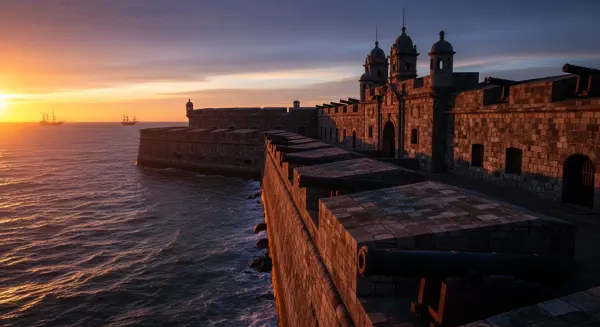
The erasure of the Bandanese civilization was also a physical and symbolic act. On the island of Rhun, the VOC forced the "miserable people" to "with their own hands... throw down the said wall" of their towns until "not one stone was left upon another". They "ranged the whole island" to ensure all walls were "made even with the ground," not even sparing the "monuments of the dead".
This was the "performance of surrender." The Bandanese were forced to present the Dutch with a "nutmeg tree in a basin," a local custom of ceding territory that was weaponized by the VOC to formalize their genocide. By forcing a population to destroy its own physical history and religious markers, the VOC was practicing "psychological erasure"—ensuring that even if individuals survived, their civilization would not. The "terror of the English" and the "great grief of the inhabitants" were the intended side effects of a corporate policy that sought to leave "no naturals left".
The Slave-Labor Repopulation Experiment#
Once the "extermination" was complete, Coen’s focus shifted to "bringing in worthy good people who could govern slaves". The archipelago was divided into concessions and given to Dutch "mestizo" concessionaires, who were provided with an initial workforce of VOC-trafficked slaves. By 1638, the total population of 3,842 inhabitants included only 280 free indigenous Bandanese. The rest were 2,743 "foreigners"—the vast majority of whom were slaves from Africa, India, and China.
This was the birth of a new kind of society: the "multicultural" colonial plantation. While some historians argue the VOC was "tolerant" because it employed diverse nationalities, this "tolerance" was merely the byproduct of a corporate need for labor. The reality was a rigid racial hierarchy where "white population... were on the top of the social hierarchy pyramid". The VOC’s "integrated extraction" model had successfully turned a sovereign civilization into a high-yield asset, fueled by the forced migration of over a million people across its 200-year history.
The Synthesis of the Corporate Shadow#
The VOC’s "sunset in the East" in 1799 did not end the legacy of the Banda genocide. The "dark and bloody stain" on the map remained, as the VOC’s territories were nationalized into the Dutch East Indies, inheriting the Company’s structures of control and extraction. The "ugly reality" of the VOC’s history is that it was not "intentionally trying to be evil"; it was simply a business "striving only for personal gain". This makes the lesson of Banda even more terrifying: genocide can be a byproduct of "simply doing their jobs" as efficiently as possible.
The "So what?" of the Banda genocide is found in the DNA of modern capitalism. The VOC invented the "speculative instruments" we use today—stock futures, short selling, and stock options—in the same era they were perfecting starvation blockades. The world they created is one where "immense impact on mankind" and "the smell of blood" are often found in the same ledger. As we look at today’s megacorporations, we must remember that "ambition can be blinding". The ghosts of Banda, speaking their ancient language 400 kilometers away, remind us that while a civilization can be "irreparably destroyed," the human spirit of survival endures—even in the face of history’s most powerful corporation.