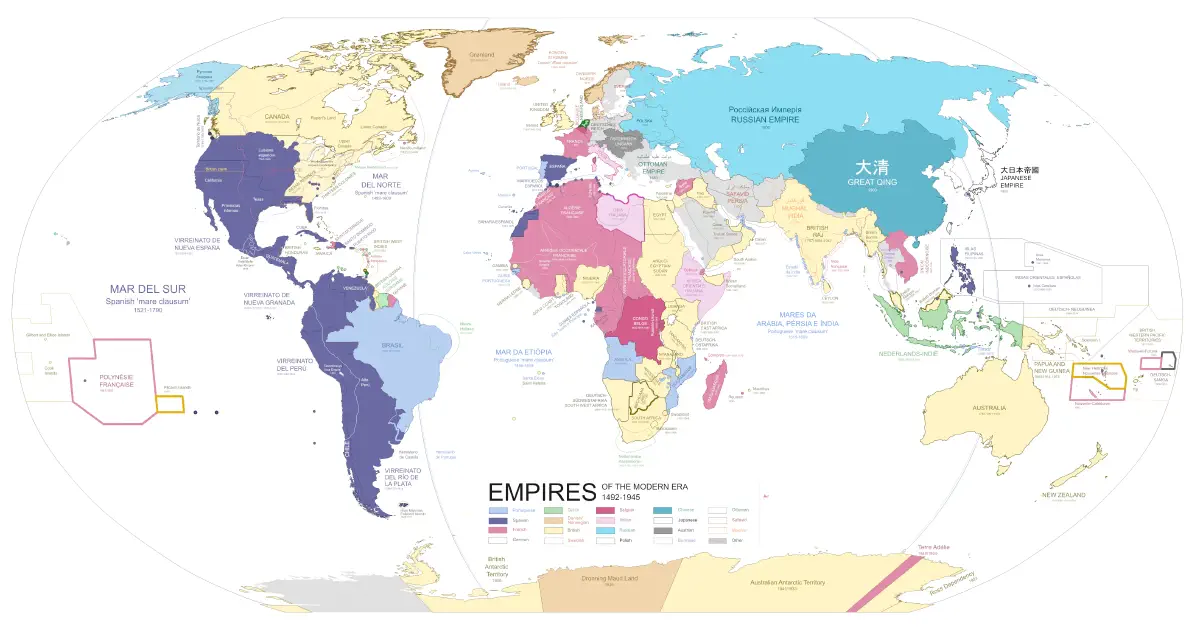
Between 1415 and 1999, eight European states occupied foreign territories on every inhabited continent. They governed, extracted, and administered lands they had never been invited into. The last formal possession reverted only when Portugal handed Macau to China in December 1999. From the first Portuguese foothold in Ceuta to that handover, 584 years passed. Most people alive today were born inside that span.
The data from Bastian Becker’s Colonial Dates Dataset makes it possible to measure two dimensions of this history with some precision: how long each power held colonial possessions, and how much territory those possessions covered. Both dimensions tell different stories, and the gap between them is itself revealing.
Key Takeaways#
The British Empire occupied more land than the next three largest empires combined: 42.6 million km² against Spain’s 12.3 million, Portugal’s 11.2 million, and France’s 11 million.
Portugal operated as a colonial power for 584 years, longer than any other state, yet its total territorial footprint was smaller than Britain’s by a factor of nearly four.
Germany and Belgium colonized for 35 and 54 years respectively, arriving late in the Scramble for Africa and losing most of their possessions during or after the First World War.
Duration and territorial scale were not correlated. The Netherlands held colonial possessions for 380 years but accumulated only 3.5 million km², less than a tenth of Britain’s total.
The six largest empires by land area each surpassed one million km², but below that threshold the figures drop sharply: Germany at 827,774 km² and Belgium at just 54,172 km².
The Scramble for Africa (1884–1914) compressed into three decades what the Iberian powers had spread across three centuries, leaving the latecomers with smaller and less profitable territories.
The Timeline: Who Lasted Longest#
Portugal’s colonial project began in 1415 with the capture of Ceuta on the North African coast and ended, formally, with the Macau handover in 1999. The 584-year span is not a continuous story of expansion; it includes long periods of contraction, foreign occupation, and managed retreat. But the endpoint matters. Portugal held Mozambique and Angola until 1975, long after Britain and France had wound down their African empires.
Spain followed closely, running from Columbus’s 1492 landfall to the 1976 withdrawal from the Spanish Sahara: 484 years. The British Empire lasted 412 years (1585–1997), the Netherlands 380 years (1595–1975), and France 355 years (1605–1960).
The latecomers stand apart. Germany entered the colonial game in 1884 at the Berlin Conference and lost its overseas empire during the First World War, a span of just 35 years. Belgium’s formal colonial history runs from 1908 to 1962: 54 years. Italy, which began occupying African territories in 1885, lost them by 1947. All three arrived after the profitable centuries of Atlantic trade and plantation agriculture had already defined the global hierarchy of colonial power. They got the leftovers of Africa and the Pacific, and they held them briefly.
🇵🇹 Portuguese Empire
1415 – 1999
584 years
Start: Capture of Ceuta (North Africa)
Peak: 16th century trading empire from Brazil to Indonesia, Spice Islands, Japan
End: Handover of Macau to China (1999)
Character: Earliest and longest-lived European colonial empire; focused on coastal trading posts rather than deep territorial conquest.
🇪🇸 Spanish Empire
1492 – 1976
484 years
Start: Columbus reaches the Americas
Peak: 16th-17th centuries — vast territories from California to Patagonia, plus Philippines
End: Withdrawal from Spanish Sahara (1976)
Character: First empire “where the sun never sets”; built on territorial conquest, precious metals (gold/silver), and Catholic mission.
🇬🇧 British Empire
1585 – 1997
412 years
Start: Roanoke Colony (failed) & first trading posts
Peak: “Pax Britannica” (1815–1914) — controlled 1/4 of world’s land and population
End: Handover of Hong Kong to China (1997)
Character: Largest empire in history; driven by commerce, naval supremacy, and settler colonies (North America, Australia, New Zealand).
🇳🇱 Dutch Empire
1595 – 1975
380 years
Start: First Dutch fleet sails to Asia
Peak: 17th century “Golden Age” — controlled East Indies (Indonesia), Suriname, Caribbean islands, Cape Colony, New Netherland
End: Suriname independence (1975)
Character: Maritime commercial empire; pioneered joint-stock companies (VOC, WIC) and held Spice Islands monopoly.
🇫🇷 French Empire
1605 – 1962
357 years
Start: Port Royal (Acadia) settlement
Peak: Second colonial empire (19th-20th centuries) — Algeria, Indochina, West & Central Africa
End: Algerian independence (1962)
Character: Two distinct empires (first lost to Britain by 1815); second empire focused on Africa and direct assimilation (“mission civilisatrice”).
🇩🇪 German Empire
1884 – 1919
35 years
Start: Berlin Conference launches “Scramble for Africa”
Peak: Brief control of Togoland, Cameroon, German Southwest Africa, East Africa, Pacific islands
End: Lost all colonies under Treaty of Versailles after WWI
Character: Latecomer empire; short-lived but significant for provoking European rivalries pre-1914.
🇮🇹 Italian Empire
1885 – 1947
62 years
Start: Occupation of Eritrea and Somalia
Peak: 1936–1941 — Ethiopia, Eritrea, Somalia, Libya (briefly held Albania and parts of Greece)
End: Lost all colonies under 1947 peace treaty after WWII
Character: “Fourth shore” ambition in Africa; Mussolini’s fascist empire collapsed militarily in WWII.
🇧🇪 Belgian Empire
1908 – 1960
52 years
Start: Belgian state annexes Congo from King Leopold II (his personal colony since 1885)
Peak: 1908–1960 — Congo (modern DRC), plus mandated Ruanda-Urundi from 1922
End: Congo independence (1960)
Character: Notorious for Leopold’s brutal exploitation of rubber; later state-run colony with paternalistic “mission civilisatrice.”
The Territory: Who Occupied the Most Land#
Duration alone does not explain scale. Britain’s 412 years produced 42.67 million km² of colonial territory. Portugal’s 584 years produced 11.17 million km². The Netherlands held colonies for 380 years and accumulated 3.5 million km². Spain, despite a shorter run than Portugal, controlled 12.26 million km².
The British total is almost incomprehensible in scale. Canada alone (9.98 million km²) and Australia (7.74 million km²) together exceed France’s entire colonial footprint. Add India (3.29 million km²) and you have already surpassed Spain. The British Empire’s territorial dominance was partly a function of timing: Britain industrialized first, built a naval supremacy that no rival could match after Trafalgar, and arrived in the era of formal colonialism with the logistical capacity to hold and administer vast interiors. The Spanish and Portuguese empires, by contrast, were built primarily around coastal trading posts and extractive zones, with genuine territorial control concentrated in a smaller share of their nominal holdings.
France’s colonial total of 11.02 million km² is superficially comparable to Spain and Portugal, but the composition differs. The French empire leaned heavily on Saharan Africa: Algeria (2.38 million km²), Chad (1.28 million km²), Niger (1.27 million km²), and Mali (1.24 million km²) together account for more than half the French total. These were among the least economically productive territories in the colonial world, vast in area, sparse in population, and costly to administer.
The Latecomers’ Problem#
Germany’s 827,774 km² and Belgium’s 54,172 km² illustrate a structural feature of late colonialism: by 1884, the most valuable territories were already claimed. The Berlin Conference partitioned Africa on paper, but the practical result was that Germany received Namibia (824,292 km², mostly Namib and Kalahari desert), three small Pacific islands, and a handful of coastal posts in East Africa. The economic returns were meager relative to administration costs, and the German colonial project never achieved fiscal self-sufficiency.
Belgium is an outlier in a different direction. Its 54,172 km² comes almost entirely from the Congo basin, a territory King Leopold II initially ran as a personal estate before the Belgian state took formal control in 1908. The Congo Free State, later Belgian Congo, was not large by colonial standards. But it was extraordinarily productive. Rubber, ivory, and later copper made it one of the most intensively exploited territories in Africa. The land area figure understates Belgium’s colonial weight considerably; the extraction rate per square kilometer was among the highest on the continent.
Duration Versus Scale: The Efficiency Question#
A rough measure of territorial productivity can be constructed by dividing total colonial area by years of colonial activity. By that metric, Britain generated roughly 103,000 km² per year of colonial presence. Spain generated 25,000 km² per year. Portugal, despite its longevity, generated only 19,000 km² per year. France and the Netherlands fall in between.
These ratios reflect structural differences in colonial strategy. Portugal built a maritime trade network with strategic chokepoints rather than a territorial empire. Its holdings were shaped by the spice routes and the South Atlantic slave trade, not by an ambition to govern continental interiors. Britain, particularly from the mid-eighteenth century onward, pursued territorial administration at scale. The East India Company’s transformation from a trading firm into a governing power over the Indian subcontinent is the clearest example of this shift.
The Netherlands followed a similar maritime logic to Portugal, concentrating its holdings in the Dutch East Indies (Indonesia, 1.9 million km²) and South Africa (1.2 million km²). The four remaining Dutch territories, Guyana, Suriname, and two smaller holdings, together add only 378,789 km². The colonial portfolio was geographically concentrated in a way that made the Dutch empire more like a network than an occupation. However, the Dutch also pioneered the joint-stock company model (VOC, WIC), which allowed them to generate significant returns from a smaller territorial base. The VOC’s monopoly on the Spice Islands, for example, was highly profitable despite the limited land area. VOC: The World’s First Corporate Superpower – A Four‑Part History explores how the Dutch achieved outsized influence with a relatively small territorial footprint.
What the Numbers Leave Out#
The data measures land. It does not measure people, extraction, or violence. Belgium’s 54,172 km² produced one of the most thoroughly documented atrocities of the colonial era. Germany’s 35-year occupation of Namibia included the Herero and Nama genocide, in which German forces killed an estimated 80,000 people. Duration and territory are useful coordinates for understanding the structure of empire, but they are not proxies for harm.
The figures also treat territory as static, which it was not. The British total of 42.67 million km² represents the sum of territories held at their maximum extent, not a simultaneous occupation. The empire contracted throughout the twentieth century in stages: Ireland (1922), India and Pakistan (1947), Ghana (1957), Nigeria (1960), Kenya (1963), and so on through to Hong Kong in 1997. At any given moment, the actual administered area was smaller than the cumulative total suggests.
Portugal’s unusually late endpoint, 1999, reflects a different kind of persistence. Macau was never a significant economic asset in its final decades; it was a historical residue, retained through negotiation rather than capacity. The 1999 date does not mean Portugal was still an active colonial power in the manner of its fifteenth-century self. It means that the formal legal structure of a colonial possession remained in place long after the substance had dissolved.
Closing#
Five centuries of European colonialism were not a uniform phenomenon. They encompassed Iberian maritime trading empires, British territorial administration at continental scale, French Saharan occupation, Dutch mercantile networks, and the brief, brutal scramble of the German and Belgian latecomers. The data captures the skeleton of that history: who held what, for how long, and how much of the earth’s surface passed under each flag.
The British Empire’s 42.67 million km² remains the largest territorial domain in recorded history. We will examine in detail, how it managed to be the largest The Improbable Empire: How a Small Island Ruled the World . Portugal’s 584-year run remains the longest continuous period of overseas colonial activity by a single European state. Those two facts together define the outer edges of what European colonialism achieved as a geopolitical project. Everything else falls between them.
References#
- Becker, B. (2023). Colonial Dates Dataset (COLDAT) 3.0. Harvard Dataverse. https://dataverse.harvard.edu/dataset.xhtml?persistentId=doi:10.7910/DVN/T9SDEW
- Our World in Data. (2023). European overseas colonies and their colonizers over time. https://ourworldindata.org/grapher/european-overseas-colonies-and-their-colonizers
- Hochschild, A. (1998). King Leopold’s Ghost: A Story of Greed, Terror, and Heroism in Colonial Africa. Houghton Mifflin.
- Darwin, J. (2007). After Tamerlane: The Rise and Fall of Global Empires, 1400–2000. Allen Lane.
- Ferguson, N. (2003). Empire: The Rise and Demise of the British World Order and the Lessons for Global Power. Basic Books.
- Pakenham, T. (1991). The Scramble for Africa: White Man’s Conquest of the Dark Continent from 1876 to 1912. Random House.