
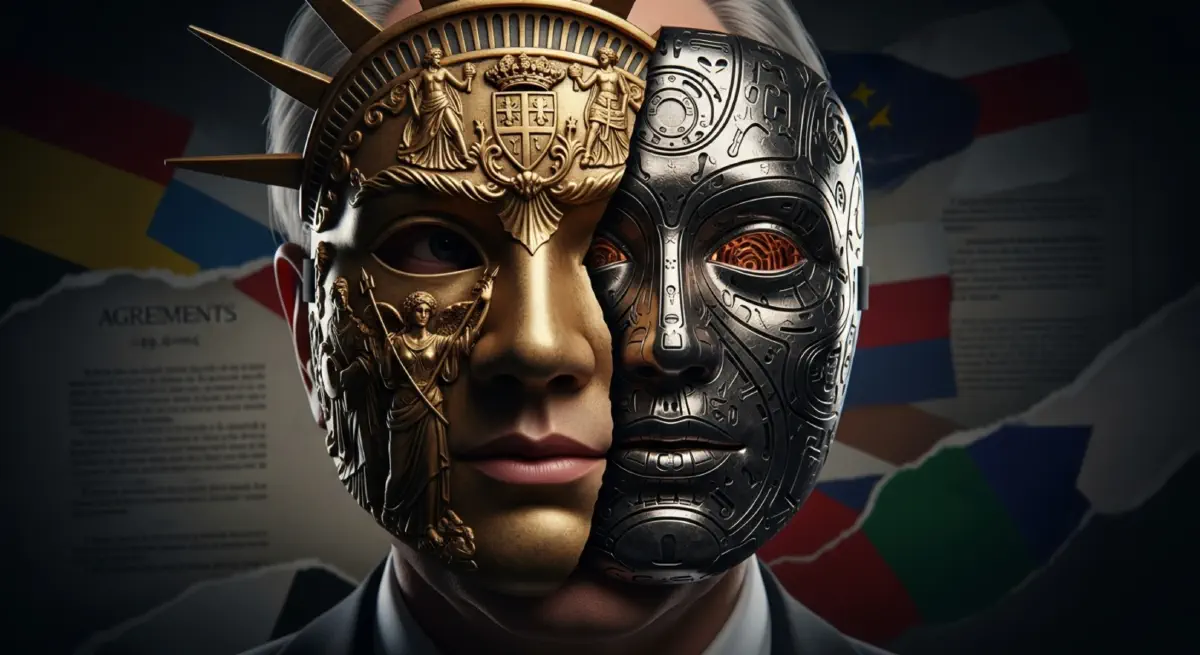
The vulgarizer, not the inventor#
Donald Trump did not create the contradiction at the heart of American power. He simplified it. He translated a long-standing imperial dialect into blunt transactional speech. Allies became cost centers. Institutions became bad deals. Treaties became optional burdens. Moral language shrank, and appetite became visible.
That is why Trump mattered beyond conventional partisan analysis. Earlier administrations often practiced selectivity while preserving the ceremony of stewardship. Trump treated the ceremony itself as waste. He did not merely bend the old language. He signaled contempt for the need to maintain it.
The effect was clarifying. Many critics of American primacy had long argued that ideals such as democracy, law, and multilateralism were applied selectively. Trump made that selectivity easier to see because he abandoned much of the careful tone that once softened it. He did not invent imperial hypocrisy. He accelerated its exposure.
The system began eating its own symbol#
Trump’s significance lies in the way he consumed American legitimacy reserves. He treated symbolic capital accumulated over decades—alliances, institutional trust, treaty reliability, public-health cooperation, climate diplomacy—not as assets to steward but as inventory to spend. The old imperial idol was not merely neglected. It was cannibalized.
What changed when the mask stopped pretending#
Withdrawal became a doctrine of disdain#
During Trump’s first presidency, the United States withdrew from the JCPOA in May 2018, despite the wider UN framework built around Security Council Resolution 2231. ([Trump White House Archives][1]) That decision signaled more than a policy dispute over Iran. It reinforced a broader lesson: commitments embedded in multilateral arrangements remained vulnerable if Washington no longer found them advantageous.
The same pattern later reached climate and public-health governance. The United States formally exited the Paris Agreement on January 27, 2026, after the UN confirmed the withdrawal timeline the previous year. The agreement still has 194 Parties, and the U.S. exit stands out precisely because it makes the country an outlier rather than a leader in cooperative climate governance. ([Reuters][2])
Trump also moved the United States out of the World Health Organization. Reuters reported in February 2025 that the U.S. decision forced the WHO to consider a $400 million budget cut, with Washington previously providing roughly 18% of the agency’s overall funding. ([Reuters][3]) These acts were not merely withdrawals. They were statements that multilateral institutions were worthy only when directly subordinate to a narrow definition of U.S. advantage.
The rhetoric of stewardship gave way to the rhetoric of extraction#
Postwar American power depended partly on the image of stewardship. Even critics had to contend with the fact that Washington often described itself as carrying costs for a wider order. Trump weakened that image by speaking in openly extractive terms. The question was no longer what arrangement stabilized the system. It was who was paying, who was cheating, and how quickly advantage could be reclaimed.
This rhetorical shift had real strategic consequences. It told allies that institutional commitments were conditional on immediate bargaining value. It told rivals that American claims to universal leadership were thinner than advertised. And it told domestic audiences that global responsibility was a scam performed by naive elites.
That combination mattered because empires survive not only through external control but through internal stories. Trump turned one of those stories against itself. He persuaded many Americans that the very institutions underpinning U.S. hegemony were signs of weakness or exploitation. In doing so, he loosened the domestic political basis for long-term stewardship.
The consumption of legitimacy is slower than the consumption of power#
It would be a mistake to exaggerate. The United States remains materially formidable. It still possesses unmatched global military reach, vast financial influence, deep technological ecosystems, and extraordinary cultural and institutional overhang. Trump did not abolish American primacy.
What he damaged was the credibility premium once attached to it. Legitimacy, unlike hardware, cannot simply be printed, deployed, or sanctioned into existence. It accumulates through reliability, self-restraint, and procedural seriousness. It erodes when a great power repeatedly treats shared frameworks as disposable.
That is why the metaphor of cannibalization fits. Trump fed on symbolic reserves built by previous generations of American statecraft. Each withdrawal, each insult to multilateral process, each reduction of universal language to commercial grievance consumed some of the myth that had made U.S. dominance easier for others to tolerate. The empire did not cease to be powerful. It became easier to read.
The world now sees the ingredients#
There is a hard political value in that clarity. For years, much of the world encountered the United States through a split-screen experience: a lecture on values paired with a practice of selective coercion. Trump narrowed the distance between the two screens. He made the operating logic legible.
That does not mean the outcome is good. Exposure is not emancipation. A hegemon that loses moral cover may become more dangerous, not less, because it can compensate for waning legitimacy with sharper force, harsher discipline, and more erratic signaling. Nor does Trump alone explain the pattern. He is better understood as a revelatory moment inside a longer history of strategic selectivity.
Still, the revelation matters. It forces a more honest description of American power. The issue is no longer whether the United States sometimes failed its ideals. All political orders fail their ideals. The issue is that its central legitimizing principle—democracy as a universal political good—was increasingly used as a flexible instrument abroad, then treated as expendable when domestic political currents shifted against the costs of maintaining the system that principle helped justify.
This is the logic of the edible idol. The object is honored while conditions permit reverence. Under pressure, rulers discover its material utility. They consume what they once displayed as sacred. Trump did not sculpt the idol. He bit into it in public.
That act changed the atmosphere. The world now sees more clearly that American order was never just democracy institutionalized at planetary scale. It was democracy fused to hierarchy, law fused to discretion, and multilateral language fused to sovereign exemption. Trump did not invent those pairings. He removed the veil that made them easier to deny.
The implication is larger than one presidency. A political order that has begun eating its own myth is entering a different stage of history. It may remain stronger than its rivals for years. But it no longer commands belief in the same way. Once the symbol becomes edible, reverence is never fully restored.