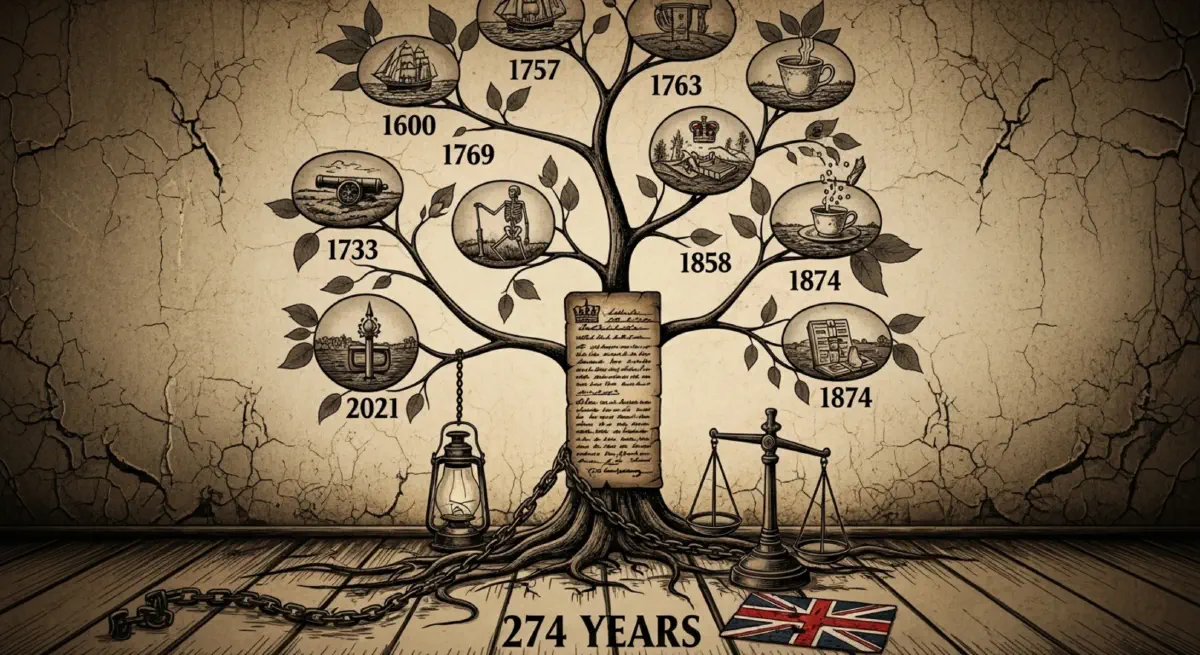
A chronological overview of the East India Company's rise to power and its impact on India.
The Charter
31 Dec 1600
Elizabeth I grants the Royal Charter
The Governor and Company of Merchants of London trading with the East Indies is born. The Charter grants a monopoly on all trade east of the Cape of Good Hope for fifteen years. Limited liability — a special gift from the Crown — shields investors from full ruin. The first voyage departs the following year.First Factory in India
1612–1619
Surat, west coast of India
Sir Thomas Roe, ambassador of James I, secures permission from the Mughal Emperor Jahangir for the Company to establish a permanent trading post at Surat. The EIC obtains a trade charter granting concessions and protection to resident English merchants.Permanent Joint‑Stock
1657
Cromwell’s reforms
Reorganisation transforms the EIC into a permanent joint‑stock company. Capital no longer disperses after each voyage; it accumulates, compounds, and becomes a permanent lobby — a permanent hold on the state’s ear.The First Tea
1664
100 lbs of Chinese tea
The EIC purchases its first parcel of Chinese tea — a modest one hundred pounds. Over the next two decades it establishes a factory in Taiwan and gains trading permissions in Chinese ports. Tea will become an English obsession that reshapes global commerce.The Weavers' Riot
1667
London
Weavers, dyers, and cloth‑workers attack the Company’s London headquarters. The rising flood of Indian calicoes and silks — imported by a monopoly that answers to no one — is destroying their livelihoods. The state protects the Company; no one protects the weavers.Sovereign Powers Granted
c. 1670
Right to coin money, wage war, acquire territory
The Crown grants the Company the right to mint its own money, command armies, erect fortresses, form alliances, and prosecute war at its own discretion. A merchant venture now carries the legal instruments of a sovereign state — without a single vote cast.The Merger
1708
United Company of Merchants
After a brief period of deregulation (the Deregulating Act of 1694, which temporarily ended the monopoly), the original EIC merges with its chief domestic rival to form the United Company of Merchants of England Trading to the East Indies.The Opium Prohibition
1729
China bans the drug
China, alarmed by deepening addiction, issues its first anti‑opium edict. The EIC does not retreat. It expands poppy production in Bengal and creates a system of licensed private traders to smuggle the drug into China. The ledger stays clean; the proceeds do not.The Battle of Plassey
23 Jun 1757
Bengal, India
Robert Clive's EIC army — three thousand men — defeats the fifty‑thousand‑strong force of Nawab Siraj‑ud‑Daulah. The battle is won through bribery: the Nawab’s commander Mir Jafar is promised the throne. The EIC seizes the diwani — the right to collect taxes. The merchant has become a king.The Great Bengal Famine
1769–1770
One to three million dead
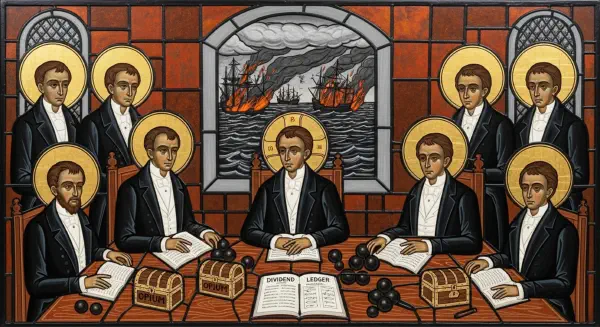
EIC tax collectors continue their rounds amid the corpses. Land taxes triple; a third of the population dies. The Company’s revenue actually increases during the famine year. The boardroom in London drinks claret and approves the dividend.The Regulating Act
1773
Parliament steps in
The British Parliament imposes the first major reforms. The Act separates the EIC’s political and commercial functions and asserts that the Company cannot acquire sovereignty "in its own right" but only "on behalf of the Crown." The fiction of independence begins to crack.The Board of Control
1784
East India Company Act
A Board of Commissioners for the Affairs of India is created — a cabinet‑level body that directs the Company’s political and military policy. The directors retain their commercial powers, but they are now yoked to Whitehall.Monopoly Broken
1813
Charter Act
The Charter is renewed for twenty years, but the broad monopoly ends. Private British merchants may now trade with India. Only the tea trade with China and the opium trade remain in the Company’s grip.Mercantile Lobotomy
1833
Government of India Act
The EIC loses all commercial functions. It is stripped of even the tea monopoly. It becomes nothing but an administrative and political agency for the Crown — a de‑facto foreign‑policy bureau with a corporate letterhead.The Stolen Tea
c. 1848
Darjeeling, India
Decades of covert effort bear fruit: the EIC establishes the first successful tea plantations in India using plants and expertise smuggled out of China. China’s virtual monopoly on tea is broken. India will eventually become the world’s dominant producer.The Indian Rebellion
1857
Central and northern India
Indian sepoys mutiny. The rebellion spreads across the subcontinent, and British rule trembles. Atrocities are committed on both sides; the British reprisals are especially savage — rebels blown from cannons, villages burned. The myth of the "Company Bahadur" perishes in a season of blood.The Crown Takes All
2 Aug 1858
Government of India Act
Parliament transfers all territories, armies, and revenues from the Company to the British Crown. The Governor‑General becomes the Viceroy. The EIC is relegated to a single vestigial function: managing the Indian tea trade on behalf of the government.Dissolution
1 Jun 1874
The East India Stock Dividend Redemption Act
After 274 years, the East India Company ceases to exist. The boardroom doors close quietly. No state funeral. No grand inquest. What remains is a more efficient extraction machine — the British Raj — which retains the Company’s army, its revenue system, and its deep contempt for the people it governed.
End of the series: "The Honourable Company: A Study in Avarice and Power."