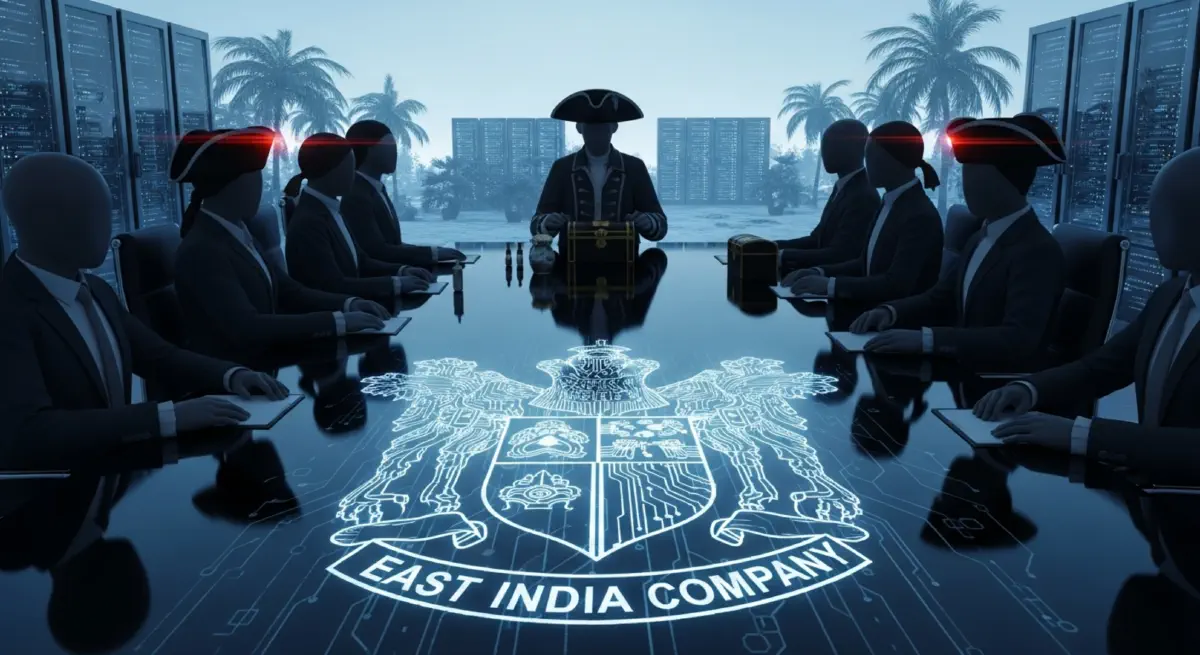
The East India Company was dissolved on the first of June 1874. Its assets were transferred to the Crown, its armies absorbed, its boardroom vacated. The historian’s file closes neatly. But the Company did not remain in its grave. It escaped—not as a secret society, but as a template. Its bones were picked clean and reassembled into the corporate architecture that now governs the global economy.
The Template Endures#
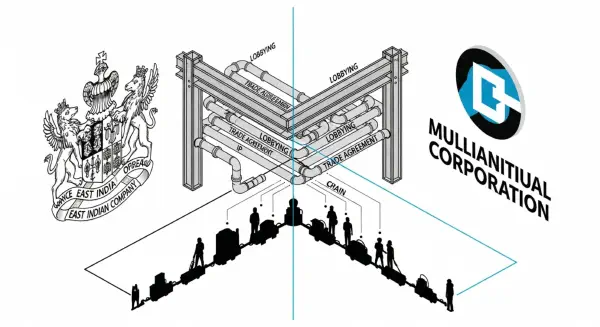
The Company was a joint‑stock body with limited liability, a state‑granted monopoly, and a private army. It extracted resources, controlled labour, and rewrote laws in its favour—all while insisting it was merely trading. Modern multinationals do not carry cannon, but the structural logic is unchanged. They are chartered by states, granted limited liability, and invested with rights that earlier ages would have called sovereign. They extract, they lobby, they exit, leaving local populations to clean the mess.
Consider the parallels—not as metaphor, but as mechanisms:
graph LR
    subgraph "East India Company"
        EIC_Charter[Royal Charter granting monopoly]
        EIC_Army[Private army]
        EIC_Tax[Tax collection and land control]
        EIC_Lobby[Loans and gifts to Crown]
        EIC_Extract[Resource extraction: tea, opium, cotton]
    end

    subgraph "Modern Multinational"
        Mod_Charter[Bilateral Investment Treaty / ISDS]
        Mod_Army[Private security / state police on payroll]
        Mod_Tax[Tax holidays & land concessions]
        Mod_Lobby[Campaign donations & revolving door]
        Mod_Extract[Resource extraction: oil, minerals, cash crops]
    end

    EIC_Charter --> EIC_Extract
    EIC_Army --> EIC_Tax
    EIC_Lobby --> EIC_Charter

    Mod_Charter --> Mod_Extract
    Mod_Army --> Mod_Tax
    Mod_Lobby --> Mod_Charter
The colonial company and the modern multinational are not distant cousins. They share a single operational gene: the use of state power to insulate private profit from public consequence.
Limited Liability: The Original Subsidy#
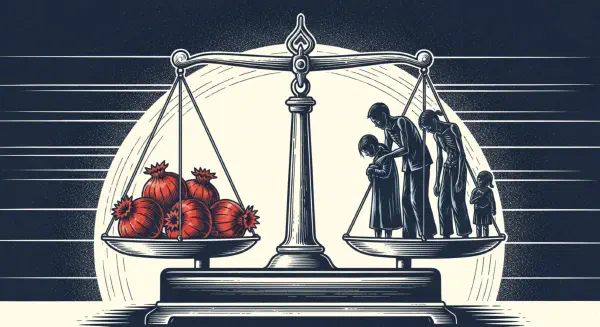
Limited liability was the Company’s founding privilege—the Crown’s gift that allowed investors to face risk with a cap. Today, limited liability is the oxygen of global capitalism. A mining company spills cyanide into a river in Ghana; the cleanup costs fall on the community, while the parent corporation’s exposure is capped at its local subsidiary’s value. The shareholders are shielded. The pattern is identical to the EIC’s opium auctions: the profit is booked in London, the cost is borne by the foreign body.
The same logic now governs sovereign debt. When a nation is trapped in an IMF structural adjustment programme, it is required to privatise its water, sell its state enterprises, and open its markets—all in the name of “reform.” The creditor institutions are shielded; the population endures austerity. The EIC, which forced Bengal to pay for its own conquest through land taxes, would recognise the technique immediately.
The Revolving Door: Gifts, Not Bribes#
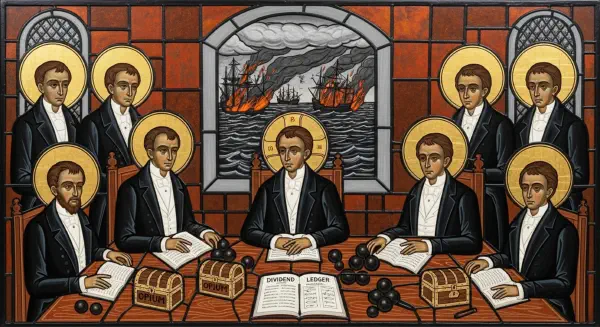
The EIC’s directors lent money to the Crown, bought estates, and finagled seats in Parliament. Today, that blunt exchange has been polished. A former mining executive becomes a minister for trade; a cabinet secretary retires to a directorship at a pharmaceutical giant. The movement is called “public service experience.” The transfers are legal, but the underlying transaction—influence for access, access for profit—has not altered by a comma since 1680.
— Fictionalised, but the mechanism is intact.
The only shift is in the vocabulary. The EIC’s “gifts” are today’s “campaign contributions.” Its “directors” are today’s “non‑executive board members.” The substance—the buying of political protection—is as durable as granite.
Free Trade as a Weapon#
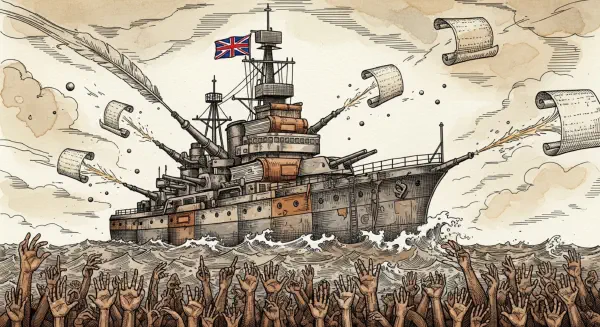
The Opium Wars were fought under the banner of “free trade,” but the freedom in question was the freedom of British merchants to market narcotics. Today, free trade agreements are framed as mutual liberalisation, but the fine print often locks in intellectual property rules that make generic medicines unaffordable, or investor‑state dispute settlement (ISDS) clauses that allow corporations to sue governments for lost future profits.
A poor country that tries to raise its minimum wage or ban a toxic pesticide can find itself hauled before an arbitration panel by a multinational that brandishes an ISDS clause. The panel is not a public court; it sits in secret, and its rulings cannot be appealed. The Chinese Commissioner Lin Zexu, who dared to destroy British opium, would recognise this logic: the sovereignty of the weaker party is a fiction to be dispensed with when profit demands it.
Modern ISDS cases:
- Philip Morris v. Uruguay (2010): Tobacco giant sued a small country for requiring health warnings on cigarette packs.
- Renco Group v. Peru (2011): A U.S. mining company sued Peru for $800 million after being ordered to clean up pollution.
The EIC, which bombarded a port when its chests of opium were burned, would nod in approval.
The Language of Development#
The East India Company spoke of its mission as the spread of “civilisation” and the improvement of “backward” peoples. All colonial enterprises employ such phrases. Today, the same idea wears a fresher suit. It is called “development,” “capacity building,” “poverty reduction.” But when you look closely at the programmes—land grabs for agri‑business in Ethiopia, forced displacement for a World Bank‑funded dam in India—you see the old grammar: the resources and labour of the poor are reorganised to benefit the rich, and the process is dressed in the vocabulary of benevolence.
Orwell understood this. He wrote that political language “is designed to make lies sound truthful and murder respectable, and to give an appearance of solidity to pure wind.” The EIC’s “land settlement” was wind. The modern “structural adjustment” is wind. The purpose of both was the same: to extract while pretending to uplift.
The Ghost in the Digital Sovereigns#
The EIC’s ultimate power was its ability to act as a state while enjoying the immunities of a corporation. In the twenty‑first century, technology corporations have begun to exercise a similar ambiguous sovereignty. They administer digital territories where their rules are supreme. They negotiate directly with governments. They deploy private security and accrue data resources more valuable than any pepper or tea. When a platform bans a user or a cloud provider cuts off a nation, it is acting with a form of territorial power—unaccountable, unappealable, and borderline stateless.
The Company’s ghost is not nostalgic. It is operational. It lives in the algorithms that score our lives and the contracts that bind nations to the profit of shareholders whose names we will never know.
The Unburied Remains#
History tells us the East India Company ended in 1874. But a body of law, habit, and property does not die when the signboard is taken down. The Company’s DNA passed into the chartered banks of the empire, the multinationals of the twentieth century, and the digital behemoths of the twenty‑first. Its double‑speak—monopolist as “free trader,” plunderer as “developer”—is now the common tongue of the powerful.
The important thing is not to remember the East India Company as a curious relic. It is to recognise it when it walks past us in a new suit. It walks past us every day, in every trade deal signed behind closed doors, in every land concession forced upon a peasant community, in every phrase that makes extraction sound like liberation.
Next in the series: "Timeline: The East India Company's Legacy" — a visual timeline tracing the key events of the Company’s history and its enduring influence on modern economic and political structures.