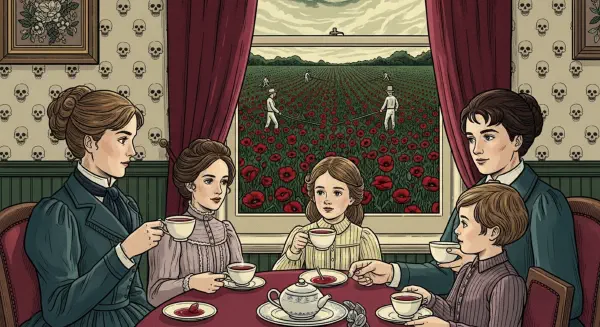
The state did not destroy the East India Company in a fit of moral clarity. It dismantled the Company because the Company had become a nuisance—too visibly corrupt, too entangled in war, too embarrassingly at odds with the new gospel of free trade. The beast that had been fattened on monopoly and militarism was put down not because it was evil, but because it was no longer useful.
The Fruits of Plunder Become Too Heavy#
By the end of the eighteenth century, the Company’s servants returned to England swollen with Indian wealth. The “nabobs,” as they were called, bought country estates, seats in Parliament, and social rank. Their ostentation provoked a backlash. Questions were asked, none too politely, about how a few years in Bengal could produce a fortune that would have taken a century in England to accumulate.
The answer was simple: extortion, bribes, and outright theft. Even the Company’s most loyal defenders found it hard to explain away the sheer volume of private enrichment. The trial of Warren Hastings, Governor‑General of Bengal, dragged on for seven years (1788–95) in the House of Lords. He was accused of corruption and cruelty. The charges were eventually dismissed, but the spectacle planted a permanent suspicion in the public mind: the Company governed for its own pockets, not for the governed.
The American Interruption#
The loss of the American colonies in 1783 hit the Company like a cannonball. The tea that Boston had dumped into its harbour in 1773 was Company tea; the rebellion had cut off a growing market. In India, the costs of war against Mysore and the Marathas ran up debts that made the Company a permanent supplicant before the British government. At its lowest point, the EIC had to borrow over £1 million from the Bank of England just to stay afloat.
A failing joint‑stock company is a private misfortune. A failing joint‑stock company that rules millions of people and commands a private army is a strategic emergency. The British government, which had for two centuries treated the EIC as a useful revenue stream, now saw it as a source of potential catastrophe.
The Legislative Guillotine#
The takeover was gradual, bureaucratic, and dressed in the language of reform. Each Act of Parliament trimmed another piece of the Company’s independence, until the merchant prince was reduced to a salaried clerk.
Regulating Act
1773
Separates the Company’s political and commercial functions. The Governor‑General of Bengal becomes a Crown appointee in all but name. The Company may not acquire sovereignty “in its own right” but only “on behalf of the Crown.”East India Company Act
1784
Creates a Board of Commissioners for the Affairs of India — the Board of Control. A cabinet minister now directs the Company’s political and military affairs. The directors keep their commercial powers but are yoked to Whitehall.Charter Act
1813
Renews the Company’s charter for 20 years but ends its broad monopoly. Private merchants may now trade with India. Only the tea trade with China and the Company’s control over Indian opium are left to it.Government of India Act
1833
Strips the EIC of all commercial functions. It loses even the tea monopoly. It becomes nothing but an administrative and political agency for the Crown, operating under a new 20‑year charter. “The equivalent of a mercantile lobotomy,” one historian called it.Government of India Act
1858
Passed in the wake of the Indian Rebellion, transfers all territories, armies, and revenues to the Crown. The Company is dissolved in all but the management of the tea trade.Company Dissolved
1874
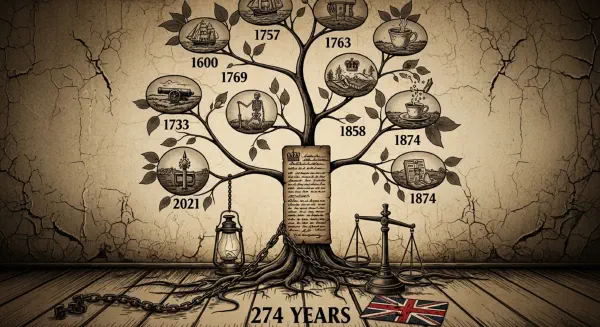
The East India Company ceases to exist, even its residual functions absorbed. After 274 years, the Honourable Company is a memory.
flowchart TD
    A[1773: Regulating Act\nPolitical functions under Crown oversight]
    B[1784: EIC Act\nBoard of Control directs policy]
    C[1813: Charter Act\nCommercial monopoly broken]
    D[1833: Gov. of India Act\nAll commercial functions stripped]
    E[1858: Gov. of India Act\nAll territories transferred to Crown]
    F[1874: Dissolution\nCompany formally wound up]
    A --> B --> C --> D --> E --> F
The Free Trade Fig Leaf#
Each of these legislative blows was delivered under the banner of economic freedom. Adam Smith’s Wealth of Nations (1776) had made its case: monopolies were parasites, trade should be open, and the Company’s swollen privileges were an insult to the natural order of commerce. The rising class of industrialists and merchant‑bankers wanted access to the Indian and Chinese markets, and they lobbied ferociously against the EIC’s remaining walls.
But the same industrialists who denounced the Company’s monopoly were quite happy to inherit its conquests. Free trade, as applied to India, meant the right to flood its markets with Lancashire cotton while extracting its raw materials without tariff barriers. The exploitation did not end; it was simply transferred from a corporate cartel to a national cartel enforced by the Royal Navy. The Company’s fall was not liberation; it was a merger.
The Indian Rebellion: The Final Shove#
In 1857, Indian soldiers—sepoys—in the Company’s army mutinied. Their grievances were many: low pay, restricted rights, the greased cartridges that touched on religious purity. The rebellion spread across central and northern India, and for a year British rule hung in the balance. Atrocities were committed on both sides, but the British reprisals were especially savage: rebels were tied to cannons and blown apart, villages were burned, thousands were executed without trial.
The rebellion exposed what careful language had concealed: the vast majority of Indians did not see the Company as a legitimate government. The myth of the “Company Bahadur” as a benevolent ruler collapsed in a season of blood. The British government, horrified and vengeful, could no longer pretend that a private company could manage an empire. The Crown stepped in directly, and the Company paid the price for its own brutality.
The Tea That Outlived the Company#
The EIC’s final years were a ghostly half‑life. The Government of India Act of 1858 left the Company with only one practical function: managing the Indian tea trade on behalf of the Crown. The tea plantations that the Company had established in Darjeeling and Assam—using smuggled plants and kidnapped expertise from China—were now maturing. By 1874, when the Company wound up its affairs, India was on a trajectory to replace China as the world’s leading tea producer. The stolen leaf had become a pillar of the British imperial economy.
The dissolution of the Company on 1 June 1874 was an anticlimax. There was no state funeral, no grand inquest. The boardroom doors closed quietly. What remained was a more efficient extraction machine—the British Raj—which retained the Company’s army, its revenue system, its alliance networks, and its deep contempt for the people it governed.
The Empty Grave#
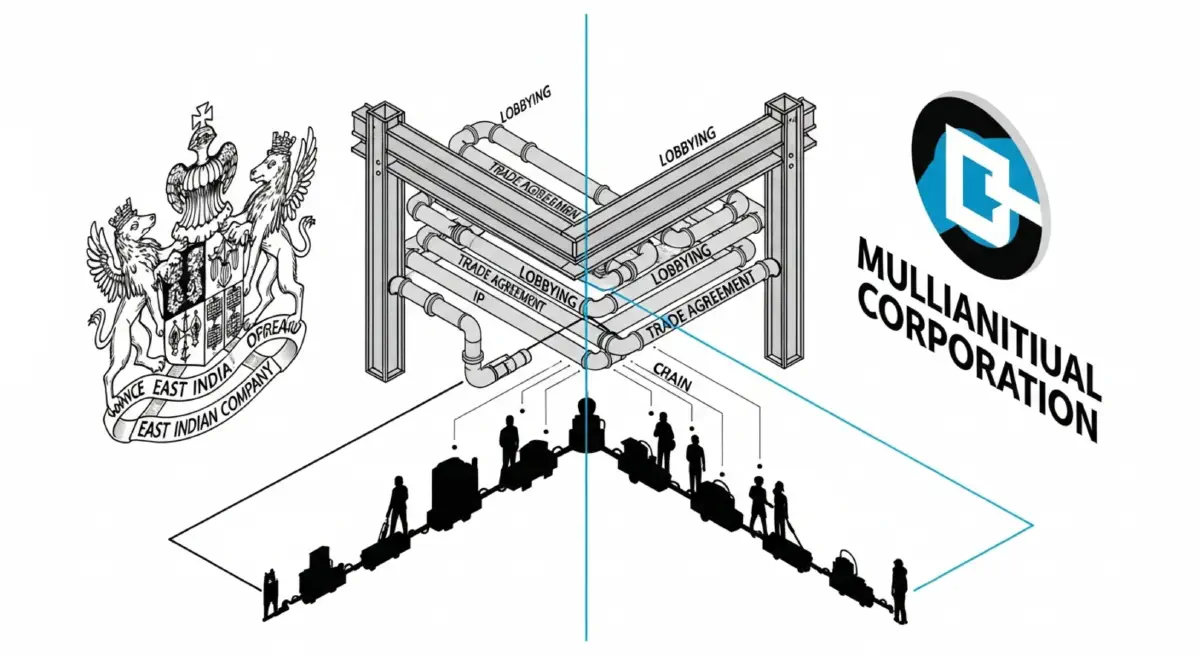
The East India Company did not truly die in 1874. Its organs were transplanted into the body of the imperial state, and they lived on. The pattern of corporate rule, state backing, and linguistic deceit migrated to other ventures: the chartered companies of Africa, the mining syndicates of the twentieth century, the multinationals that dictate terms to developing nations while hiding behind the sovereignty of their home governments.
The overthrow of the Company was not a victory for conscience. It was a rearrangement of furniture in an empire that kept the same landlord. The language changed from “charter” to “trusteeship,” from “factory” to “protectorate,” from “servant of the Company” to “servant of the Crown.” But the peasant who paid the tax and the weaver who lost his livelihood could not tell the difference.
Next in the series: "The Ghost in the Machine" — tracing the zombie body of the East India Company as it stalks through modern boardrooms and trade agreements.