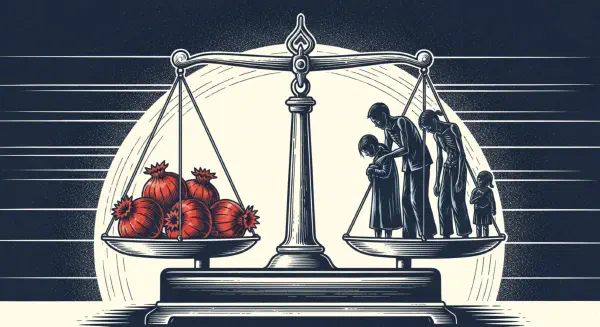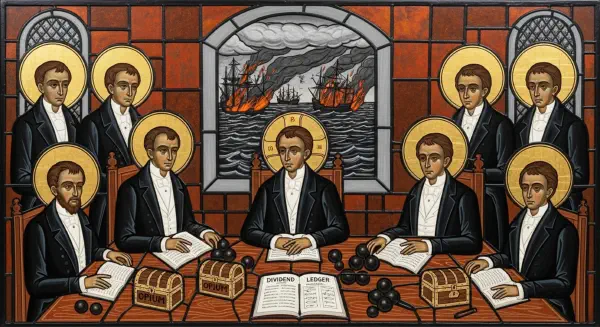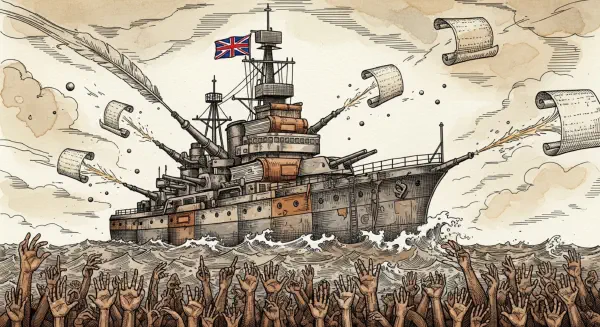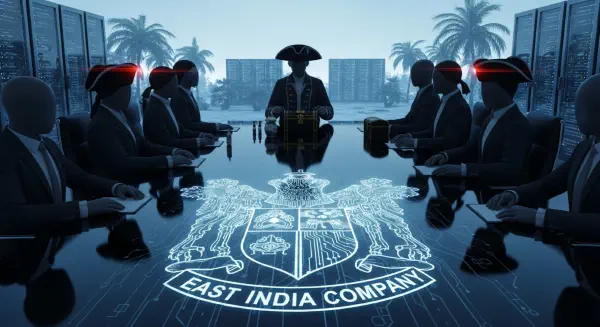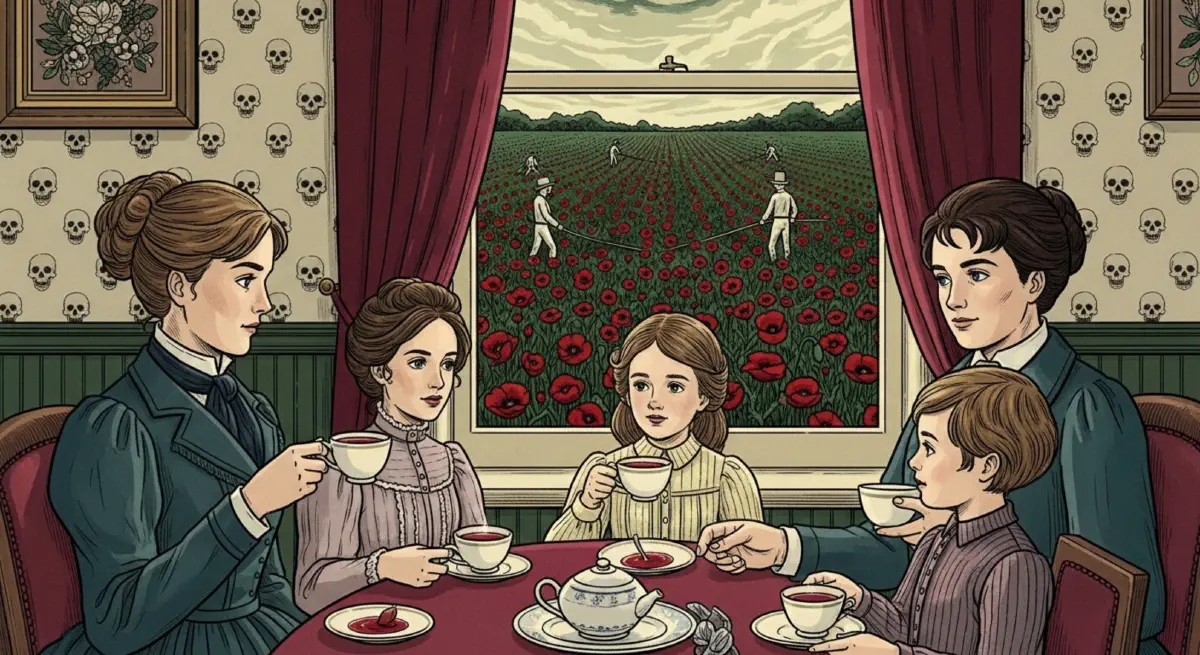
The East India Company did not solve the silver drain; it reversed it. For two centuries, Europe had bled bullion eastward to pay for silks, spices, and tea. Then the Company discovered a commodity that the Chinese would buy at any price. That commodity was not gold, not cotton, not machinery. It was opium, and the Company grew it, processed it, and flooded it into China with the full, if occasionally embarrassed, backing of the British state.
The Impasse at Canton#
By the early eighteenth century, tea had become an English obsession. The EIC imported millions of pounds annually, and the demand only grew. But China, self‑sufficient and indifferent to most European goods, insisted on payment in silver. The familiar drain continued, and the mercantilists fumed. The Company needed something the Chinese market craved—something that could be produced in its own territories and sold at a vast markup.
It found the answer in a poppy field in Bengal. Opium had been used medicinally in Asia for centuries, smoked recreationally in China since the seventeenth century. The Chinese government, alarmed by the social devastation, banned the drug in 1729. The prohibition transformed opium from a commodity into a contraband goldmine.
The Architecture of Denial#
The Company was careful. It would not ship opium to China on its own vessels; that would have been too direct an affront to Chinese law and, more importantly, too great a risk to its profitable tea monopoly. Instead, it sold opium at auction in Calcutta to licensed private traders—derisively called “country traders”—who then ran the gauntlet of Chinese patrol boats. The Company’s ledgers showed only a growing revenue from opium sales in India. The smuggling was someone else’s problem.
This was the legal fiction that enabled the whole foul enterprise. In London, directors could truthfully tell Parliament that the Company did not traffic narcotics into China. In Calcutta, they counted the proceeds. The system was so efficient that by the 1830s opium surpassed all other commodities in the India‑China trade.
graph TD
    A[EIC controls opium production in Bengal] --> B[Opium auctioned to private traders in Calcutta]
    B --> C[Country traders smuggle opium into China]
    C --> D[Silver flows back to India]
    D --> E[EIC uses silver to purchase tea in Canton]
    E --> F[Tea shipped to England, sold at profit]
    F --> G[EIC dividends; tax revenue to Crown]
    G --> A
The circle closed perfectly. No silver left England. The Chinese addict paid for the Englishman’s tea, and the Company skimmed the cream at every stage.
The Ledgers of a Narco‑State#
By 1800, the EIC controlled the entire Bengal opium industry: land, cultivation, processing, and distribution. Peasants were compelled to grow poppy under contracts that barely kept them alive. The raw opium was formed into cakes, stamped with the Company’s mark, and shipped to auction. In the decade before the first Opium War, exports from India to China averaged 40,000 chests per year—some 2,500 tonnes of the drug. Addiction hollowed out Chinese society, drained the country of silver, and corrupted its officials.
The Company did not see addicts. It saw balance sheets. In a single year, opium revenues supplied roughly one‑seventh of the Company’s total income from India. The British government, which taxed the Company’s profits and collected duties on tea, saw a vital pillar of the national revenue. Lord Palmerston, the Foreign Secretary, would later call the opium trade “a matter of moral and political consideration.” The moral consideration was shelved; the political one was armed.
Free Trade Means the Freedom to Sell Poison#
In 1833, the Company lost its remaining commercial privileges, including the China trade. Private British merchants—Jardine Matheson, Dent & Co., and others—took over the smuggling with an even more aggressive enthusiasm. They built armed clippers, bribed mandarins, and poured nearly 30,000 chests into China in 1838 alone. When the Chinese Imperial Commissioner Lin Zexu seized and destroyed 20,000 chests of British‑owned opium in 1839, the merchant class in London and Calcutta howled. They had lost their “property.”
The British government, lobbied heavily, dispatched a naval expedition. The First Opium War (1839–42) was not a war for trade; it was a war for the right to smuggle narcotics. The language used to justify it was, as ever, a masterpiece of obfuscation. The Chinese were accused of “aggression against British commerce” and of violating the “rights of free traders.” The word “opium” was barely mentioned in the parliamentary debates. When the guns fell silent, China was forced to cede Hong Kong, open five treaty ports, and pay an indemnity—for the drug chests it had destroyed.
The Treaty of Nanking (1842):
- Cession of Hong Kong to Britain.
- Indemnity of 21 million silver dollars.
- Opening of five ports to British residence and trade.
- No mention of opium. The drug was simply left outside the treaty’s legal language, free to flow through the open ports without official endorsement—a nod, a wink, and a loaded clipper.
A second Opium War (1856–60) followed, in which Britain and France ravaged the Summer Palaces of the Qing emperors to force the full legalisation of opium imports. By the end, the narcotic trade was completely open. The British Empire had fought two wars to ensure that a mass addiction market remained in foreign hands.
Tea: The Honourable Leaf#
While opium was rotting China from within, the EIC had been quietly stealing something else: the tea plant itself. For centuries, China held a virtual monopoly on tea production. The Company wanted to break that monopoly, and it did so through what today would be called industrial espionage. In the 1840s, a Scottish botanist named Robert Fortune, working on behalf of the EIC, smuggled tea plants and skilled Chinese tea‑makers out of the country and into the foothills of the Himalayas.
The result was the Indian tea industry—centred in Darjeeling and Assam—which the Company and later the British government nurtured with the same meticulous care they applied to opium. By the time of the Company’s dissolution in 1874, India was on its way to becoming the world’s dominant tea producer. The porcelain cup in a Victorian parlour held a double distillation: the stolen leaf of the Himalayas and the addictive poison of the Bengal poppy. The British taste for empire was, quite literally, a taste for stolen goods.
The Unbroken Thread#
The East India Company was stripped of its commercial powers in 1833 and dissolved in 1874. But the opium trade it had built continued for decades under the British Crown. The architecture of drug production and state‑backed smuggling was not dismantled; it was simply transferred from a corporate office to a colonial bureaucracy. Hong Kong, taken at gunpoint to serve as a smuggling entrepôt, became one of the world’s great financial centres—a city built on a narcotic foundation.
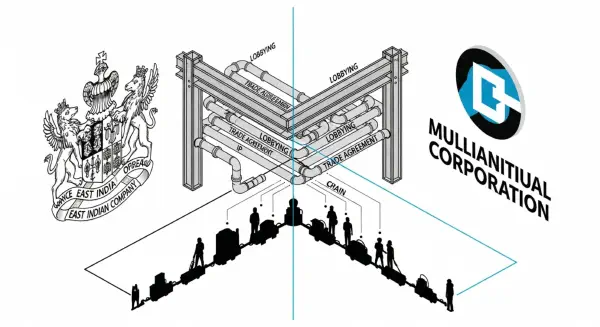
When we look today at the quiet parleys between multinational corporations and governments, at the way a product that destroys health can be defended as a matter of “market access,” we are looking at the long shadow of the East Indiamen. The Company’s genius was not trade. It was the invention of a language in which the most sordid transactions could be dressed as progress, and the most aggressive wars could be called the defence of commerce. That language has not died. It is merely spoken with a smoother accent.
Next in the series: "The Corporation Unmade: Reform, Revolt, and State Absorption" – how the state that had enabled the monster finally moved to swallow it, not out of shame, but because the monster had become a liability.