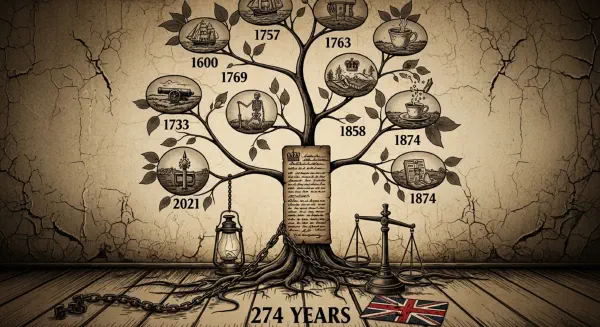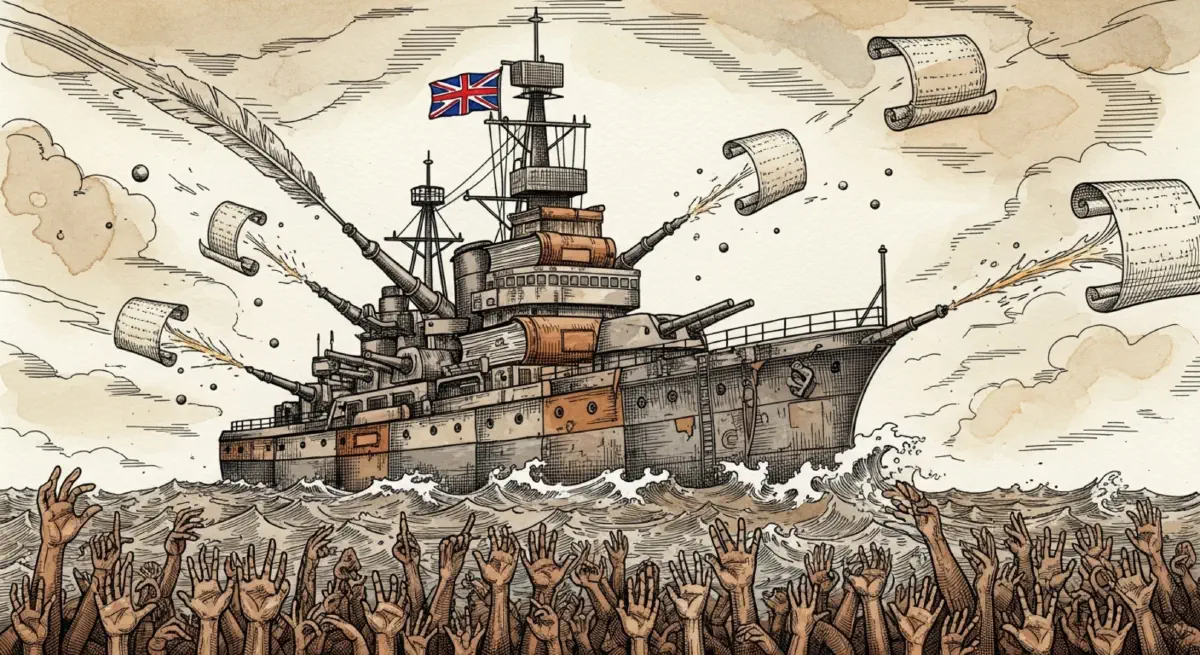
Until the middle of the eighteenth century, the East India Company was a merchant. It bought and sold; it bribed and smuggled; it petitioned and profited. Then, in 1757, it became something else. It became a king—without a crown, without a parliament, without any law except its own appetite.
The Unstable Chessboard#
In the early 1700s, India was a patchwork of warring states. The Mughal Empire, once vast, had rotted from within. Provincial governors—nawabs—ruled their territories with nominal allegiance to Delhi but real independence. Into this chaos stepped two European trading companies, each with a private army and a keen nose for weakness: the English EIC and the French East India Company.
The game was simple. Indian princes fought one another; the companies offered their disciplined, European‑trained troops as allies. The side that won rewarded its helpers with trade concessions, tax exemptions, and land grants. Soon, the companies stopped being helpers and became kingmakers. Then they stopped being kingmakers and became kings.
flowchart TD
    A[Trade monopoly charter] --> B[Private army raised for protection]
    B --> C[Army used to influence Indian succession disputes]
    C --> D[Company extracts concessions and territory]
    D --> E[Revenue from territory funds larger army]
    E --> F[Company cements political control]
    F --> G[Nawabs become puppets; EIC becomes sovereign]
    G --> H[Monopoly trade replaced by direct tax collection]
The Battle That Was Not a Battle#
The year 1756 brought a pretext. The young Nawab of Bengal, Siraj-ud-Daulah, had grown tired of the Company’s fortifications, its abuse of trade privileges, and its arrogant answer to his authority. He seized the Company’s settlement at Calcutta—the infamous "Black Hole" incident, exaggerated then and since, was part of that capture. The Company sent Robert Clive, a former clerk turned soldier, to re-establish its position.
Clive arrived in Bengal with an army and a plan far older than gunpowder: he bribed the Nawab’s own commanders. Mir Jafar, the Nawab’s uncle and military chief, agreed to betray his master in exchange for the promise of the throne. When the armies met at Plassey on 23 June 1757, Clive’s 3,000 men faced a Bengali force of perhaps 50,000. The battle was over in hours because most of the Nawab’s army, following Mir Jafar’s lead, did nothing. Siraj-ud-Daulah fled, was captured, and was murdered. Mir Jafar became Nawab—a puppet with a hollow title.
The Famine That Followed#
After Plassey, the Company stopped pretending to be a trade partner. It was now the de facto government. Its agents fanned out across the countryside, collecting land taxes at rates that made the old Mughal exactions look merciful. The Company’s priority was "revenue," and revenue meant squeezing the peasant until the soil itself seemed to bleed.
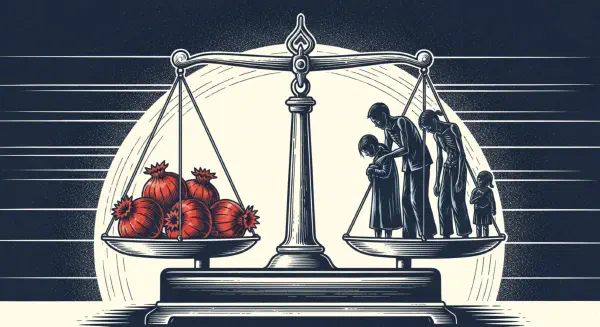
The result was a series of catastrophic famines. The Great Bengal Famine of 1769–70 killed between one and three million people—roughly a third of the region’s population. EIC tax collectors continued their rounds amid the corpses. In some districts, the Company’s revenue actually increased during the famine year because surviving peasants were forced to sell everything, including their children, to meet the demand.
"Stagnant pools of water covered the lowlands; the rice‑fields were parched; the air was filled with the stench of decaying bodies. The Company’s revenue increased by ten per cent in the year of the famine."
— Contemporary reports, cited by William Hunter, Annals of Rural Bengal
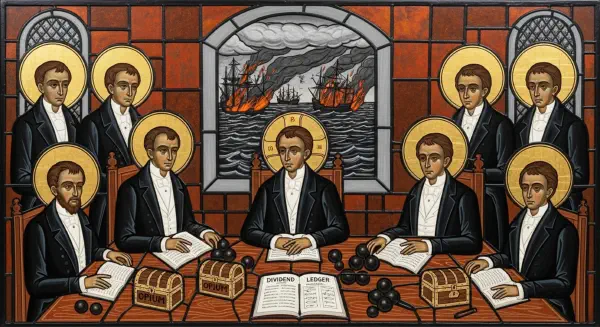
The Company did not call it murder. It called it "land settlement." It called the starvation a "shortfall in agricultural output." Its directors in London drank claret and approved dividends while they read the mortality figures. Language had once again done its poison work: when you drain a province of its food and its silver, you say you are "administering a territory." When millions die, you say they succumbed to "natural calamity." The calamity was neither natural nor incidental; it was the direct consequence of a private corporation running a countryside for profit.
The French Rivalry and the Final Triumph#
The EIC was not unopposed. The French East India Company, equally armed, equally cynical, contested the same ground. Indian rulers, seeing the danger, tried to play the two off each other. But the French lost the wider imperial struggle: the Seven Years' War (1756–63) left Britain dominant at sea, and the French Compagnie des Indes withered into irrelevance.
By the end of the century, the EIC had become nothing less than a shadow British Empire in India. It ruled Bengal directly and held the rest of the subcontinent in a web of "subsidiary alliances"—treaties by which Indian princes paid for the Company’s "protection" with land and treasure, while the Company’s troops ensured their thrones were safe from both external enemies and their own people. If a prince could not pay, the Company annexed his territory outright.
The shift in governance:
- Before Plassey (1757): EIC operated by permission of Indian rulers.
- After Plassey: EIC chose and deposed rulers at will.
- By 1773: Regulating Act forced the Company to formally acknowledge Crown sovereignty—a legal fiction to obscure the Crown’s complicity.
- By 1784: British government created a Board of Commissioners for the Affairs of India, absorbing oversight while leaving the EIC to carry out the dirty work.
The Machine of Extraction#
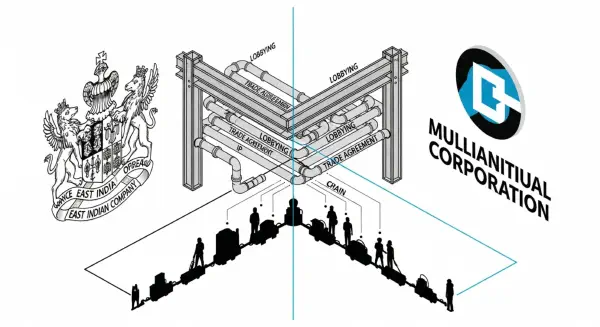
The Company minted its own money. It maintained its own armies—by 1800, the largest standing army in Asia, composed largely of Indian sepoys commanded by British officers. It collected taxes, dispensed justice, and even waged war on its own authority. It had all the machinery of a state, yet it remained, in law, a joint‑stock company answering to its shareholders.
This was the ultimate Orwellian inversion. A sovereign power was exercised by a board of directors whose only responsibility was to the dividend. When the Company committed atrocities, the British government could shrug and say, "They are a trading company; we do not govern them." When the Company demanded military support, the government could send the Royal Navy to "protect British commercial interests." The arrangement allowed each side to disclaim the consequences while pocketing the rewards.
The Language of "Civilisation"#
The Conquest of Bengal gave birth to a new vocabulary. The Company’s apologists began to speak of "improvement," "civilisation," and "the British peace." What they meant was the systematic extraction of wealth from one of the richest regions on earth. In one generation, Bengal went from being a major textile exporter and a centre of global manufacturing to a de‑industrialised supplier of raw materials, its skilled weavers put out of work by British factory cloth, its grain reserves shipped out while the people starved.
The word "empire" was not used for the Company’s rule—not at first. That would have triggered awkward questions about why a board of merchants held sovereignty over millions of people. Instead, the government invented phrases like "territories administered on behalf of the Crown." But the Bengali peasant kneeling in his ruined field did not need a dictionary to understand what had happened.
The Enduring Pattern#
The conquest of Bengal was the moment the English East India Company demonstrated, once and for all, that a corporation armed with monopoly privilege, a private army, and a license from the state will inevitably become a government. The hunger of capital does not stop at the boundary between trade and rule. It consumes everything in its path—land, labour, life—and calls the result "progress."
When you read today of mining companies maintaining private security forces in Africa, of agribusiness monopolies rewriting land laws in South America, of tech giants functioning as de facto sovereigns in the digital realm, you are not looking at a new phenomenon. You are looking at the same pattern that appeared in Bengal in 1757: the merchant with a gun, the merchant with a treasury, the merchant who calls his plunder "governance" and his victims "externalities."
Next in the series: "The Poison and the Leaf: Tea, Opium, and the Opium Wars" – how the same corporation, faced with the Chinese refusal to accept Indian silver, invented a drug trade that brought a nation to its knees.