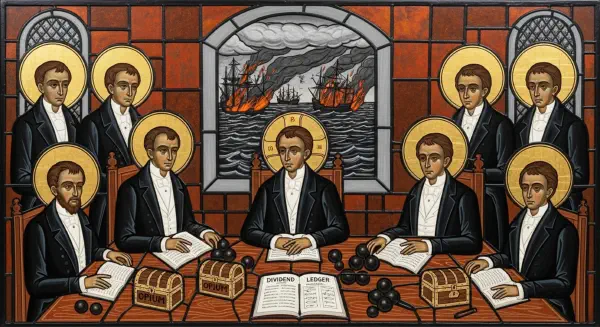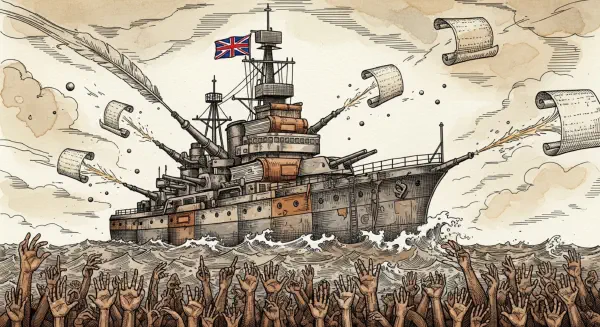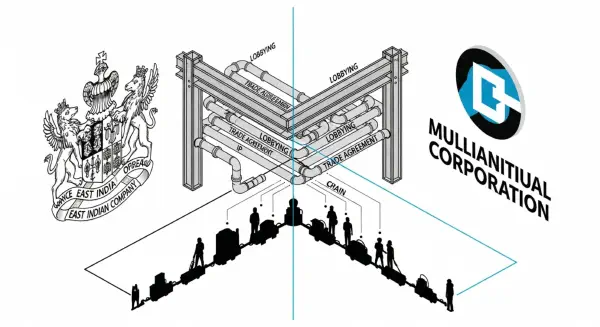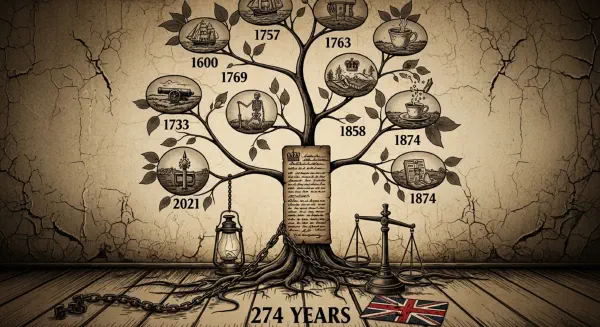
The East India Company was not born of bold merchants staking their own fortunes on the open sea. It was a hatched creature of privilege, a monopoly woven from a royal signature and a few strokes of legal language that pretended risk was being shouldered when in fact it was being fenced off.
In 1600, a group of London merchants went to Queen Elizabeth I with a plan. They did not ask for a fair wind. They asked for a wall—a high legal barrier that would keep every other Englishman out of the trade east of the Cape of Good Hope for fifteen years. The Queen granted it. The "Governor and Company of Merchants of London trading with the East Indies" was created, soon abbreviated to the East India Company. The name sounded like a collective of adventurers. In truth, it was a state‑sponsored cartel.
The Joint-Stock Chimera#
Modern apologists often hold up the EIC as a pioneer of the joint‑stock company. Its shareholders, they say, were protected by limited liability—a feature we now regard as a cornerstone of capitalism. But limited liability in 1600 was not an economic right; it was a political gift. No law of nature dictated that an investor could lose only what he put in. The Crown granted that insulation as a special favor, and the Company guarded it as jealously as its trade routes.
The effect was predictable. With the Crown’s guarantee that ruin would be partial, not total, capital poured in from men who would never have risked their entire estates on a monsoon‑dodging ship. The EIC could raise far larger sums than any ordinary partnership. But the richness of the pot had little to do with efficiency and everything to do with the legal cataract that protected the subscribers from the full glare of loss.
The Invisible Strings#
Conventional history draws a neat line: the Company was private, the government was public, and never the twain did meet. This is a falsehood. The state exercised a constant, quiet pull on the EIC’s tiller through the simple mechanism of the charter.
The original charter was for fifteen years. After that, the Company had to return to the Crown and ask for renewal. Each renewal was an audit, not of whether the Company had traded well, but of whether it had served the interests of the state and its officials. Gifts to courtiers, loans to the Treasury, and well‑placed bribes smoothed the way. The Company’s directors learned early that a directorship was also a political listening post.
The government did not own shares. It did not need to. By holding the power to renew or revoke the monopoly, it could steer the Company toward wars, territorial acquisitions, and revenue streams that aligned with national policy while the Company picked up the bill—so long as the profits kept flowing back.
Consider the loop of influence that became the EIC’s circulatory system:
graph TD
    A[Crown grants monopoly charter] --> B[EIC raises capital, controls trade]
    B --> C[EIC generates wealth for shareholders]
    C --> D[Gifts, loans, lobbying to Crown and Parliament]
    D --> E[Charter renewed, privileges expanded]
    E --> A
This was not a market at work. This was the marriage of power and money, officiated by the state with an indifferent shrug for everyone else.
The First Forty Years: Managing the Bargain#
By 1657, the EIC had survived two charters and a civil war. That year, Oliver Cromwell’s administration reformed the Company into a permanent joint‑stock corporation. The old system had funded each voyage separately, liquidating the accounts after every ship returned. The new structure made the Company itself the permanent vessel. Capital stayed inside, accumulating, compounding, and ever more capable of buying influence.
The change is often hailed as a modernising reform. But it also locked in the monopoly for good. Permanent capital meant a permanent lobby. A permanent lobby meant a permanent hold on the state’s ear. And a permanent hold on the state’s ear meant that when the Company later raised its own army, minted its own coin, and conquered Bengal, the English government would discover that it had already ceded the keys to a private empire.
The Language of the Charter#
Orwell taught us to watch language when it is used to conceal. The 1600 charter is a masterclass. It grants the Company the power "freely to trade" in the East Indies while simultaneously forbidding anyone else from doing so. The word "free" here means exactly the opposite: a closed shop, enforced by the full authority of the Crown.
Similarly, the charter speaks of the Company’s "governor" and "merchants" acting for the "honour of this realm." It would have been more honest to say they were acting for the honour of their own ledgers. But the state needed the fiction that private greed was a form of national service, and the merchants needed the fiction that the state’s protection was merely the reward for patriotic enterprise. Both sides profited from the lie.
The Unseen Toll#
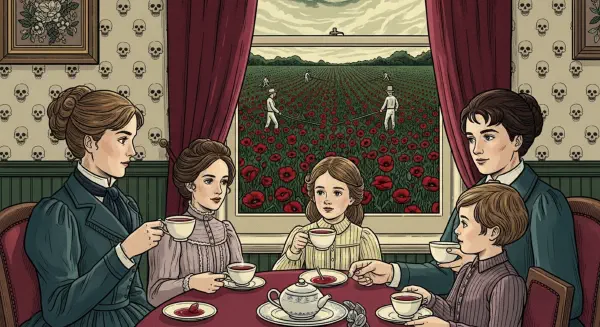
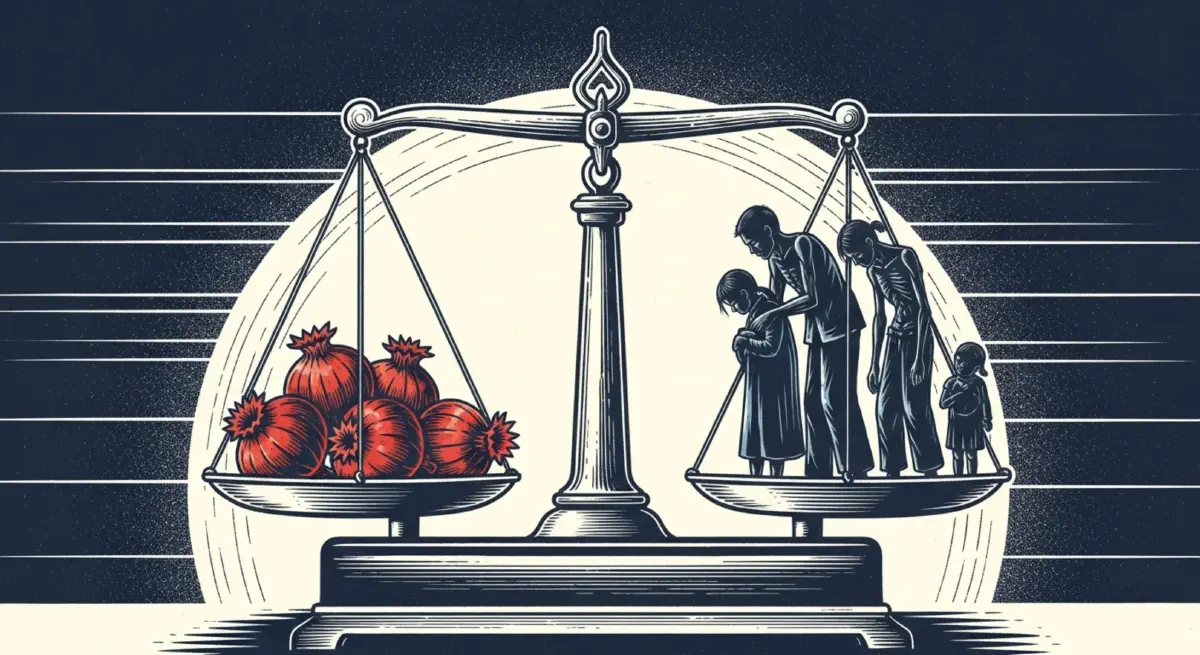
It is easy at this distance to treat the monopoly as a dry commercial arrangement. But monopolies have victims. Every English merchant shut out of the trade lost potential income. Every consumer paid a higher price for pepper, cloves, and calico because the Company could set prices without competition. And in the East, the same monopoly that enriched London shareholders would soon arm itself, seize land, and levy taxes—all under a piece of parchment signed by a Queen who had never seen the Ganges.
When the weavers of London rioted in 1667 against the flood of Indian cloth that was destroying their livelihoods, they were protesting not a natural market shift but an artificial one, engineered by a monopoly that had every incentive to import cheap textiles and none to care about domestic pain. The Crown protected the Company; no one protected the weavers.
The Enduring Architecture#
The East India Company was dissolved in 1874, but its template did not vanish. Limited liability, once a royal indulgence, is now the water in which modern capitalism swims. The revolving door between corporate boardrooms and government ministries is simply the old gift‑loan‑charter cycle, polished with ethics legislation. And the language—"free market," "level playing field," "public‑private partnership"—still does the work of concealing the exclusion and the privilege that always lurk behind a state‑sanctioned monopoly.
When we look back at 1600, we are not looking at a pre‑modern curiosity. We are looking at ourselves, 425 years later, still pretending that when the powerful lock arms the rest of us are somehow freer.
Next in the series: "Silver, Spice, and Squalor" – where the Company’s trade begins to bleed England of bullion while its agents grow rich in the East.