The Honourable Company: A Study in Avarice and Power
Summary#
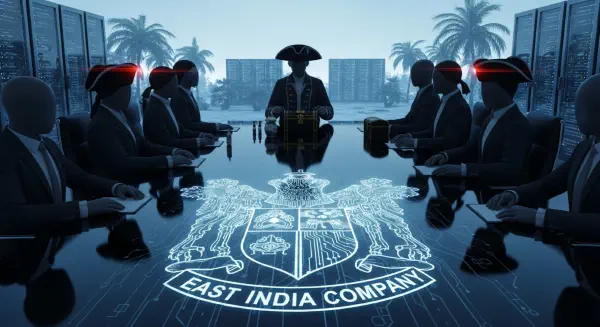
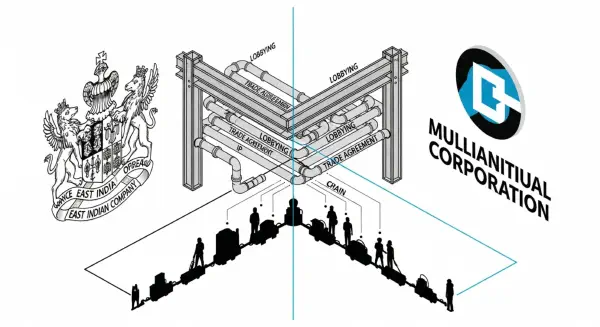
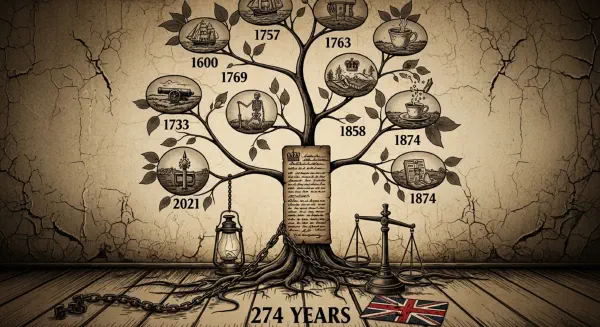
The East India Company was not a mere trading venture. It was the prototype of the modern corporation‑state nexus—a private, profit‑driven entity granted monopoly, army, and sovereignty while its shareholders and government backers perfected a language that renamed extortion “revenue” and drug trafficking “free trade.” This series follows the Company’s 274‑year life and its long afterlife, arguing that the machinery of colonial extraction never vanished; it merely relocated from lead‑lined charters to bilateral investment treaties, from private armies to retained security firms, from “land settlements” to structural adjustment programmes. Written in the plain, prosecutorial style of George Orwell, each post unmasks one layer of the Company’s architecture and shows how its grammar of power remains the vernacular of global capital.
Introduction to the Series#
The six posts trace an arc—from birth to dissolution to resurrection:
- The Charter and the Monopoly – How a royal signature created a cartel and invented limited liability as a state privilege.
- Silver, Spice, and Squalor – The bullion drain, the weavers’ riot, and the human cost of mercantile logic.
- The Conquest of Bengal: When the Merchant Became King – Plassey, the rake of taxation, and the famine that followed.
- The Poison and the Leaf: Tea, Opium, and the Opium Wars – How the Company reversed the silver flow by flooding China with narcotics, then waged war to protect its smuggling.
- The Corporation Unmade: Reform, Revolt, and State Absorption – The legislative dismantling of a monster that had become too embarrassing to leave independent.
- The Ghost in the Machine – The Company’s template persisting in modern multinationals, investor‑state tribunals, and the doublespeak of “development.”
Key Insights#
- Monopoly was a political gift, not a market outcome. The EIC’s trading exclusion was enforced by the Crown; limited liability shielded investors from full loss, an indulgence that became the foundation of modern corporate law.
- State and corporation were partners, not antagonists. The Crown shaped Company policy through charter renewal, loans, and patronage, while the Company bought influence with gifts and seats in Parliament—an early revolving door.
- Language was the instrument of plunder. “Free trade” meant a closed shop; “civilisation” meant extraction; “revenue settlement” meant coerced taxation. Orwell’s warning that political language “is designed to make lies sound truthful” finds its perfect case study in Company documents.
- The shift from merchant to sovereign was logical, not exceptional. A private army, granted for “protection,” was inevitably used to tip succession wars and then to govern. The Battle of Plassey (1757) sealed the Company’s status as a shadow state.
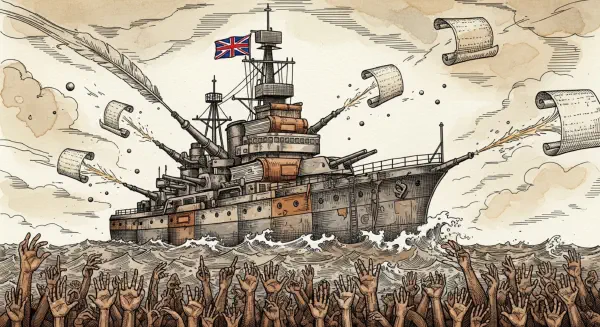
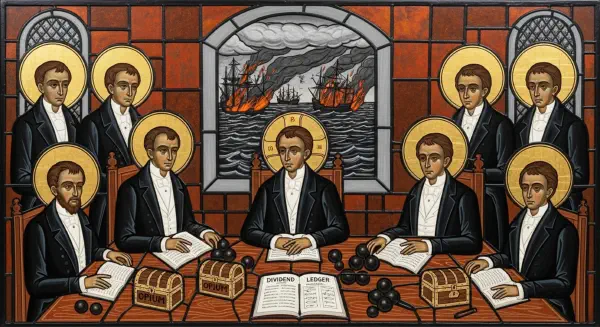
- The Opium Wars were corporate wars disguised as national crusades. The Company built an illegal drug trade to finance its tea addiction, then successfully lobbied Britain to attack China when Beijing destroyed its contraband. The treaties named no opium, leaving the architecture of smuggling intact.
- The Company was not killed by morality; it was absorbed by convenience. Successive reforms (1773–1858) gradually transferred its powers to the Crown not out of concern for Indian lives but because a private firm governing millions had become a strategic and ideological liability in the age of free trade.
- The EIC’s ghost is alive. The same template—limited liability, state‑backed monopoly, linguistic laundering—reappears in today’s resource extraction firms, investor‑state dispute mechanisms, and digital platforms that exercise sovereign‑like powers without democratic accountability.
References#
- Brunton, B. (2013). The East India Company: Agent of empire in the early modern capitalist era. Social Education, 77(2), 78–81, 98.
- Chaudhuri, K. N. (1965). The English East India Company: The study of an early joint‑stock company 1600–1640. A. M. Kelley.
- Irwin, D. A. (1991). Mercantilism as strategic trade policy: The Anglo‑Dutch rivalry for the East India trade. Journal of Political Economy, 99(6), 1296–1314.
- Orwell, G. (1946). Politics and the English language. Horizon, 13(76), 252–265.
- Smith, A. (1776). An inquiry into the nature and causes of the wealth of nations. W. Strahan and T. Cadell.