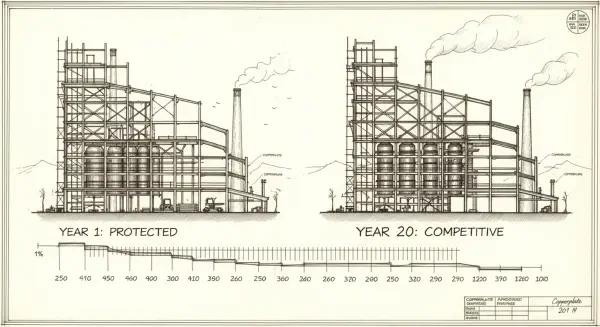
The orthodox narrative of free trade as a universal engine of growth overlooks a crucial historical reality: today’s wealthy nations reached their status through state-led protectionism and industrial strategy. This post synthesizes qualitative historical insights from Ha-Joon Chang’s Bad Samaritans into a formal Dynamic Comparative Advantage Model that quantifies the trade-off between short-term inefficiency and long-term productivity gains. By modeling infant industry protection, learning-by-doing, and cumulative wealth, we expose the “historical amnesia” of institutions that prescribe immediate liberalization to developing countries.
Key Takeaways#
Productivity is learned, not static – Industrial capabilities improve with cumulative experience and government-supported skill acquisition, following a dynamic learning curve.
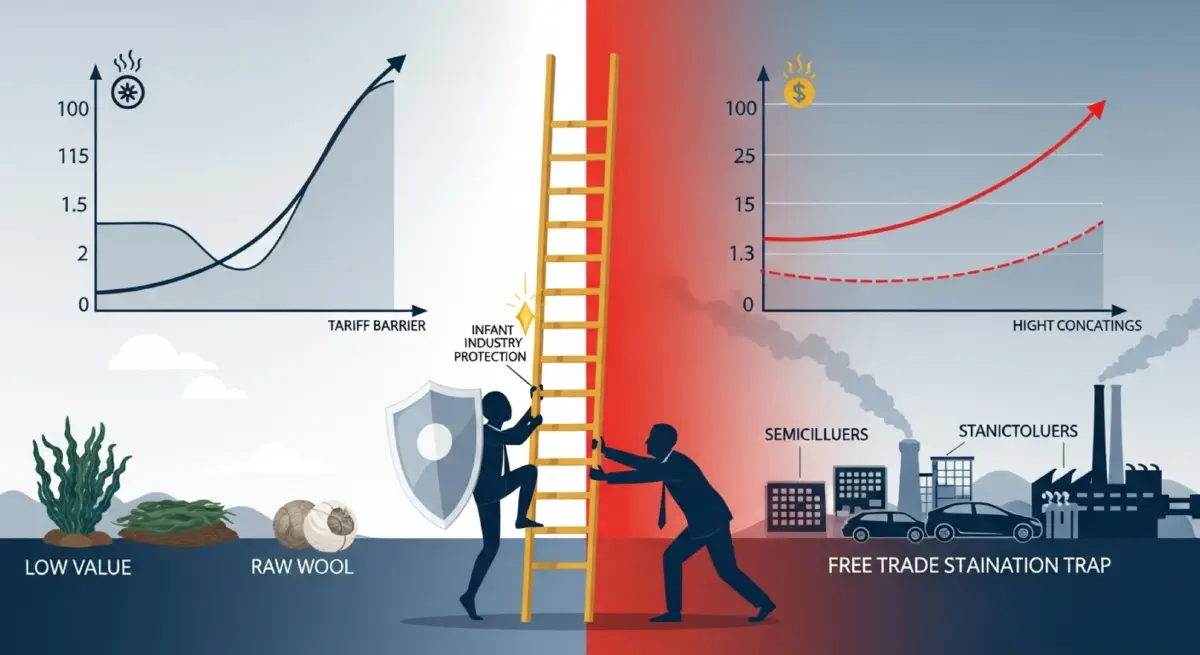
Protection barriers shield infant industries – A tariff barrier $\tau$ reduces effective competitive pressure, allowing domestic firms to survive long enough to climb the productivity ladder.
Static comparative advantage is a trap – Specializing in low-value goods (e.g., raw wool, seaweed) yields linear, slow wealth growth, locking nations into permanent underdevelopment.
Short-term costs enable exponential gains – Strategic protection incurs higher consumer prices initially, but once domestic productivity catches up to the global frontier, wealth expands exponentially through high-value exports.
Historical success stories defy free‑trade dogma – Britain, the United States, and South Korea all ignored their current comparative advantages to build future ones (e.g., steel, automobiles, semiconductors).
International financial institutions suffer from “historical amnesia” – The IMF, World Bank, and WTO prescribe policies that remove the very ladder their own countries used to climb, preventing latecomers from reaching industrial maturity.
Motivation for the Model#
International financial institutions often prescribe immediate liberalization to developing nations, ignoring how today’s rich countries used tariffs, subsidies, and state-led investment to nurture their industries. The model quantifies the consequences of this “historical amnesia”. By visualizing the development ladder, we see that removing protection too early prevents a nation from ever reaching high-value industrial maturity.
Model Assumptions#
- Dynamic Learning Curves – Productivity is not a static endowment but a learned capability that improves with experience and government-supported skill acquisition.
- Market Failures in Infancy – Young industries in developing countries are inherently inefficient compared to established industries in advanced nations. Without temporary protection, they cannot survive the transition period.
- Strategic Defiance – Economic “miracles” (e.g., South Korea’s POSCO steel mill) occur precisely when a government ignores its current comparative advantage (e.g., agriculture) to build a future one (e.g., steel).
Mathematical Logic of the Model#
The model transitions an economy from low-productivity resource extraction to high-productivity manufacturing. Two regimes are compared: immediate free trade (the “Bad Samaritan” path) and strategic protection (the “Infant Industry” path).
Productivity Growth Function#
Let $P_d(t)$ be domestic productivity at time $t$, and $P_g$ the global frontier productivity. Under free trade, if $P_d(t) < P_g$, the domestic industry cannot capture market share and collapses. Under protection, a barrier $\tau$ (tariff or subsidy) reduces effective competitive pressure:
$$ C_{eff} = P_g \cdot (1 - \tau) $$Domestic productivity follows a logistic learning curve:
$$ \frac{dP_d}{dt} = \alpha \cdot P_d(t) \cdot \left(1 - \frac{P_d(t)}{P_g}\right) $$where $\alpha$ is the learning rate – boosted by government-led “headhunting” of skills, subsidies, and coordinated industrial policy.
Wealth Accumulation Logic#
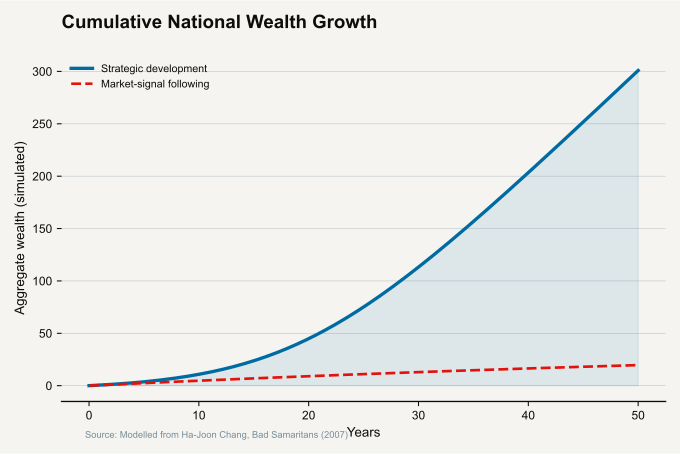
National wealth $W(t)$ is the integral of output over time. In the static (free trade) scenario, the nation specializes in low-value goods, yielding linear, slow growth. In the dynamic (protection) scenario, the nation incurs an initial cost (higher consumer prices) to reach a “take-off” point where $P_d(t) \approx P_g$. Thereafter, wealth grows exponentially through high-value exports.
Quantitative Significance of Figures#
Figure 1: Productivity Evolution Over Time
This figure illustrates the non‑linear growth of domestic capability. The navy line (strategic path) shows how tariffs allow $P_d(t)$ to rise steadily toward the global frontier. The red dashed line (Bad Samaritan path) shows how exposure to superior foreign competition leads to a stagnation trap. The key quantitative insight is the catch‑up time – the decades required for an infant industry (e.g., British wool, Korean automobiles) to become globally competitive.
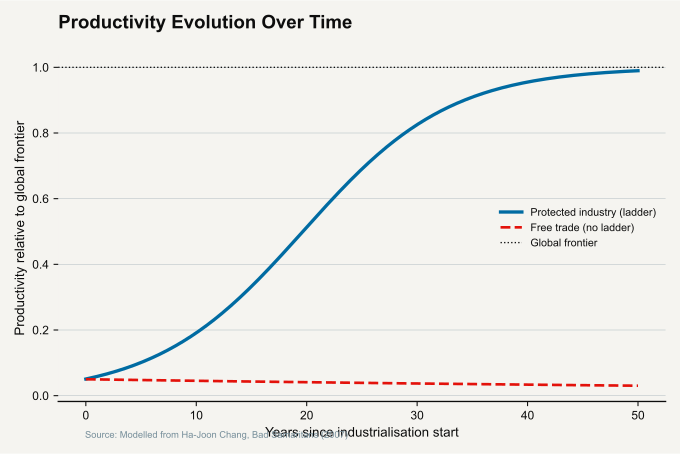
Figure 2: Cumulative National Wealth Growth
This chart visualizes the long‑term payoff of short‑term “inefficiency.” While the red line (free trade) may show slightly higher initial consumption due to cheaper imports, the navy line (strategic protection) yields an exponential explosion in wealth once the industry reaches global competitiveness. This proves the text’s assertion that “investing in children when they are inefficient” is the only way they eventually become highly productive adults.
Closing#
The Dynamic Comparative Advantage Model demonstrates that the path to prosperity is rarely a free‑market shortcut. Instead, it requires strategic defiance of static efficiency – temporary protection, state coordination, and patient investment in learning‑by‑doing. For developing nations today, the lesson is clear: policy space to nurture infant industries is not a distortion to be eliminated, but a ladder to be climbed. Without it, the “Bad Samaritans” of international finance will continue to kick away the very rungs that enabled their own wealth.
References#
- Chang, H. J. (2007). Bad Samaritans: The Myth of Free Trade and the Secret History of Capitalism. Bloomsbury Press.
- Hamilton, A. (1791). Report on the Subject of Manufactures. United States Congress.