The most expensive labor in the history of global infrastructure was not the skilled engineering of the French but the non-performance of Egyptian peasants who were legally barred from the site. In 1864, the Emperor of the French, Napoleon III, issued an arbitration decree that remains a masterclass in colonial accounting: he ordered the Egyptian government to pay the Suez Canal Company eighty-four million francs as compensation for the company’s “loss” of access to the Egyptian corvée, or forced labor. This meant the Khedive was essentially fined the equivalent of nearly half the company’s total starting capital for the privilege of ending a system of slavery that the French themselves had initially demanded. This transaction did not merely build a waterway; it constructed a financial enclosure that converted the fertile land and human life of the Nile Valley into a debt instrument for Parisian banks. The canal was never an Egyptian asset in any functional sense; it was a mechanism for the systematic transfer of sovereign wealth to European creditors, ending in the total liquidation of Egyptian interests to the British Crown in 1875.
The Universal Company functioned as a French monopoly disguised as a global consortium#
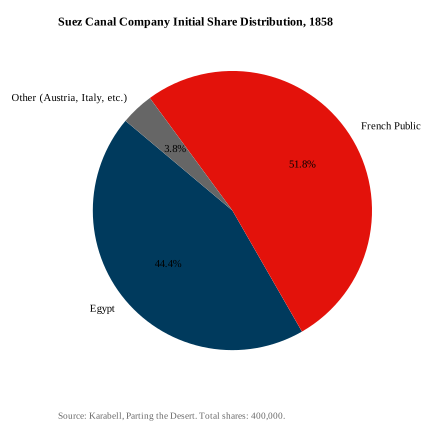
The financial architecture of the Universal Company of the Maritime Suez Canal was designed by Ferdinand de Lesseps to appear international while ensuring French control. When the company opened its subscription in 1858, Lesseps envisioned a broad base of European shareholders to shield the project from British diplomatic interference. However, the refusal of the British and most other European powers to buy in left a massive capital void that Lesseps filled by pressuring the Egyptian Viceroy, Said Pasha, to purchase the remaining shares. As shown in Figure 1, this left the Egyptian state holding 177,642 shares—roughly 44 percent of the company—while the French public held the majority of the rest. This configuration created a precarious imbalance where Egypt provided the plurality of the capital and all the land and labor, yet the company’s headquarters and legal domicile remained in Paris, subject to French law and imperial protection.
Figure 1: Suez Canal Company Initial Share Distribution, 1858
Figure 1 presents a pie chart of the Suez Canal Company’s initial capital structure in 1858, measured in individual shares. The horizontal axis represents the three primary groups of shareholders: the Egyptian state, the French public, and other international investors. The relationship is one of massive concentration; Egypt’s 44.4 percent stake demonstrates that the viceroy was the project’s single largest financier, yet the remaining 51.8 percent held by the French public ensured that control remained in Paris. This finding supports the post’s argument that the canal was an Egyptian-funded project managed for French benefit, creating a mismatch between investment and influence.
Imperial arbitration transformed Egyptian labor into a sovereign liability#
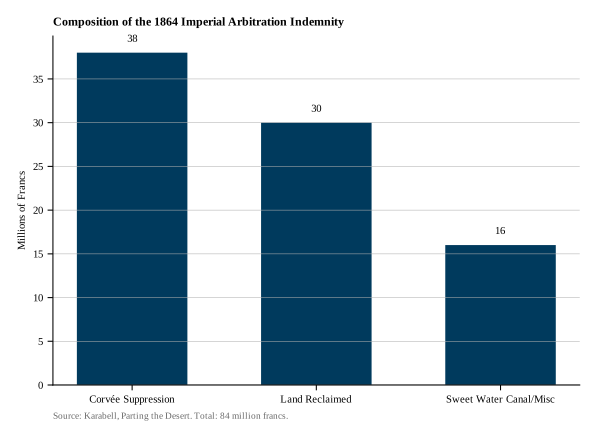
The transition from manual labor to mechanized dredging was not an evolution of efficiency but a forced financial conversion. Initially, the 1856 concession required the Egyptian government to provide four-fifths of the labor force via the corvée, a system of mandatory service that saw tens of thousands of peasants moved to the desert. When the British government protested this as a form of slavery to stall the project, Lesseps used the diplomatic crisis to trigger an arbitration by Napoleon III. The resulting 1864 award was a staggering blow to the Egyptian treasury, totaling eighty-four million francs to compensate the company for the return of land and the loss of forced labor. This indemnity was not a payment for work performed but a penalty for the cessation of work, effectively turning a “free” labor obligation into a massive cash debt. The scale of this penalty relative to the project’s costs is detailed in Figure 2, illustrating how the arbitration became the single largest financial burden on the Egyptian state during the construction phase.

Figure 2: Composition of the 1864 Imperial Arbitration Indemnity
Figure 2 uses a bar chart to itemize the components of the eighty-four million franc indemnity imposed on Egypt by Napoleon III in 1864. The vertical axis measures value in millions of francs across three categories: corvée suppression, land reclamation, and infrastructure for the Sweet Water Canal. The relationship is additive, showing that the “fine” for stopping forced labor (38 million francs) was the primary driver of this debt. This figure is central to the argument that the imperial arbitration functioned as a financial weapon, converting a political labor concession into a fixed monetary liability that Egypt could not pay without external borrowing.
The modernization of the Isthmus required the abandonment of the Nile#
The physical construction of the canal necessitated a redirection of Egyptian resources that permanently altered the country’s agricultural economy. To support the thousands of workers in the arid desert, the company required the construction of a Sweet Water Canal to bring fresh water from the Nile to the Isthmus of Suez. While this enabled the birth of cities like Port Said and Ismailia, the concession terms forced Egypt to surrender vast tracts of land alongside this new waterway to the company. When the 1864 arbitration forced the “return” of this land to Egypt, it did so at a price of thirty million francs. This created a paradoxical loop where the Egyptian state was paying to buy back its own territory, financed by loans from the same French banks that were profiting from the canal’s construction. This circular flow of capital ensured that every engineering milestone in the desert corresponded to a deepening of the financial hole in Cairo.
Debt servicing created a terminal dependency on European capital markets#
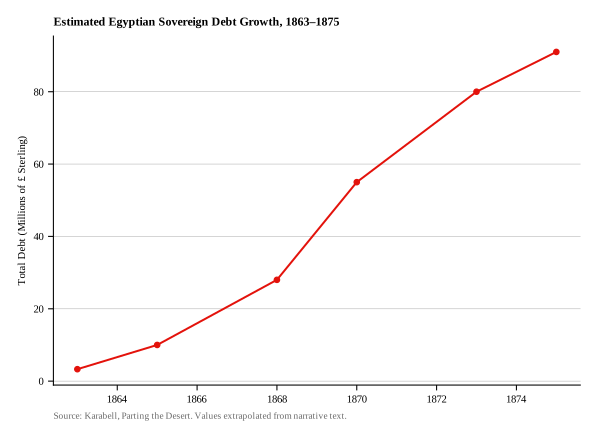
The financial pressure of the canal construction forced the Egyptian viceroys into a cycle of high-interest borrowing that far outpaced the country’s tax revenues. While the Khedive Ismail—who succeeded Said in 1863—attempted to modernize Egypt through a flurry of infrastructure projects, the canal remained the primary drain on his liquidity. By the late 1860s, Egypt was borrowing at effective interest rates often exceeding 10 or 12 percent, with much of the principal deducted upfront by European bankers as fees. The rising trend of Egyptian sovereign debt, as seen in Figure 3, shows a sharp inflection point during the canal’s final construction years. The canal, intended to be a source of national prestige and “the East opened to the West,” instead became a conduit for the East to be foreclosed upon by the West. By the time the canal opened in 1869, the Egyptian state was already effectively insolvent, spending a majority of its revenue merely to service the interest on the debts incurred to build it.
Figure 3: Estimated Egyptian Sovereign Debt Growth, 1863–1875
Figure 3 illustrates the trajectory of Egyptian sovereign debt from 1863 to 1875, with the vertical axis representing millions of pounds sterling. The relationship is exponentially monotonic, showing a sharp acceleration in borrowing that coincides with the canal’s final construction and the subsequent interest payments. The key finding is the near-vertical climb from roughly three million pounds at the start of Khedive Ismail’s reign to over ninety million pounds by the time of the share sale to Britain. This visualization substantiates the claim that the canal’s financial structure served as a terminal “debt trap” that liquidated Egyptian sovereignty. The £91 million figure for 1875 is approximately £11 billion ($14 billion) in 2020.
The 1875 liquidation completed the transfer of control to the British Empire#
The ultimate failure of the Suez Canal as an Egyptian project was codified in the 1875 sale of the Khedive’s shares. Facing a total collapse of the national treasury, Ismail offered his 176,602 shares to the British government for the sum of four million pounds sterling. This transaction, famously secured by Benjamin Disraeli with a loan from the Rothschilds, was a geopolitical coup that cost the British roughly 100 million francs—a price only slightly higher than the indemnity Egypt had been forced to pay a decade earlier for its own labor. With this sale, Egypt’s share in the company’s profits and its voice in its management vanished entirely, leaving the country as the canal’s host but not its owner. The transition from Egyptian ownership to British strategic control was the logical conclusion of a financial design that prioritized debt over equity and imperial arbitration over commercial partnership.
The Suez Canal was a triumph of 19th-century engineering achieved through the deliberate bankruptcy of the state that hosted it. This legacy suggests that infrastructure in the colonial era functioned less as a public good and more as a method of extracting sovereign autonomy through the leverage of debt.
References#
Karabell, Z. (2003). Parting the desert: The creation of the Suez Canal. Alfred A. Knopf.