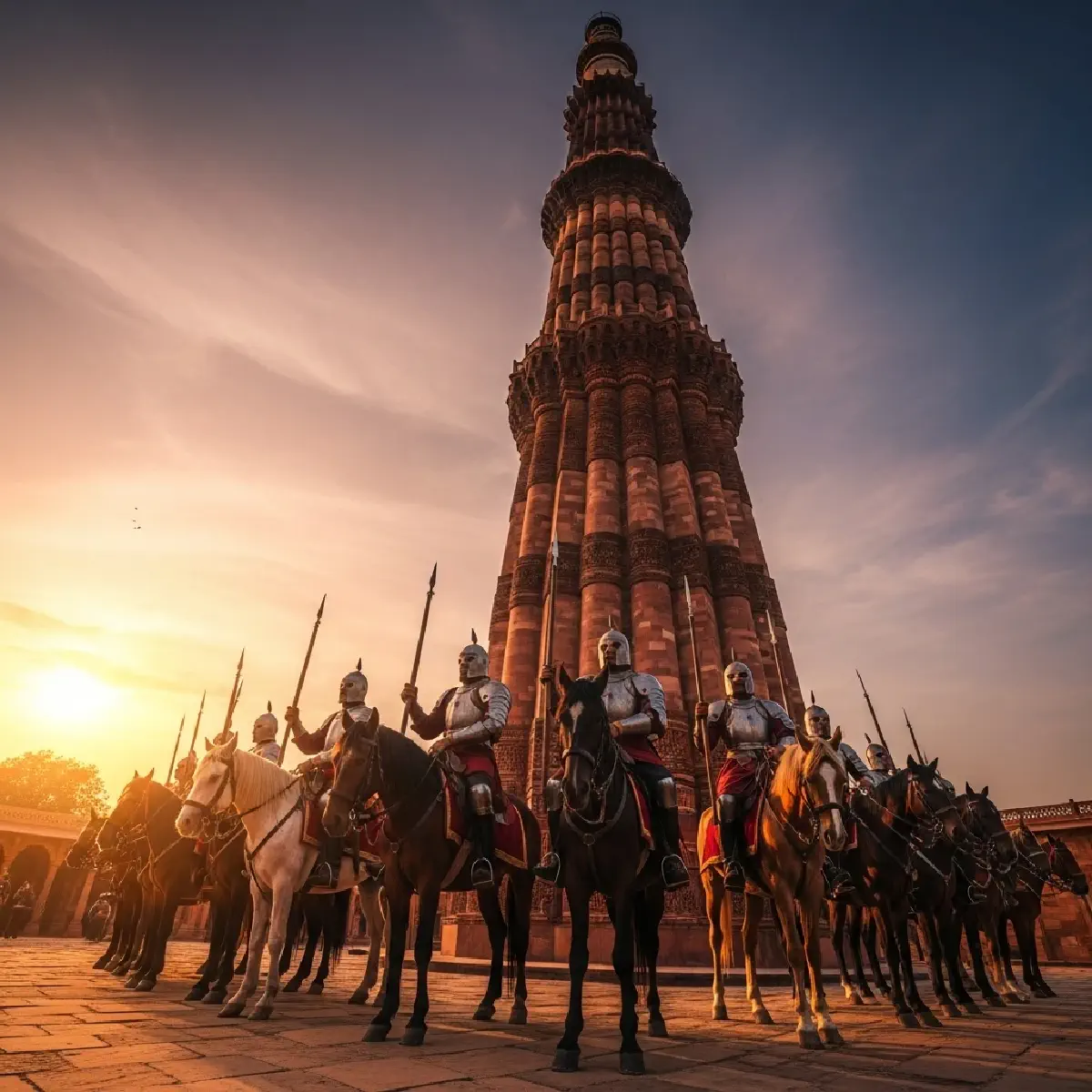
The Century of Fire and Stone#
For 350 years, the city of Delhi served as the iron heart of Islamic India. Between the 13th and 16th centuries, five successive dynasties—the Mamluks, Khaljis, Tughlaqs, Sayyids, and Lodis—governed a territory that was constantly under threat. This was the era of the “Delhi Sultanate,” a period defined by its ability to withstand the greatest military force the world had ever seen: the Mongol Horde.
The Bastion of the East#
The Delhi Sultanate was the primary reason that India did not suffer the same devastation as Baghdad or Central Asia. It served as a systemic “shield” that allowed Islamic civilization to flourish even as the caliphate’s heartlands were being leveled.
The Mechanism of the Mamluk Shield#
The Mamluk and Khalji sultans developed a specialized military system designed for one purpose: stopping the Mongols. Alauddin Khalji, perhaps the most capable military mind of the era, defeated five separate Mongol invasions. His administrative reforms, which included strict price controls and a centralized standing army, turned the Sultanate into a “total war” state. This resilience saved India from the “Calamity of the Mongols” that had destroyed the Abbasids.
The Crucible of the Refuged Scholars#
Because Delhi was the only major Islamic capital that remained unconquered, it became a sanctuary for the world’s displaced intellectuals. Thousands of scientists, poets, and theologians fled the Mongol advance in Persia and Central Asia, seeking safety in the Sultanate. This “brain drain” transformed Delhi into a global center of Persian-Islamic learning. The 8-volume “Al-A’lam” by Abdul-Hayy al-Nadwi documents the sheer density of scholars who shaped this era.
The Cascade of Southern Expansion#
The Sultanate was not merely defensive; it was aggressively expansionist. Under the Tughlaqs, the Islamic system moved south into the Deccan plateau. This expansion introduced the faith to southern India and created a patchwork of local sultanates that would eventually become the vibrant cultures of Hyderabad and Bijapur. The Sultanate’s reach now spanned from the Himalayas to the edge of the southern tip.
The Shield that Held#
The Delhi Sultanate was more than a series of dynasties; it was a survival mechanism for the Islamic world. It preserved the culture, law, and traditions of the East while the West was in turmoil. Although the Sultanate would eventually weaken and succumb to the next great wave of conquest, it had fulfilled its historical mission: it had anchored Islam in the soil of India.