The Final Links in the Chain#
By November 1875, Egypt’s financial position had deteriorated to the point where Khedive Ismail could no longer meet payment obligations on his government’s treasury bills. He had exhausted every domestic option: the mukabala internal loan of 1871, which raised £7 million from Egyptian landowners; the compulsory ruznameh loan of 1874, which yielded barely £2 million despite mandatory participation; and a series of increasingly desperate short-term borrowings from Alexandrian banking houses. What remained was a single large asset: 176,602 shares in the Suez Canal Company, representing approximately 44 percent of the company’s total capital.
Ismail offered them first to France. Paris hesitated. Benjamin Disraeli, the British Prime Minister, did not. Without consulting Parliament or his cabinet, Disraeli borrowed £4 million from Rothschild and purchased Egypt’s canal shares on behalf of the British government within 48 hours. The transaction was completed on November 25, 1875. Egypt received £4 million. The shares had cost £16 million to construct and finance. The debt they had generated had consumed £300 million from the Egyptian economy. By 1910, those shares would be worth £35 million on the open market.
The share sale was not simply a bad transaction. It was the moment when the canal’s institutional logic reached its conclusion. Britain had previously had a commercial interest in the canal remaining open and politically stable. Now it had a proprietary interest — a shareholding that required protecting. The distance between a commercial interest and a proprietary one, in the colonial politics of the 1870s, was approximately six years.
The Occupation That Debt Made Inevitable#
When Financial Control Became Political Control#
The Cave Report of 1876 established Dual Control: British and French officials appointed to supervise Egyptian fiscal management. This was presented as a temporary measure to stabilise the country’s finances and protect creditor interests. In practice, it meant that Egypt’s most senior economic administrators were appointed by, and answered to, the governments of its largest creditors.
The Dual Control arrangement did not restore fiscal stability. It imposed it through extraction. In order to meet the coupon payments due in January 1877, Egyptian tax collectors were sent to the Delta provinces with instructions to collect nine to twelve months of taxes in advance. The kurbash — a whip with five rhinoceros-hide lashes — was used systematically. The French government, confronted with reports of these conditions, declared in a statement of extraordinary audacity that “the distress alleged to exist in Egypt is fictitious.” The coupon was paid in full. The Egyptian people had financed it.
The Arabi Revolt and the Pretext for Intervention#
By 1879, the accumulated pressures of foreign financial control, unpaid military salaries, and the structural humiliation of the Dual Control arrangement had generated a serious nationalist opposition movement. Lieutenant-Colonel Ahmed Arabi, the son of a Delta farmer, organised the Wataneun — the Nationalists — around the first coherent political slogan in modern Egyptian history: Egypt for the Egyptians. The movement drew support from the army, the peasantry, and a broad coalition of Egyptians who understood, with increasing clarity, that their country’s fiscal system existed to service European debt rather than Egyptian development.
Ismail himself, by now genuinely hostile to the European advisers who had reduced him to a figurehead, was deposed in June 1879 at the joint request of Britain and France, transmitted through the Ottoman Sultan. His son Tewfik replaced him. When Arabi’s nationalist movement pressed Tewfik toward constitutional government in 1881 and 1882, Britain and France issued a joint note warning that any challenge to Tewfik’s authority would be met with force. The note, intended to stabilise the situation, had the opposite effect: it convinced Egyptian nationalists that the external threat was real and immediate, and accelerated the political crisis it was meant to prevent.
In July 1882, British warships bombarded Alexandria. In September, British forces defeated the Egyptian army at the Battle of Tel el-Kebir. In October, Arabi Pasha surrendered. The British occupation of Egypt, officially described as temporary for the next 40 years, had begun. Its stated justification was the protection of the canal and the orderly management of Egypt’s debt. Both justifications were accurate. Both had been made necessary by the concession of 1854.
The Agricultural Endpoint: A Nation That Forgot How to Feed Itself#
Cotton Monoculture and Its Logic#
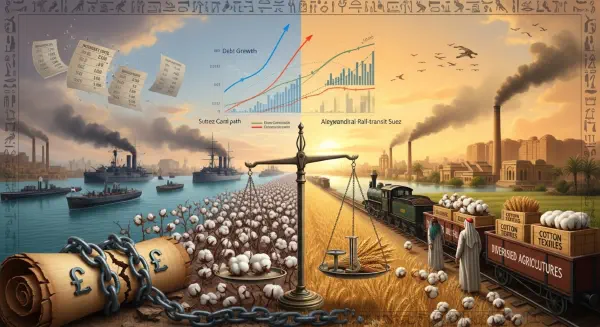
The occupation did not cause Egyptian agricultural dependence on cotton. It institutionalised a trajectory that was already underway. During the American Civil War cotton boom of 1861–1865, Egyptian farmers had shifted massively toward cotton cultivation — by 1865, the crop provided £11.8 million of Egypt’s export earnings. When cotton prices collapsed after 1865, the farmers who had shifted to cotton were trapped by debt obligations taken on during the boom years, while European merchants and landowners who had accumulated cotton-growing land during the same period retained the capacity to hold their crop through price downturns.
British administrators after 1882 accelerated this trajectory. Their interest was in maximising Egypt’s export earnings to service the consolidated debt and fund colonial administration. Cotton exports generated the hard currency that made both possible. E. R. J. Owen’s data shows the result: by 1909–1914, cotton provided 93 percent of Egypt’s export earnings. A country that had exported grain to Arabia and the eastern Mediterranean for centuries had become structurally dependent on food imports.
From Food Exporter to Food Importer#
Owen’s analysis is precise on the mechanism. Egypt did not become a net food importer around 1900 because domestic cereal yields fell. They remained broadly stable. It became a food importer because population growth and the progressive displacement of cereal cultivation by cotton — enforced by land-tenure changes that favoured large cotton operations — meant that domestic production could not keep pace with domestic demand. The land that had grown wheat and beans for Egyptian consumption was now growing raw fibre for British mills.
The 1916 Ministry of Finance cotton statistics, the most comprehensive contemporary record of this system in operation, document a country whose entire statistical infrastructure — the Railway Administration, the Irrigation Department, the Statistical Department — was organised around the movement of raw cotton from Egyptian field to European port. There is no equivalent apparatus tracking domestic food production, domestic manufacturing, or Egyptian industrial output. The Egyptian state had become an administrative extension of the export-cotton supply chain.
Sinai: The Territory the Canal Made Foreign#
There is one dimension of the canal’s cost that rarely appears in economic histories, though its consequences are visible in every map of modern Egypt. The canal bisected the country. Sinai — Egyptian territory since antiquity, administratively part of Egypt, inhabited by Egyptian Bedouin communities with roots older than Islam — was physically separated from the Nile Delta by a 193-kilometre waterway. Before the canal, Sinai was an inconvenient desert; after it, Sinai was an island accessible only by boat or tunnel.
The consequences compounded through the twentieth century in ways that no one in 1869 could have fully anticipated but that the canal’s geography made structurally inevitable. When Israel captured Sinai in 1967, the canal became the ceasefire line. Egypt lost its eastern territory at the same moment it lost its most productive waterway. The Ahmad Hamdi road tunnel, opened in 1980 to reconnect Egypt proper with North Sinai, represents an infrastructure cost that exists solely because the canal interrupted what was previously contiguous land. Every tunnel, bridge, and underpass connecting the two banks of the Suez Canal represents a cost that does not appear in any accounting of the canal’s benefits to Egypt.
What the Chain Looks Like, Laid Flat#
The argument of this series has been structural rather than moral. De Lesseps was not uniquely villainous. European bankers were not uniquely rapacious by the standards of their era. Said Pasha was not uniquely naive. The point is not that bad actors made bad decisions. The point is that the concession of 1854 created a mechanism — a sequence of logically entailed consequences — that operated largely independently of individual intentions.
The mechanism ran as follows: an unjust concession transferred Egypt’s geographic advantage to a European company. The company used forced labour and claimed compensation when that labour was abolished. The debt generated to finance the share subscription compounded through loans structured to yield less than their nominal value. The cotton boom temporarily obscured the debt trajectory while accelerating agricultural monoculture. The debt eventually consumed 80 percent of Egypt’s fiscal capacity. Fiscal collapse required the sale of the canal shares, which converted Britain’s commercial interest into a proprietary one. Proprietary interest plus nationalist opposition produced a military justification for occupation. Occupation institutionalised the cotton monoculture that had been developing since the 1860s. Cotton monoculture converted Egypt from a food exporter to a food importer. The canal that was built across the Isthmus to move the world’s goods made the eastern third of Egypt permanently harder to administer, defend, and develop.
Each link in this chain was forged by the previous one. The first link was a handshake in 1854.