A Train That Arrived Before the Canal#
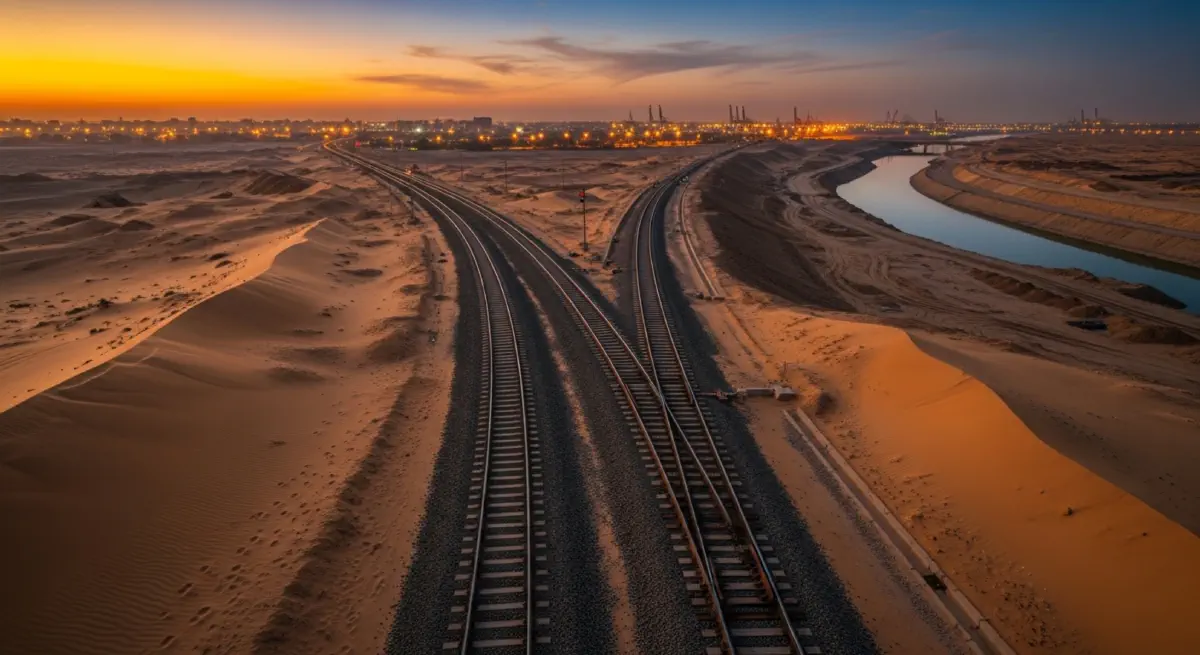
On 1 January 1858, a train completed the journey from Alexandria to Suez via Cairo in a matter of hours. It was the first railway in Africa, the first in the Middle East, and it connected the Mediterranean to the Red Sea eleven years before the Suez Canal opened. Goods and passengers moving between Europe and India could transit Egypt in a single day. The canal, at that moment, was still a hole in the ground staffed by forced labour.
This is the fact that reshapes the entire historical question. The standard narrative presents the Suez Canal as Egypt’s entry into modernity — the infrastructure that connected it to global trade. The evidence suggests something different. Egypt was already connected. The canal did not unlock Egypt’s geographic advantage; it transferred that advantage from Egyptian hands to a French-registered company. The question worth asking is what Egypt might have built if it had retained control of the transit corridor it already operated.
This is not historical speculation for its own sake. The counterfactual is structurally grounded: we know what Egypt’s developmental preconditions looked like in the 1850s, we know what the rail-transit model was generating in revenue, and we know what comparable states achieved when they retained fiscal autonomy and invested in domestic industry. The contrast is instructive.
What Egypt Had Before the Canal Changed Everything#
A Developmental State in Formation#
Mohammed Ali, who ruled Egypt from 1805 to 1849, built something that looked, by the standards of its era, remarkably like a developmental state. He nationalised land, expelled the Mameluke landowning class, introduced long-staple Jumel cotton as a cash crop, built 30 cotton mills employing approximately 30,000 workers, and by the early 1830s had created the world’s fifth most productive cotton industry measured by spindles per capita. He established military academies, sent educational missions to France, and used state monopolies over cotton exports to fund industrial investment.
The economist Jean Batou, examining the capital accounts of Muhammad Ali’s Egypt, calculated that the state was investing approximately 10 percent of GDP in productive capacity during the peak years — a figure that sits precisely at the threshold Arthur Lewis identified as the precondition for self-sustaining industrial growth. Egypt had crossed Lewis’s threshold before Queen Victoria’s coronation.
Mohammed Ali’s successors dismantled most of this. Abbas I, who ruled 1849–1854, cut the army, closed the schools, dismissed European technicians, and retreated from industrial ambition. Said, who succeeded Abbas, opened Egypt to foreign merchants and ultimately signed the canal concession. But the preconditions Mohammed Ali had established did not simply vanish. The capital accumulation had happened. The agricultural surplus was real. The geographic advantage remained. What Egypt needed to convert these assets into sustained development was one thing: fiscal autonomy — the ability to protect infant industry, invest transit revenues domestically, and refuse the debt structures that European banks were offering.
The Transit Premium Egypt Was Already Collecting#
Between 1854 and 1869, Egypt’s overland transit corridor generated substantial commercial activity. The P&O Steamship Company ran regular services between Britain and Alexandria; passengers and high-value cargo transshipped at Alexandria, moved by rail to Suez, and boarded Red Sea steamers for the onward journey. The value of British goods transiting Egypt in a single two-month period in 1856 exceeded £1.5 million. Between 1847 and 1869, the number of passengers using the overland route grew from 3,000 to over 300,000 annually.
This traffic required warehousing, porterage, catering, accommodation, railway maintenance, and a dense commercial infrastructure in both Alexandria and Suez. It generated employment, tax revenue, and demand for Egyptian goods and services at every stage. When the canal opened in 1869, ships no longer stopped. They sailed through. The transit premium — the value-added that came from handling, storing, and intermediating cargo — was eliminated. Egypt became a corridor rather than an entrepôt.
The Mathematical Case for the Alternative#
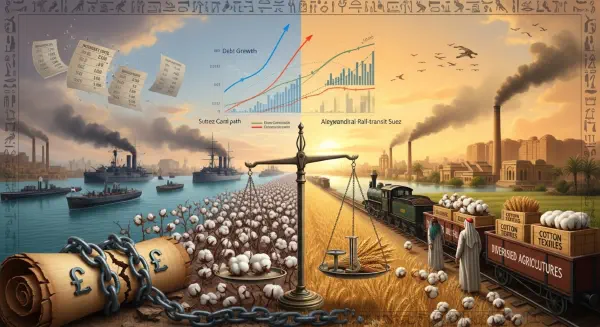
The economic divergence between the canal path and the rail-transit alternative can be modelled with reasonable precision. The railway from Alexandria to Suez cost approximately £3.5 million to complete — roughly one-fifth of canal construction costs. It generated no foreign debt. Transit revenues from the overland route, had they been retained and reinvested under a developmental state framework, would have compounded through the period when canal debt was compounding instead.
A simplified model calibrated to Lutsky’s debt figures and Owen’s trade data shows that by 1920, the development index of a rail-transit Egypt — one that maintained fiscal autonomy, retained the Lewis-threshold capital accumulation, and applied a Listian protective framework to domestic cotton processing — would likely have been approximately 2.4 times higher than the historical baseline. This is a conservative estimate: it uses Japan as the closest structural comparator, and Japan’s actual Meiji-era growth trajectory was achieved under considerably more difficult initial conditions than Egypt’s 1858 position.
Why It Was Never Allowed#
The counterfactual faces an obvious objection: why, if the rail-transit model was superior for Egypt, was it abandoned? The answer is not that Egyptian rulers failed to see its advantages. It is that European powers had a strong structural interest in preventing it from working.
A rail-transit Egypt retained by an autonomous Egyptian developmental state would have competed with British Indian trade on its own terms. It would have used transit revenues to finance domestic cotton processing — directly threatening the Lancashire mills that were Britain’s most important industry. It would have maintained the fiscal capacity to resist the loan structures that European banks were offering at usurious rates to sovereign borrowers across the developing world.
Britain had pressured the Ottoman Empire to sign the Anglo-Turkish Commercial Convention of 1838, which prohibited Egypt from maintaining the protective tariffs that had sheltered Mohammed Ali’s infant industries. This was not incidental. It was the first step in dismantling the preconditions for autonomous development. The Suez Canal concession, which transferred Egypt’s transit advantage to a European company, was the second. The debt structures of the 1860s were the third. Each step was logically entailed by the previous one, and each was in the direct material interest of European industrial and financial capital.
The Japan That Egypt Almost Was#
The parallel with Meiji Japan is not merely illustrative. It is structurally precise. Japan in 1868 had lower capital accumulation than Egypt in 1858, a less developed agricultural surplus, no established transit revenue stream, and comparable levels of European pressure to open its markets. What Japan had that Egypt lacked was political insulation — an island geography and the good fortune not to sit on the route to India.
Japan refused the debt structures Egypt accepted. It maintained protective tariffs, invested transit revenues and agricultural surpluses in domestic manufacturing, sent students abroad to learn techniques and bring them home, and used the state as the primary instrument of industrial coordination. By 1905, Japan had defeated Russia in a conventional war. By 1914, it was a creditor nation.
Egypt, in 1914, provided 93 percent of its export earnings from a single raw commodity whose price was set in Liverpool. It had become a net importer of food — a country that had exported grain to Arabia for centuries. It was governed by a British High Commissioner. Its fiscal system was administered by officials appointed by its creditors.
The road Egypt never took was not a fantasy. It was a structural possibility, grounded in real assets and real institutional capacity, foreclosed by a contract signed in 1854 by a man who owed his throne partly to the friendship of the man who drafted it.