The Numbers That Tell the Story#
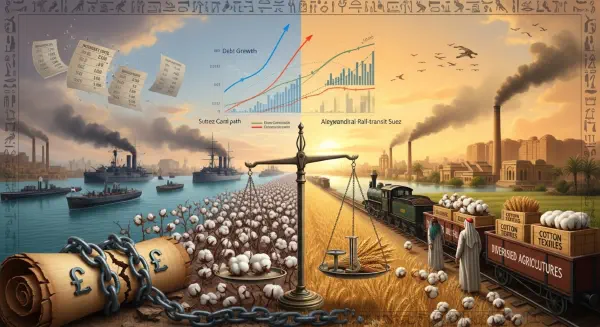
In 1862, Egypt’s sovereign debt stood at approximately £6 million — significant, but manageable against an annual budget that had grown from £2 million to over £5 million during the cotton boom of the early 1860s. By 1875, that debt had reached £100 million in nominal terms. The Egyptian people would ultimately pay £300 million in principal and interest to European bankers before the cycle was broken by British occupation — an occupation that was itself a direct consequence of the debt. In 1875, Egypt sold the canal shares it had been manipulated into holding for £4 million: roughly one-quarter of what it had cost to build the canal, and one seventy-fifth of what the debt had extracted.
These are not figures from an anti-colonial polemic. They appear in the 1876 Cave Report, commissioned by the British government itself to document the state of Egyptian finances. The arithmetic of ruin was so visible, so precisely recorded, that even Egypt’s creditors could not dispute it. What they disputed — successfully — was responsibility.
Understanding how £6 million became £100 million requires following the debt mechanism through three distinct phases: the initial loans and their hidden costs; the compounding interest structures that ensured Egypt’s receipts were always less than its liabilities; and the political leverage that made renegotiation impossible.
How European Bankers Turned Debt into a Perpetual Claim#
The Discount That Wasn’t Disclosed#
Every major Egyptian loan of the 1862–1875 period followed the same structural pattern. Egypt received significantly less than the loan’s nominal value — the difference was retained by the contracting banks as “difference in exchange value,” commission, and emission fees — but was required to repay the full nominal amount plus interest. The 1862 Oppenheim loan had a nominal value of approximately £3.3 million; Egypt received closer to £2.1 million in usable funds. The 1864 Frühling and Goschen loan nominally totalled £5.7 million; Egypt received £4.86 million. The gap between what was borrowed and what was received — approximately £22 million across all loans in this period, by Lutsky’s accounting — was counted in full against the Egyptian debt.
This was not a market anomaly. It was standard practice in nineteenth-century sovereign lending to emerging states, refined over decades of operations in Latin America, the Ottoman Empire, and Tunisia. The mechanism worked precisely because borrowing governments lacked the technical capacity to fully evaluate the terms and the political leverage to refuse them. Said Pasha had agreed to the first loans because the canal construction created obligations that could not be met from ordinary revenue. Ismail had extended the borrowing because each new loan was used partly to service the previous one — a cycle that required increasing nominal amounts to maintain the same real cashflow.
The Interest Trap and the Pledged Revenues#
By 1875, Egypt’s annual debt service had reached approximately £8 million against a total government income of £10.5 million. Eighty percent of the state’s fiscal capacity was committed to foreign creditors before a single school, irrigation canal, or hospital could be funded. The remaining 20 percent had to cover military salaries, judicial functions, infrastructure maintenance, and the personal expenses of a court that had grown accustomed to Khedival grandeur.
The mechanism that made this ratio stable — and therefore permanently extractive — was the pledging of specific revenue streams as security for individual loans. The 1864 loan was secured against revenues from three of the Delta’s richest provinces. Later loans consumed customs revenues from Alexandria and Cairo, tobacco excises, and the income from the Khedival Daira estates. Each pledge removed a revenue stream from Egyptian control and placed it under the supervision of a foreign debt commissioner. By 1876, the Egyptian state’s most productive fiscal assets were administered by representatives of its creditors. The state had become, in functional terms, a tax-collection apparatus for European banks.
The Cost of Ending Forced Labour#
The 84 million franc arbitration award of 1864 — the penalty Egypt paid for abolishing corvée construction labour — deserves particular attention because it reveals the legal architecture underlying the entire enterprise. When Ismail Pasha ended the forced-labour requirement on humanitarian grounds in 1863, the Suez Canal Company claimed breach of contract and demanded compensation for the additional expense of replacing fellahin with mechanical dredgers.
Napoleon III arbitrated the dispute. He awarded 38 million francs for the loss of corvée labour, 30 million for land returned to Egypt, 10 million for work on the freshwater canal, and 6 million for anticipated toll revenues. The total — 84 million francs — represented approximately 2.1 billion in today’s terms. Egypt paid this sum, which it did not have, by borrowing it at rates that added further to the debt spiral. The political economics of this transaction were precise: Egypt was fined for ending a practice that international opinion had condemned as slavery, by an arbitrator who was related by marriage to the man who had imposed that practice as a contractual right.
What the Cotton Boom Concealed#
The years between 1861 and 1865 were anomalous for Egypt in ways that temporarily obscured the debt trajectory. The American Civil War had destroyed most of the world’s exportable cotton supply — the United States had provided five-sixths of European cotton before the war — and Egyptian long-staple cotton commanded extraordinary prices. Egypt’s export earnings rose from approximately £1.1 million in 1860 to £11.8 million in 1865. For those five years, the debt problem looked manageable.
This obscured the structural damage in two ways. First, Ismail used the cotton boom revenues not to retire debt but as collateral to borrow more, on the reasonable expectation that high cotton prices would continue. Second, the boom accelerated the conversion of Egyptian agriculture from diversified production toward cotton monoculture — a shift that would prove catastrophic when prices collapsed after 1865. By 1866, Egyptian fair cotton had fallen from 30 pence per pound to 21 pence. The collateral had depreciated; the loans remained; and the interest continued to compound.
David Landes, drawing on the private correspondence of Alexandrian bankers, documented that by autumn 1863 — less than nine months into the cotton boom — the Khedive already owed the two leading banking houses in Alexandria approximately 40 million francs on current account alone. The boom had not solved the debt problem. It had made it possible to extend the boom problem until it was no longer containable.
The Cave Report’s Verdict#
In November 1875, the British government sent Stephen Cave to Egypt to assess the state of its finances. His report, submitted in April 1876, was comprehensive and damning. It documented the gap between nominal loan values and actual receipts, the pledging of specific revenue streams, the debt-service ratio, and the accumulated cost to the Egyptian treasury.
Cave calculated that Egypt’s interest in the canal — which had cost £16 million to build and had generated £100 million in nominal debt — had been sold for £4 million. He noted that the debt had cost the Egyptian people £300 million in principal and interest paid to foreign bankers. He observed that by 1876, Egypt’s annual debt service exceeded its annual revenues by margins that made solvency mathematically impossible without either debt restructuring or the kind of fiscal extraction that would destroy the agricultural economy it relied upon.
The report did not result in debt relief. It resulted in Dual Control — the imposition of British and French officials to supervise Egyptian fiscal management, nominally to protect creditor interests. Egypt had been diagnosed with a condition caused by its creditors and was now to be managed by those same creditors in perpetuity. The arithmetic of ruin had produced its logical institutional outcome: the elimination of Egyptian fiscal sovereignty without the administrative inconvenience of formal annexation.
Formal annexation came six years later anyway.