When Friendship Becomes Policy#
In November 1854, Mohammed Said Pasha had been Viceroy of Egypt for exactly two weeks when he granted his old friend Ferdinand de Lesseps the right to build a canal across the Isthmus of Suez. The concession document opened with the words “Our friend M. Ferdinand de Lesseps, having called our attention…” — a phrase that tells you almost everything about what followed. This was not a diplomatic negotiation between equals. It was a favour extended by a man who had known de Lesseps since childhood to a man who had spent years cultivating precisely that relationship for precisely this moment.
De Lesseps’s father had helped Mohammed Ali — Said’s own father — consolidate power in the early years of the nineteenth century. Ferdinand himself, assigned to manage the French Consulate in Alexandria, had befriended the young Said at a time when the boy was on a punishing diet imposed by his father, who considered his son’s corpulence an embarrassment. De Lesseps fed him spaghetti in secret. Twenty years later, Said signed over Egypt’s most strategically valuable geographic asset to the man who had once smuggled him pasta.
The personal dimension is not incidental. It is structural. Said lacked both the technical expertise to evaluate what he was signing and, more importantly, the political independence to refuse. Egypt was nominally a province of the Ottoman Empire. Said had no authority to sign concessions of this magnitude without Ottoman approval — a requirement he and de Lesseps quietly bypassed. When the Porte objected, de Lesseps simply continued construction and presented Istanbul with facts on the ground.
What the Concession Actually Said#
The 1854 and 1856 concessions together created a legal architecture that would drain Egypt for the next two decades. Understanding their precise terms is essential, because the damage was not caused by a canal — it was caused by a contract.
The Profit Share That Wasn’t#
The Compagnie Universelle du Canal Maritime de Suez was structured so that Egypt received 15 percent of annual net profits. France’s investors received 75 percent. The remaining 10 percent went to the company’s founders. On the surface this looks merely inequitable. In practice it was worse: the company defined “net profit” after deducting all operating costs, depreciation, and management fees — categories it controlled entirely. Egypt had no audit rights and no seat from which to contest these calculations.
The 1856 firman compounded the problem. Egypt was required to provide, free of charge, all land and quarries needed for construction. It was required to build a freshwater canal from the Nile to supply the construction zone with drinking water — at Egyptian expense. It was granted exemption from customs duties for all company imports. In other words, Egypt provided the land, the water, the logistics, and the fiscal concessions, while retaining 15 percent of whatever the company chose to declare as profit.
The Labour Clause and Its Cost#
The concession gave the company the right to recruit Egyptian fellahin — peasant farmers — for construction labour through the corvée system, a form of conscripted work with roots in Pharaonic administration. At peak construction, between 20,000 and 60,000 men were working the Isthmus at any given time, cycling in and out in rotations that pulled them from their fields during critical agricultural seasons.
Mortality estimates range widely. Conservative figures cite 30,000 deaths over the construction period; other sources place the figure at 120,000. What is not disputed is that the workers were not volunteers, were not adequately compensated, and died at rates that drew international criticism even from governments that had little sympathy for Egyptian interests. When Ismail Pasha, Said’s successor, unilaterally abolished the corvée in 1863 on humanitarian grounds, the Suez Company claimed breach of contract and sued Egypt for damages. The arbitrator was Napoleon III — who happened to be a cousin of de Lesseps’s wife. He awarded the company 84 million francs in compensation. Egypt was fined for ending forced labour.
The Share Subscription That Wasn’t Voluntary#
When de Lesseps opened subscriptions for the canal company in 1858, he reserved shares for Britain, the United States, Austria, and Russia on the assumption that international participation would legitimise the enterprise. All four declined. Rather than reduce the company’s capitalisation, de Lesseps pressed Egypt to absorb the unsold shares. Said, who had originally agreed to subscribe to 64,000 shares, found himself holding 176,602 — roughly 44 percent of the entire capital — before he fully understood what had happened.
Egypt became the company’s majority shareholder not by strategic calculation but by diplomatic manipulation. And it financed that shareholding not from surplus revenues but from borrowed money, at interest rates that would compound into catastrophe over the following decade.
A Geography Misread as a Gift#
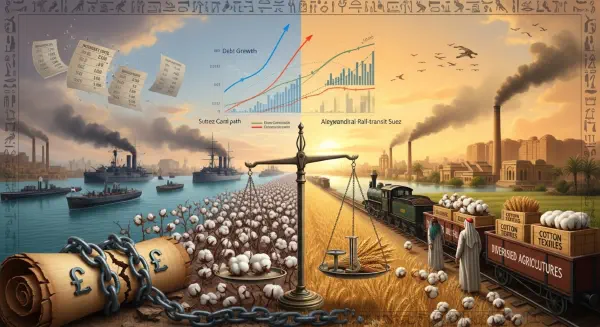
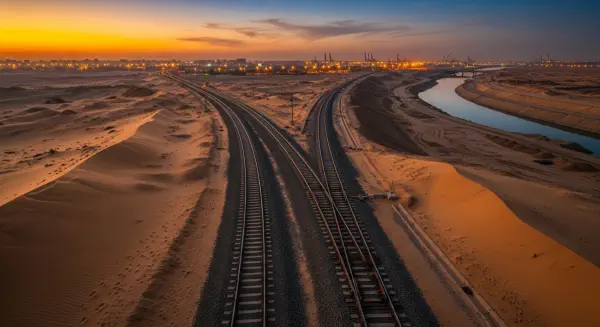
Egypt’s geographic position — straddling the shortest route between European and Asian markets — was not a passive asset waiting to be unlocked by a canal. It was an active economic mechanism that Egypt had been operating, profitably, for centuries. The overland transit route from Alexandria to Cairo to Suez, formalised by rail from 1858 onwards, was already functioning as a modern commercial corridor. In 1854, Egypt ranked fifteenth as a source of British imports. By 1860, before the canal existed, it had climbed to sixth — driven by transit trade and cotton exports moving through Egyptian-controlled infrastructure.
Mohammed Ali, Said’s father and Egypt’s most consequential moderniser, had understood this clearly. When British interests first proposed a railway across the Isthmus in the 1830s, Mohammed Ali refused — not because he opposed modernisation, but because he recognised that any externally financed infrastructure project would eventually transfer control along with the asset. His instinct was correct, and his son ignored it.
The canal did not create Egypt’s geographic advantage. It transferred that advantage — from Egypt to a French-registered company whose shareholders were overwhelmingly European and whose profits would flow to Paris and London rather than Cairo.
The Asymmetry That Would Define the Century#
Said Pasha died in January 1863, eight years before the canal opened, and before the full weight of what he had signed became visible. His successor Ismail inherited the shares, the debt used to finance them, the construction liabilities, and the diplomatic entanglements — without having agreed to any of them.
What Said had created was not merely a bad contract. He had created a mechanism. Each clause generated obligations; each obligation required borrowing; each loan created leverage for European creditors to extract further concessions. The corvée compensation was only the first iteration. There would be many more.
By the time the canal opened in November 1869 — celebrated with an opera commissioned from Verdi, a ceremony attended by the Empress Eugénie, and festivities that cost Egypt £1.3 million it did not have — the financial trap had already closed. Egypt owed money it could not repay, secured against revenues it did not yet control, to creditors who had every institutional incentive to ensure the debt was never fully retired.
The handshake in 1854 had not built a canal. It had built a claim on Egypt itself.