
The Canal That Broke Egypt: How a Ditch Became a Debt Trap
Key Insights#
The Suez Canal concession of 1854 was not a diplomatic agreement between equals. It was a document extracted from a newly installed ruler by a lifelong friend who had spent years positioning himself for precisely this moment. The personal origin of the concession explains why its terms were so structurally predatory: there was no adversarial negotiation.
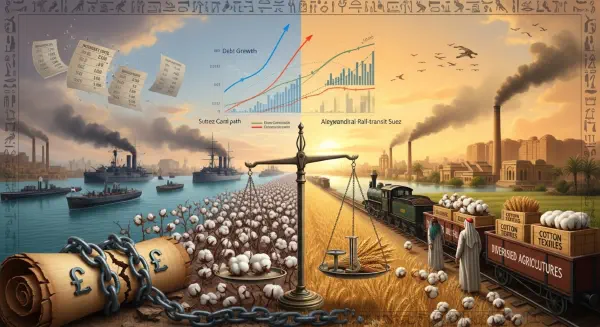
The damage was not caused by the canal’s existence. It was caused by the concession’s legal architecture — the 15 percent profit share, the free land grants, the corvée labour clause, and the forced share subscription that made Egypt the company’s majority shareholder against its fiscal interests.
The debt mechanism that followed was systematic, not accidental. European loans of this era were structured to yield significantly less to the borrower than their nominal value while requiring repayment of the full amount. The gap between Egypt’s receipts and its liabilities — approximately £22 million by Lutsky’s calculation — was counted in full against the Egyptian debt.
Egypt had a functioning developmental state in formation under Mohammed Ali. By the 1850s, Egypt had crossed Arthur Lewis’s 10 percent capital accumulation threshold for self-sustaining industrial growth. The canal concession did not interrupt Egypt’s pre-modern stagnation; it interrupted a real developmental trajectory with measurable momentum.
The rail-transit alternative was not speculative. Egypt had completed the Alexandria-Suez railway in 1858, eleven years before the canal opened. The transit premium from this corridor — warehousing, porterage, commerce — was generating substantial domestic economic activity. The canal eliminated this activity by converting Egypt from an entrepôt into a corridor.
The occupation of 1882 was the institutional endpoint of a financial sequence that began in 1854. Britain’s purchase of Egypt’s canal shares in 1875 converted its commercial interest in the canal into a proprietary one. Proprietary interest plus Egyptian nationalist resistance produced the military justification for occupation. The sequence was logically entailed, not improvised.
Cotton monoculture — Egypt providing 93 percent of its export earnings from a single raw commodity by 1909–1914 — was not a market outcome. It was enforced by the fiscal conditions of debt repayment, the land-tenure changes promoted by the occupation, and the occupying power’s direct commercial interest in keeping Egypt as a raw-material supplier to British industry.
The canal bisected Egypt’s territory, converting Sinai from an administered interior into a functionally insular appendage. Every subsequent cost of reconnecting Egypt to Sinai — tunnels, bridges, security operations — is a cost that flows from this bisection and does not appear in any accounting of the canal’s benefits to Egypt.
References#
- Landes, D. S. (1958). Bankers and pashas: International finance and economic imperialism in Egypt. Harvard University Press.
- Lutsky, V. B. (1969). Modern history of the Arab countries (L. Kanassar, Trans.). Progress Publishers.
- Owen, E. R. J. (1969). Cotton and the Egyptian economy, 1820–1914: A study in trade and development. Clarendon Press.
- Hallberg, C. W. (1931). The Suez Canal: Its history and diplomatic importance. Columbia University Press.
- Sabry, M. (1933). L’empire égyptien sous Ismaïl et l’ingérence anglo-française. Paul Geuthner.