The Subsidy Paradox#
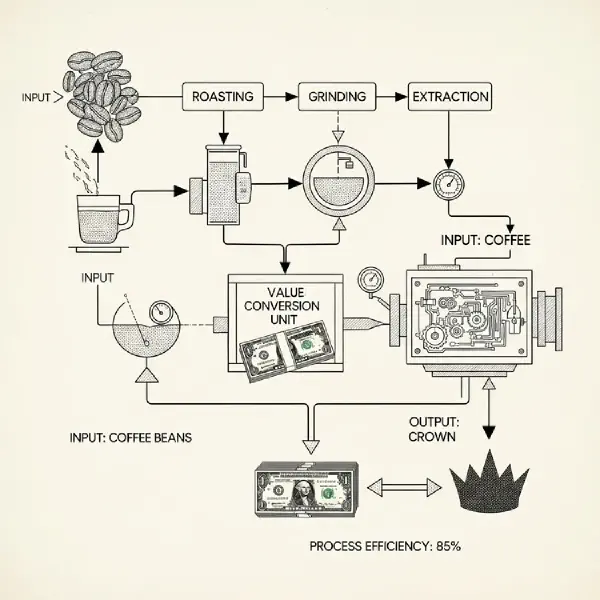
By the late 1980s, the international price of coffee had collapsed, plunging the Rwandan state into a severe fiscal crisis. The regime faced a fundamental problem: the producer price required to keep farmers loyal was higher than the price the state received on the world market. In 1987 and 1989, international prices fell so dramatically that the government was forced to reduce social services by 40%. To prevent a total loss of political support, the Habyarimana regime began heavily subsidizing the coffee sector. In 1990 alone, the coffee subsidy reached 4.6 billion RWF (approximately $51 million USD at the time). Despite these efforts, the real income of the farmers plummeted; by 1991, a bag of coffee could only purchase half the goods it could in 1980. This economic decay eroded the “price of loyalty,” making the population increasingly receptive to alternative political movements.
The Thesis of the Coercive Pivot#
When a dictator can no longer afford to buy loyalty through economic rewards, they must substitute repression to maintain power. The Habyarimana regime, identified as a totalitarian type of dictatorship, maximized power over the population rather than simply seeking personal wealth. As the coffee budget shrank, the regime shifted its strategy toward “immiserization,” using violence and property confiscation to prevent the population from funding an opposition. Genocide emerged not as an accidental outburst of ethnic hatred, but as a deliberate “double-corner solution” in the loyalty-repression model. By buying the extreme loyalty of one group through the promised spoils of exterminating another, the elite attempted to secure their survival against a backdrop of economic failure and civil war.
The Conflict of the Canopy#
The economic crisis was worsened by a direct competition for land between coffee and bananas. Bananas were a more attractive crop for peasants because they provided a year-round source of food and income through the sale of banana beer in domestic markets. Banana cultivation required less labor than coffee and was highly valued in social life. However, the Habyarimana regime actively discouraged banana cultivation because it competed for the same land as coffee, which was the primary source of foreign exchange for the state. As the real value of coffee declined, farmers began to uproot their coffee trees in secret, despite the legal penalties. Surveys from 1992 indicated that if the price fell to 100 RWF per kg (0.45 RWF per lb), at least 10% of farmers would destroy their plants, a significant act of defiance in a highly controlled society.
The Architecture of the “Zero Network”#
As the economic foundation of the regime crumbled, a small group of extremists known as the “zero network” or the Akazu became the dominant force in Rwandan politics. This group, centered around the presidential clan, viewed the country as a private enterprise and sought to extract as much profit as possible. They were responsible for inciting ethnic tensions to mask their own interests during the political crisis of the early 1990s. In 1988, the murder of Colonel Mayuya, a top leader and potential successor to the president, signaled that internal competition for shrinking resources had turned lethal. The “zero network” began preparing a plan for genocide as a political strategy to retain control. They replaced the expensive system of buying loyalty through coffee prices with a cheaper alternative: the mobilization of unemployed youth into militias trained for mass murder.
The Double-Corner Solution of 1994#
The outbreak of civil war in 1990 provided the regime with an ideological tool to replace lost economic incentives. The government used extremist propaganda based on Hutu supremacy to increase the supply of loyalty from the Hutu population at a low cost. This ideology told the Hutu farmer that their pride and identity were tied to the survival of the Hutu-led regime, regardless of their poverty. During the genocide in 1994, the “price” paid for loyalty shifted from coffee revenue to material rewards obtained through violence. Participants were encouraged to loot houses, appropriate land, and extract cash from their victims. This created a “double-corner solution”: maximum loyalty was secured from the Hutu majority through the promise of stolen assets, while maximum repression was exercised against the Tutsi minority and Hutu political opponents.
The Legacy of Sustained Failure#
The Rwandan genocide was not the inevitable result of overpopulation or ancient tribal hatreds, but a political outcome of a failing coffee-based dictatorship. The regime’s desire to stay in power at any cost led it to transform a peaceful agricultural population into a genocidal force. Foreign aid played a significant role in this process; between the mid-1980s and 1994, foreign aid became more important to the state budget than coffee exports. This external funding allowed the Habyarimana regime to sustain its military and administrative apparatus even as the national economy collapsed. However, this aid did not reach the farmers, leaving them vulnerable to the regime’s manipulation. The tragedy of 1994 demonstrates that when the economic mechanisms for buying political loyalty fail, the survival instincts of a totalitarian elite can lead to the ultimate form of repression.