The Birth of a New Unity#
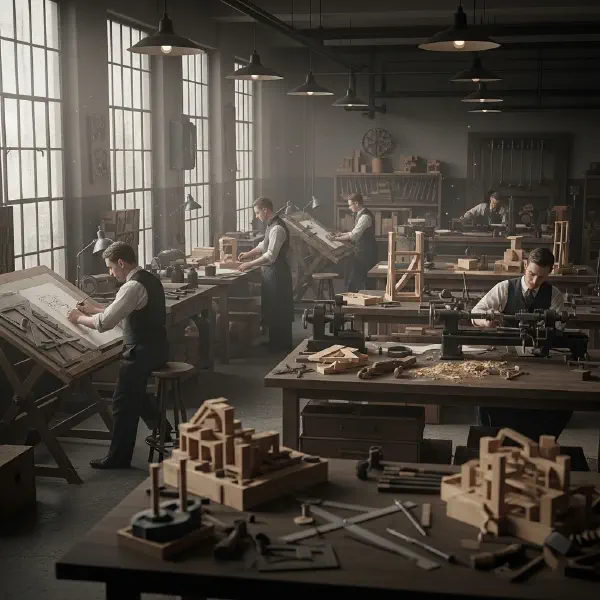
In 1919, amidst the smoldering ruins of post-war Europe, an architect named Walter Gropius issued a manifesto that would reverberate for a century. He proposed a radical merger of the Weimar Academy of Arts and the School of Arts and Crafts to form the “Staatliches Bauhaus”. Gropius sought to heal the divorce between the creative “artist” and the practical “maker” that had been torn asunder by the Industrial Revolution. The school was conceived not merely as a technical college but as a “school of life,” where students lived in a closed community of intellectual discovery. This Weimar phase was characterized by a search for “New Unity” between art and technology. Paradoxically, the movement that birthed modern minimalism began with an intense preoccupation with the individual’s spiritual relationship to materials. This early period was a crucible where esoteric beliefs and rigorous craftsmanship competed to define the future of human shelter.
The Thesis of Civilizational Reform#
The central claim of this analysis is that the Bauhaus was not a mere stylistic movement but a fundamental “remaking of making” intended to restore human dignity to an industrialized society. This matters because we currently live in an almost completely designed world where the quality of our objects dictates our subjective well-being. We must understand how these early pioneers attempted to reconcile the cold efficiency of the machine with the warm needs of the human soul.
The Foundation of the Preliminary Course#
The intellectual heart of the Bauhaus was the obligatory “foundation course,” introduced in 1919 by Johannes Itten. Its purpose was to strip away the students’ “sixteen years of miseducation” and foster an intuitive, sensory relationship with raw materials. Students were encouraged to experiment with wood, metal, and fabric to discover the “truth to materials” before ever designing a product. This inductive approach to learning meant that theory did not lead the way; instead, it was distilled from the physical act of making. By mastering the “eidetic marks” of a material, designers learned to create objects that performed their functions perfectly because they respected their own physical nature.
The Crucible of Artistic Conflict#
Despite its rational goals, the Weimar Bauhaus was a site of profound social and ideological tension. Gropius appointed abstract and cubist painters like Wassily Kandinsky and Paul Klee to teaching posts, believing that their visual grammar was essential for industrial design. However, a pervasive duality arose between the “Master of Form” (the artist) and the “Master of Craft” (the technician). Tensions flared as the autonomous artist often remained the center of attention, while the technician was relegated to a subordinate role. Furthermore, the school’s early years were colored by esoteric influences, including astrology and anthroposophy, which sat awkwardly alongside its technological ambitions. This conflict proved that “form follows function” was not a prescriptive formula but a difficult, ongoing negotiation between human desire and material reality.
The Cascade of Domestic Revolution#
The ripple effects of the Weimar phase began to manifest in the “type furniture” that aimed to overhaul the petit-bourgeois living room. Designers like Marcel Breuer experimented with the strength of tubular steel, creating chairs that were both lightweight and indestructible. This was a radical break from the dark, heavy furniture of the nineteenth century that cluttered the homes of the middle class. The goal was to provide “affordable furniture for the average consumer” that could be mass-produced without sacrificing quality. By 1923, the school staged a landmark exhibition that featured graphics and furniture that would eventually become the DNA of modern interior design. This cascade of innovation proved that design could be a “world-making” enterprise, capable of shaping society by shaping its everyday tools.
The Synthesis of the Designed Self#
The Weimar Bauhaus reminds us that “design is the most powerful tool yet given man to shape his products and himself”. It teaches us that success in design is a “learning process” that requires a constant feedback loop between the mind and the material. We learn that “success through failure” is achieved when designers have the courage to experiment with “no idea being a stupid idea” until they find the best fit for human needs. The Bauhaus legacy is not found in the museums that now house its artifacts but in the way we perceive ourselves through the objects we use. As we move into an increasingly artificial age, we must reclaim the Bauhaus spirit of “dedicated synthesis” to ensure our environments serve human flourishing rather than mere consumption. The longest journey of design began with these first steps in Weimar, and it is a journey we are still taking today.