The Search for the “Turkish Red”#
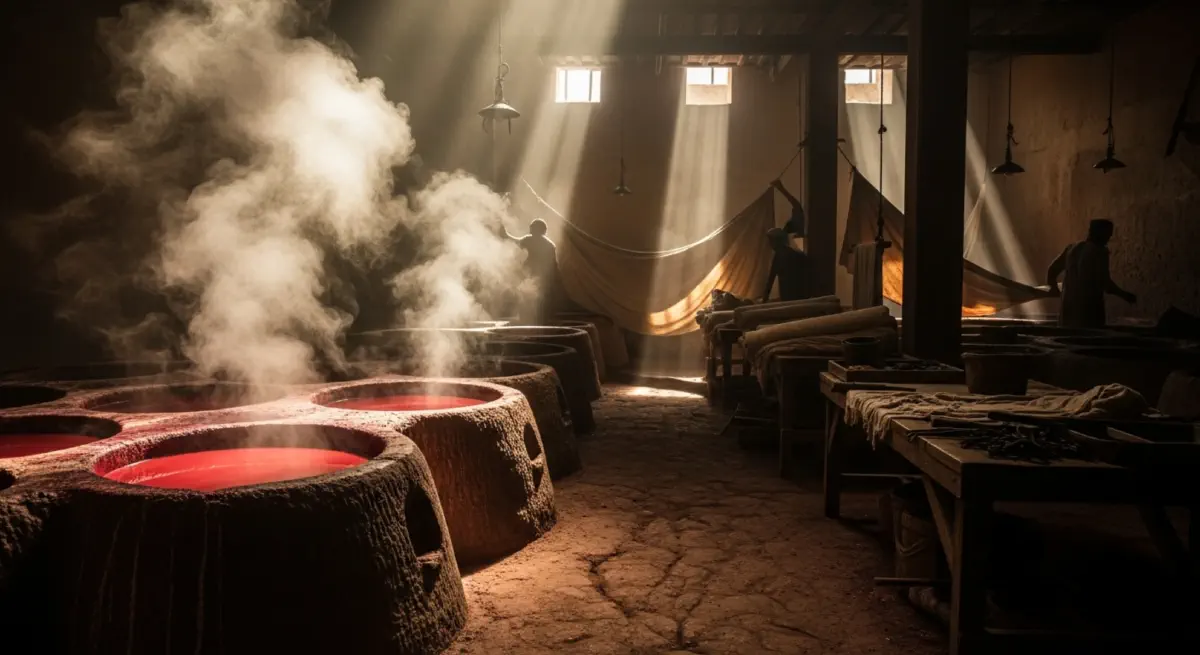
The 18th century was an era where the West viewed the East as a laboratory for technological harvesting. One of the most coveted secrets was the “Red of Adrianople” (Andrinople Red), a dye so vibrant and permanent that European chemists were baffled by it. While Western slogans touted the “Scientific Revolution” as a triumph of European theory over Eastern “superstition,” French “scientific” missions were actually sent to the East to engage in what we would today call “industrial espionage”.
The Theft of Practical Chemistry#
The West claims its scientific superiority came from the laboratory, but much of its chemical progress came from observing the “practical chemistry” of Eastern workshops. The “theft of history” included the theft of the chemical processes that made modern industry possible.
The Crucible of Scientific Espionage#
The Mechanism of Secret Harvesting#
The French government and private investors funded “journeys of discovery” that were, in reality, data-gathering missions for industrial secrets. A notable example is M. Granger, a French physician who traveled to Egypt in 1730 disguised as an Arab, walking barefoot to avoid suspicion, specifically to “steal” the secret of manufacturing sal ammoniac. This chemical was essential for European medicine and industry, and Egypt was the only place in the world producing it “industrially” at the time.
The Interdisciplinary Lens of Chemistry and Power#
European scientists like Claude-Louis Bertholet, who accompanied Napoleon’s campaign, were not just “discovering” new things; they were “interpreting” existing Eastern techniques for Western consumption. Bertholet spent days in local Egyptian dyeing workshops, recording the use of “safflower” (Carthamus) to dye cotton—a technique French صباغون (dyers) had failed to master for a century. Once these processes were documented, they were published in European journals as “scientific discoveries” by the Western observer, with the local artisan’s name erased from the record.
The Cascade of Intellectual Enclosure#
The consequence was the “standardization” of Eastern knowledge into Western patents. By the 19th century, techniques such as “steam bleaching”—used for centuries in the East—were patented in France and England as “the Chaptal method”. The local origins of “Henna” as a dye for silk in Lyon were similarly obscured, eventually being patented by French manufacturers who imported the raw material from colonized Algeria.
The Laboratory of the Dispossessed#
The Western narrative of the “Scientific Revolution” conveniently ignores the barefoot “spies” like Granger who were the real conduits of chemical knowledge. Modern chemistry was not born in a vacuum; it was built on the “unwritten” knowledge of Egyptian and Ottoman artisans whose “fools’ work” provided the foundation for Western industrial wealth. The hubris of Western science lies in its claim to have “created” what it merely “recorded” and “stolen”.