The Trevor-Roper Fallacy and the Invention of Progress#
For decades, Western textbooks maintained that the three centuries between 1500 and 1800 were a period of European exclusive activity, the “foundations of the modern world”. This narrative suggests that while Copernicus, Galileo, and Newton were unlocking the universe, the rest of the planet sat in a state of “stagnation and lethargy”. The British historian Hugh Trevor-Roper famously embodied this hubris, claiming that world history was essentially European history, and there was no need to apologize for such “Eurocentrism”. This was not merely a bias; it was a systematic intellectual enclosure act.
The Arrogant Claim to the Global Center#
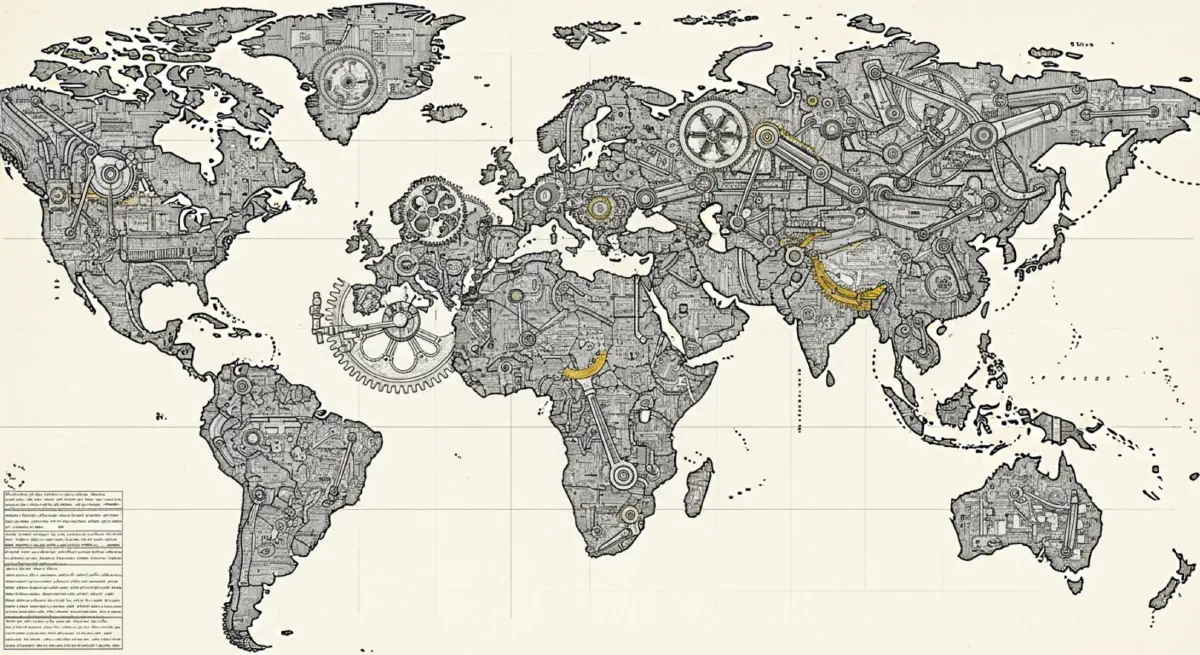
Modernity, as defined by the Western canon, is treated as a European gift to a “backward” world that only entered history upon contact with the West. This series argues that the West did not invent modernity; it synthesized, appropriated, and often stole the innovations of a multi-centric global system.
The Crucible of Historical Erasure#
The Mechanism of Diffusionism#
The West utilized a “diffusionist approach,” a psychological and academic framework asserting that culture has a single European center from which it spreads to the periphery. Under this lens, Ottoman Egypt was labeled as having “two or three centuries of backwardness,” a convenient label that justified subsequent colonial intervention. By portraying the Ottoman era as the “absolute point of decline,” Western historians could present themselves as the enlightened rescuers of a primitive people.
The interdisciplinary Lens of Stagnation#
From the perspective of both 19th-century Marxism and Hegelian philosophy, large swaths of the non-European world—India, Africa, and the Ottoman Empire—were considered “outside of history”. Karl Marx described China as a “giant empire… standing still while time turns around it,” a view that mirrored the Hegelian belief that these regions were stagnant until they adopted the European model. This intellectual hubris ignored the reality that Ottoman Egypt was a vibrant society, effectively adapting to global crises and achievements.
The Cascade of Colonial Justification#
The consequence of this erasure was the “Mission Civilisatrice,” or civilizing mission, a slogan that portrayed colonial governments as “enlightened” bringers of medicine and law to “primitive” peoples. This narrative served to cut the connection between a region’s glorious past and its 19th-century reality, justifying the theft of its current resources as a form of “rescue”. It established a false binary: Europeans as the “active” actors and non-Europeans as the “passive” receivers of history.
The Recovery of the Multi-Centric Reality#
The reality of the Ottoman era was not one of decay, but of massive expansion in trade, production, and capital employment. Contemporary research, such as that by Nelly Hanna, reveals a society deeply integrated into global networks of coffee, textiles, and technology. The West’s claim to be the sole architect of the modern world is a historical fiction designed to mask its role as a global borrower and beneficiary of Eastern ingenuity.