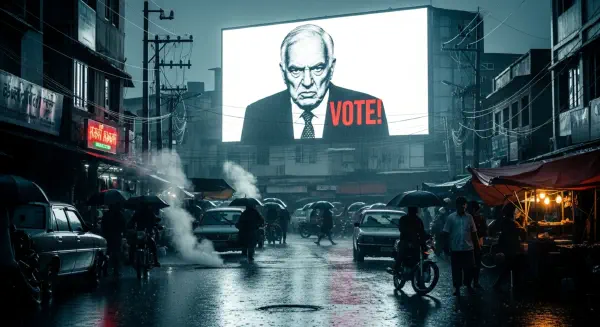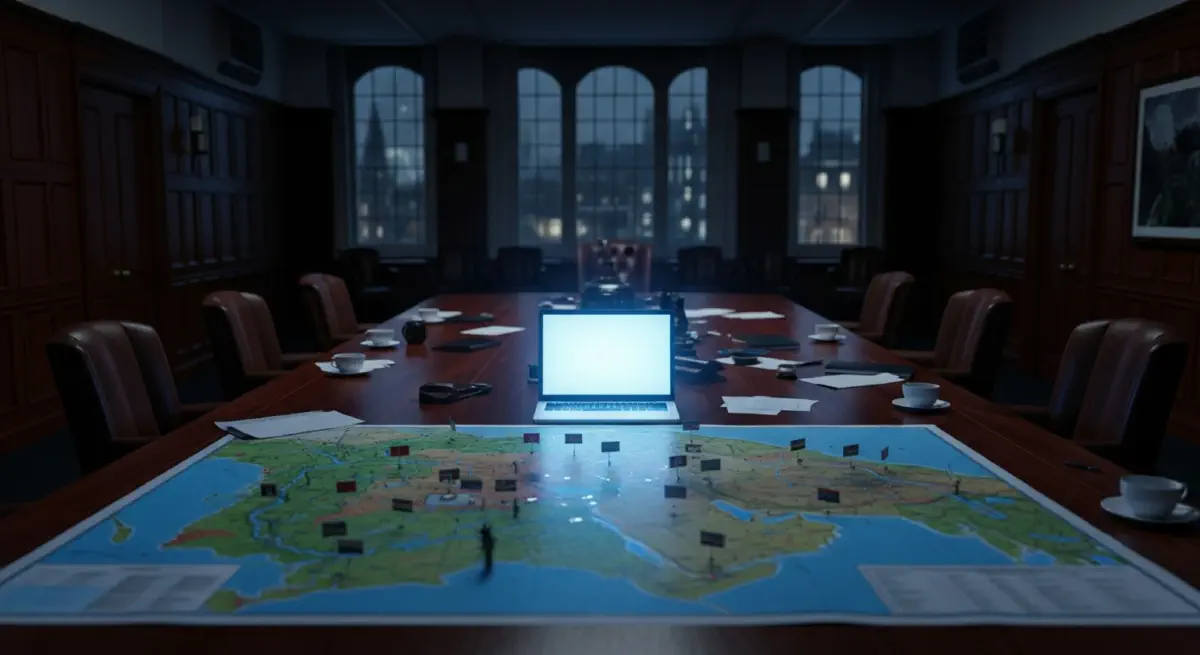
The story of modern political manipulation does not begin in a Silicon Valley startup, but in the secretive world of British military contracting. Nigel Oakes, a former DJ and advertising executive who once dated a royal cousin, founded Strategic Communication Laboratories (SCL) in 1993 with a bombastic philosophy. He claimed his company utilized the same psychological techniques as Aristotle and Hitler to appeal to people on an emotional level. To signal high-stakes tactical precision, Oakes hired the production team from the James Bond film Goldeneye to design his operations centers. These offices were designed as high-tech command hubs, signaling to world leaders that perception could be managed with the lethality of a military strike.
SCL Group established itself as a global “psyops” empire, serving the UK Ministry of Defence, the US Department of Defense, and various NATO militaries. The firm specialized in Information Operations (IO), a military strategy that weaponizes information to achieve specific operational objectives. Within the context of a combat zone, SCL provided training for Britain’s 15th Psyops Group and managed NATO projects in the Baltic region. This military pedigree provided the foundational blueprint for Cambridge Analytica, which was created to port these battlefield tactics into the civilian political sphere.
The transition from military to political application was driven by the “Breitbart Doctrine,” which posits that politics flows downstream from culture. Steve Bannon, the Vice President of Cambridge Analytica, engaged SCL specifically to build an “arsenal of informational weapons” to deploy on the American population. The objective was to create enduring change by treating the electorate not as a marketplace of ideas, but as a battlefield for cultural warfare. This shift marked the beginning of a fundamental mismatch between 20th-century democratic laws and 21st-century psychological warfare.
The Thesis of Militarized Influence#
The Military Strategy (Information Operations) Thesis posits that modern digital political campaigns are not merely advanced versions of traditional marketing, but are instead direct adaptations of military psychological operations (PsyOps) designed to achieve total “informational dominance” over civilian populations. By identifying and exploiting the mental and emotional vulnerabilities of specific subsets of the population, these operations treat the electorate as a tactical resource to be won through deception, rumor, and suppression. This system transforms the democratic process into a game of clandestine manipulation where the source of the influence remains unattributable and untrackable.
The Architecture of Total Control#
Military Information Operations are defined by two primary objectives: the achievement of informational dominance and the exploitation of target vulnerabilities. Informational dominance focuses on capturing, interfering with, or manipulating as many channels of information surrounding a target as possible. In a combat scenario, the Data Protection Act does not apply, allowing military contractors to use invasive techniques that would be illegal in a domestic context. This dominance is typically established without the knowledge of the target, ensuring that the manipulated narrative feels like a series of organic observations rather than coordinated propaganda.
The second objective involves the identification of “mental vulnerabilities”. By collecting vast amounts of data on a population, military strategists can pinpoint specific psychological triggers—such as fear, paranoia, or racial bias. These triggers are then used to deliver tailored messages designed to provoke behaviors conducive to operational goals. When SCL transitioned into the US political market, they brought these “combat-ready” approaches with them, treating the domestic population as an uncommitted group that needed to be “won” through recognition of their neuroses.
To execute these strategies, SCL and Cambridge Analytica operated through a web of structural obfuscation. Cambridge Analytica was created as a front-facing American brand to bypass electoral compliance and foreign agent restrictions in the United States. In practice, the company had no permanent staff of its own; it was merely an intellectual property license and a set of data assets. All clients were handed back to SCL staff in London, effectively making the two companies a single operational entity hidden behind different vehicles in the shadows.
The Crucible of Structural Deception#
The institutional setup of these firms was designed by the Mercers’ lawyers to ensure that funds invested in research and development were not classed as declarable campaign contributions. This allowed the firm to develop intellectual property worth far more than the value of each client contract it supported. The majority of the staff were non-US citizens, even though Steve Bannon was formally warned about the legal implications of using foreign nationals in US elections. The firm disregarded this advice, installing Alexander Nix, a British national, as CEO while sending other non-Americans to play strategic roles embedded in campaigns.
The firm’s ethos was “anything goes,” a mentality that led to activities bordering on criminality. This included the use of “black ops” capacity, such as employing hackers to break into computer systems to acquire “kompromat” (compromising material) for clients. In internal documents, these activities were often billed under the benign title of “special IT services” or “special intelligence services”. By treating domestic elections as military operations, the firm moved beyond the boundaries of traditional campaigning, introducing a level of tactical aggression that existing democratic institutions were unprepared to handle.
A complicating factor in the Information Operations thesis is the documented history of poor data handling within SCL. In 2014, the UK Defence Science and Technology Laboratory criticized SCL for its inability to properly handle sensitive Ministry of Defence information. This history of recklessness suggests that while the firm pitched itself as a high-tech “James Bond” operation, its actual internal security was often chaotic. This vulnerability created a “gross risk” of foreign intelligence gathering, especially given the lead psychologist’s contemporaneous work on Russian-funded projects.
Breach of Democratic Sovereignty#
The consequence of applying military strategy to civilian politics was the erasure of the boundary between legitimate campaigning and information warfare. In traditional media, the line between editorial content and advertising is sacrosanct; Information Operations intentionally blur this line to make propaganda “unattributable”. When disinformation is shared by a “friend” on social media, it gains a level of reliability that traditional political messaging could never achieve. The result is an environment where voters are no longer making “informed choices,” but are instead being “unduly influenced” by opaque digital technologies.
Christopher Wylie, the firm’s former research director, testified that the firm was a “corrupting force” that used the tools of democracy to dismantle democracy itself. The “James Bond style mystique” of Cambridge Analytica eventually turned the company into a “cinematic villain,” but the underlying military tactics continue to be used by other actors in the unregulated global market. The scandal confirmed that there are “systemic vulnerabilities” in our democratic systems that allow private contractors to treat the public as combatants on a digital frontline.
The fallout from these operations revealed that tech platforms like Facebook were operating as “digital gangsters,” considering themselves above the law while providing the infrastructure for military-grade manipulation. Despite the record-breaking $5 billion fine levied against Facebook by the US Federal Trade Commission, critics argue the penalty was perfunctory for a company with half a trillion dollars in market value. The failure of institutions to protect the public has created a vacuum where the “industrialization of micro-targeting” now poses a persistent threat to global stability.
Synthesis: The Unseen Occupant of the Digital Sphere#
The Military Strategy (Information Operations) Thesis reveals that the Cambridge Analytica scandal was not an isolated data breach, but a “canary in the coal mine” for a new kind of conflict. Information Operations have fundamentally changed the nature of political participation by turning human psychology into a tactical resource. When military strategies are deployed on domestic soil, the goal is no longer to persuade the electorate, but to achieve informational dominance through the exploitation of neuroticism and paranoia.
This “New Cold War” is happening in the “here and now,” affecting millions of social media users who are unaware they are the targets of tactical manipulation. If a foreign actor dropped propaganda leaflets by airplane over a domestic city, it would be condemned as a hostile act; yet, similar operations are conducted online every day with minimal oversight. We must move beyond the “defeatist mantra” that the law cannot keep up with technology. Just as we create safety standards for airplanes and medicines, we must enforce standards for software and digital platforms.
The ultimate position of war is when your adversary has no idea they are in a war. The legacy of SCL and Cambridge Analytica is the normalization of the “surveillance business” in politics, where individual autonomy is sacrificed for the sake of operational objectives. Democracy is not a “fragile flower,” but it needs active cultivation and protection from those who would treat the public as an uncommitted audience ripe for radicalization. The challenge for the future is to reclaim the digital commons from those who hold the keys to the informational arsenal.