
The Ledger of Mortality#
In 1877, as the Great Famine began to claim millions of lives in southern India, grain merchants in the Punjab were making “forward” purchases of standing crops for export to Europe. During that single fiscal year, while an estimated 6 to 10 million Indians starved to death, India exported a record 6.4 million hundredweight (cwt) of wheat to the United Kingdom. The arithmetic of the British Raj remained implacable even during total societal collapse: the need to remit the “Home Charges” and service the railway debt superseded the biological survival of the population.
This was the “Famine Dividend”—the systematic maintenance of fiscal extraction during peak mortality events. It was not a failure of the system, but its logical conclusion. By official dictate, India had become a “Utilitarian laboratory” where the sacred principles of laissez-faire were tested against the lives of the “animated skeletons” in the relief camps.
The Caloric Deficit Model#
The “Temple Wage,” introduced by Sir Richard Temple in 1877, provided only 1,627 calories per day for men performing heavy manual labor. This was less than the 1,750 calories provided in the Buchenwald concentration camp 67 years later. While the state provided a starvation wage, it continued to collect land revenue with “ruthless vigilance”.
The Revenue Vise#
Even at the height of the 1899 famine, which affected 100 million people, the British Secretary of State for India prevented the Viceroy from seeking a Treasury grant for relief, citing the “Indian obligation” to help pay for the Boer War. In some districts, taxes were reassessed upward by 50% based on speculative land values just before the rains failed. Peasants who could not pay were “forcibly reminded that dreadnaughts were the City’s debt collectors of last resort”.
The Export Paradox#
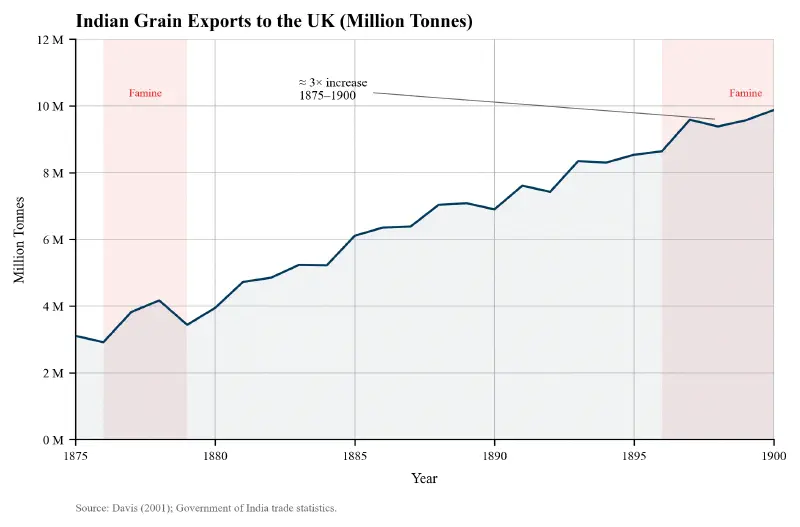
Between 1875 and 1900, the period of India’s most devastating famines, annual grain exports from the subcontinent actually tripled, rising from 3 million to 10 million tons. This quantity was equivalent to the annual nutrition of 25 million people. The railways, built at 5% guaranteed profit for British investors, served as the conduits for this grain, carrying it away from “famished villagers crying aloud for food” to the port cities for shipment to London.
The Famine Fund Diversion#
A “Famine Insurance Fund” was established after 1877, but it was frequently diverted to pay for aggressive wars in Afghanistan. As Gladstone thundered during his 1880 campaign, the pledge to protect the people from starvation was “utterly broken” to finance “ruinous, unjust, destructive war”.
The Arithmetic of Attrition#
To calculate the cost of this extraction, we must model the caloric transfer. In 1877, the 6.4 million cwt of wheat exported would have provided approximately 1 trillion calories—enough to sustain 1.5 million people at Blyn’s subsistence level for an entire year. Instead, those calories flowed to Liverpool to stabilize the price of British flour.
| Famine Extraction Metrics | 1876-79 Famine | 1896-1902 Famine |
|---|---|---|
| Estimated Mortality | 6.1 - 10.3M | 6.1 - 19.0M |
| Wheat Export to UK (Quarters) | 1.4 Million | – |
| Relief Wage (Calories) | 1,627 | 1,500 (Penal) |
| Value of Grain Exports | £10M+ | – |
| Home Charges Remitted | £15M+ | £17M+ |
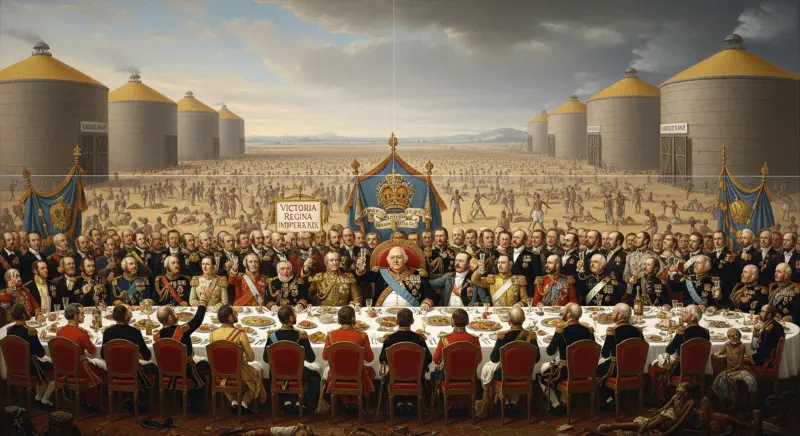
Interestingly, also in 1877, Lord Lytton hosted a banquet for 68,000 people to celebrate Victoria’s imperial title while 6 million Indians were dying within sight of grain depots, and simultaneously blocked relief funds citing laissez-faire doctrine. This event epitomizes the moral bankruptcy of the “Famine Dividend” and the prioritization of imperial spectacle over human life.
The Modernization of Mortality#
The result of this fiscal discipline was a staggering 20% decline in life expectancy for ordinary Indians between 1872 and 1921. While the British bureaucracy prided itself on “economy” in relief measures, the Indian people were being “ground to bits between the teeth of three massive and implacable cogwheels of history”: the climate system, the world market, and the imperial ledger.
The falsifiability of this final post rests on whether the state could have intervened without “bankrupting” India, as Lytton claimed. However, the records show that in 1877, the government spent more on the Imperial Assemblage to proclaim Victoria Empress than it did on life-saving irrigation projects for the famine-hit regions. The “Famine Dividend” was a choice, not a necessity.