The Deflationary Decree#
In 1926, the Hilton-Young Commission made a decision that would haunt the Indian economy for a generation: they fixed the rupee at 18d. (1s. 6d.) gold. This was a 12.5% revaluation above the pre-war parity of 16d.. To maintain this high rate in a world where prices were already starting to wobble, the Government of India was forced to aggressively contract the domestic money supply.
Between 1926 and 1931, the British authorities in Delhi withdrew nearly Rs 120 million from circulation to keep the rupee “scarce”. This “money famine” was designed to support the exchange rate, but its real-world effect was to strangle Indian industry and agricultural credit. When the Great Depression hit in 1929, the results were catastrophic. While other nations devalued their currencies to protect their farmers, India remained shackled to a high rupee, causing its trade surplus to halve in just two years.
The Arithmetic of the Gold Drain#
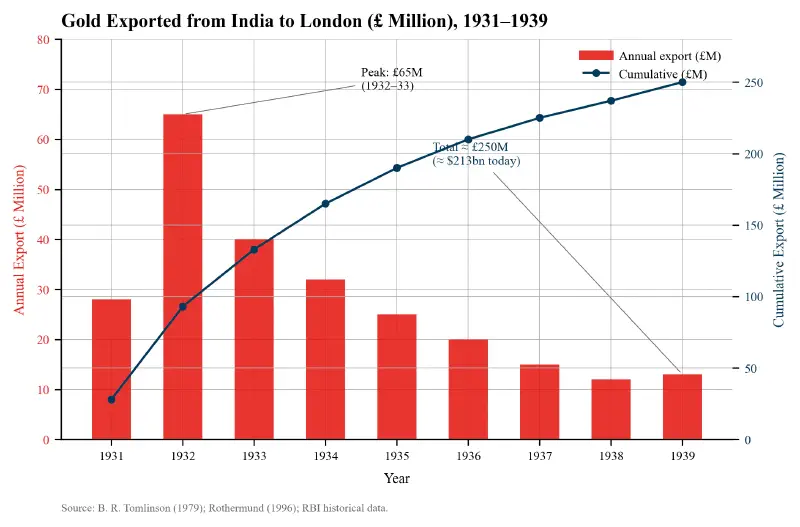
The high exchange rate made gold look “cheap” in India while making Indian goods “expensive” abroad. As agricultural incomes collapsed by 50% between 1929 and 1933, Indian households were forced into “distress sales” of their ancestral gold to pay their fixed land taxes and debts. Between 1931 and 1939, a staggering £250,000,000 of gold was exported from India. In today’s terms, this represented a “Golden Ransom” of approximately $212.82 billion.
The Debt-to-Income Vise#
Because the land tax was fixed in nominal rupees, the 50% collapse in crop prices meant that the real tax burden on the peasant effectively doubled. To meet these “fixed obligations,” the peasant had to sell more of their real assets—notably their gold ornaments. The British Treasury celebrated this as a “miracle” that allowed them to pay off their own war credits to France and the USA.
The Reserve Diversion#
The gold flowing out of Indian villages did not go to an Indian central bank. It was shipped to London to strengthen the Bank of England’s reserves. This liquidity transfer allowed Britain to maintain “cheap money” policies at home to aid its own recovery from the Depression, while India was subjected to “orthodox deflationary policies”.
The Managed Sterling Sink#
British officials recognized that the flow of gold from India depended on a high rupee. Frederick Phillips at the Treasury admitted privately that “the most single powerful force” for world recovery was the gold flow from India, and that this flow required the continued “depreciation of the sterling” relative to gold while the rupee remained pegged. India became a “gold mine” that Britain discovered in its own back pocket.
The Liquidation Model#
If we model the $212 billion gold drain as a liquidated national savings account, the scale of the transfer becomes clear. This gold represented the “safeguard against famine” for millions of families. Its removal left the Indian countryside vulnerable to the total collapse that would follow in 1943.
| The Interwar Drain (1931-1939) | Value (£) | Today’s Value ($) |
|---|---|---|
| Total Net Gold Export | £250M | $212.82 Billion |
| Highest Annual Export (1932-33) | £65M | $55.3 Billion |
| Rupee Revaluation Margin | 12.5% | – |
| Agricultural Price Fall (1929-31) | 44% | – |
The Dethronement of Silver#
The British authorities were terrified that if India went on a “pure” gold standard, it would drain the world’s gold supply. To prevent this, they assemblies a “formidable array of international financial opinion” to reject the Indian government’s own proposals for a gold currency. They insisted on keeping India on a “Gold-Bullion Standard”—a system designed to be “inoperative” for the Indian public but highly efficient for remitting wealth to London.
The falsifiability of this post lies in the motivation for the gold exports. If the sales were purely profit-driven, we should see a rise in Indian consumption of other durable goods. Instead, we see a massive rise in bank deposits and “post-office small savings,” indicating a defensive retreat into the only liquid assets left. The gold ornaments were not “disgorged” out of greed, but out of necessity.