The Sovereignty of the Creditor#
In 1850, the British launched one of the most successful “private enterprise at public risk” schemes in financial history: the Indian Railway system. To attract British investors, the government offered a “Guaranteed Interest Contract”. Any investor who put capital into Indian railways was guaranteed a 5% minimum return, paid directly by the Indian taxpayer. If the railway turned a profit, the investors kept it; if it ran at a loss, the Indian government made up the shortfall.
This system removed any incentive for economy or efficiency. Because their 5% was safe, companies built lines through difficult, expensive terrain with little regard for commercial viability. Between 1850 and 1913, the Indian taxpayer paid out approximately £150,000,000 in these “shortfall” guarantees. In today’s purchasing power, this represents a direct transfer of $31.9 billion from the poorest peasants to the London rentier class.
The Arithmetic of Guaranteed Loss#
The railway debt was part of a larger “Public Debt of India,” which stood at £177.1 million by 1914. Much of this debt was “unfunded”—it had been incurred to pay for the suppression of the 1857 revolt and the cost of the East India Company’s stocks. India was, in effect, being charged the cost of its own conquest.
The Depreciation Vise#
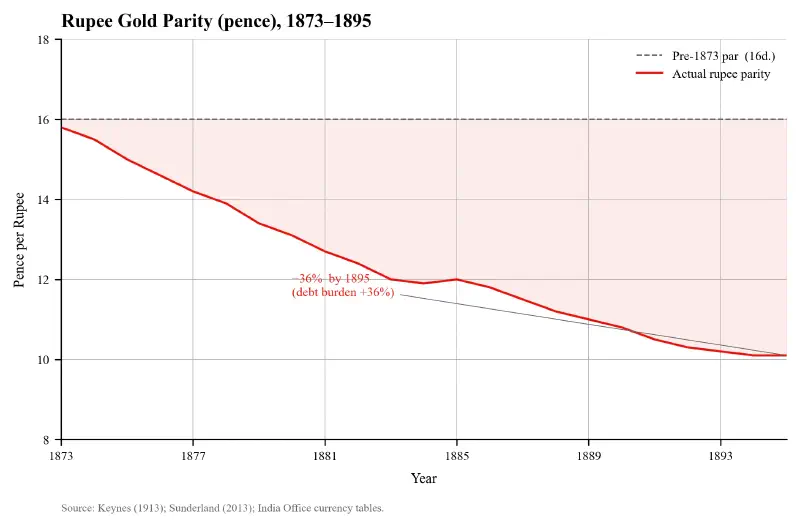
The debt was denominated in gold, but the revenue to pay it was collected in silver rupees. In the late 19th century, as the world moved to the Gold Standard, the value of silver plummeted. Between 1873 and 1895, the rupee’s gold value fell by 36%. This meant that India had to export 36% more wheat, cotton, and jute just to pay the same amount of interest on its debt. The “Home Charges” rose not because the debt had grown, but because the currency had been devalued.
The Irrigation Neglect#
While the British spent hundreds of millions on railways, which facilitated the import of British goods, they notoriously neglected irrigation, which would have increased Indian food security. By 1900, the 420,000 square miles devastated by drought had less than 100,000 acres of canal-irrigated land. The Secretary of State for India famously treated life-saving irrigation as a retail business, refusing any project that did not promise an immediate 5% profit.
The Capital Flight Model#
Unlike in the United States, where railway loans were spent on American labor and stayed in the country, the Indian railway loans were spent in London on British steel, British locomotives, and British engineers. There were no “linkage effects” to the local economy. Every farthing taken from the Indian taxpayer for “conveyance” remained in the United Kingdom.
The Debt Compound#
If we model the £150 million paid in guarantees as a lost domestic investment fund, compounded at 4.5% until 1947, the “railway tax” alone cost India the equivalent of $228 billion in today’s currency. This was a “debt trap” where the obligations were fixed in a rising currency while the income was generated in a falling one.
| Railway Finance (1850-1913) | Value | Today’s Value ($) |
|---|---|---|
| Total Guarantees Paid | £150M | $31.9 Billion |
| Cost per Mile (India) | £18,000 | – |
| Cost per Mile (USA/Canada) | £2,000 - £8,000 | – |
| Railway Debt as % of Home Charges | ~50% | – |
The Engine of Extraction#
The railways were the “visible investment in the East of the civilization of the West,” but their primary function was fiscal. They were built to “flush out India’s produce” so it could be sold at low prices on the world market to meet the gold obligations of the state. The Indian peasant was not a customer of the railway; they were the fuel for its 5% guaranteed return.
The falsifiability of this post depends on whether the indirect benefits of the railways (trade expansion) offset the direct guarantee costs. However, while exports rose, per capita foodgrain availability fell, suggesting that the “trade expansion” was a forced diversion of resources away from local consumption to meet debt deadlines.