The Dismantled Workshop#
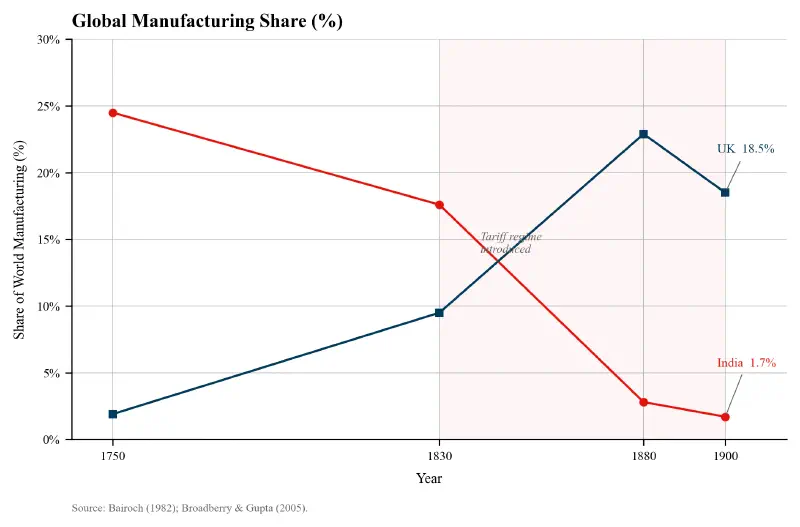
In 1750, India was the world’s manufacturing powerhouse, producing approximately 25% of global industrial output. By 1900, after a century of British fiscal management, that share had shrivelled to a mere 2%. This collapse was not driven by the “invisible hand” of the market, but by the very visible hand of the state. It was a process of “deindustrialisation”—the systematic replacement of a sophisticated handicraft sector with a raw-material export economy.
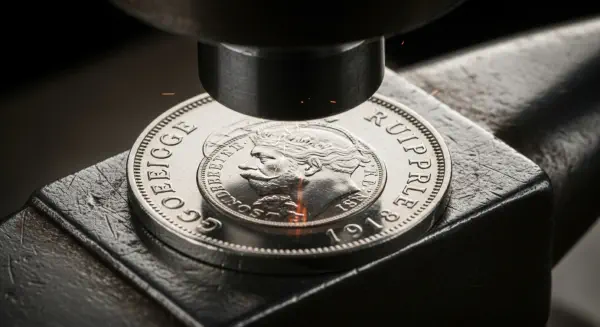
The engine of this destruction was a “one-way free trade” system. While British goods entered India with negligible duties (2-3.5%), Indian textiles entering Britain were met with prohibitive tariffs ranging from 70% to 80%. This fiscal asymmetry turned India into the “greatest captive market in world history,” forced to absorb the surplus of a British textile industry that was rapidly becoming obsolescent.
The Architecture of Market Capture#
The British “stores policy” ensured that government purchases—the largest single source of demand in the economy—were almost exclusively reserved for British products. Even when Indian firms could produce the same materials more cheaply, they were routinely denied contracts.
The Tariff Vise#
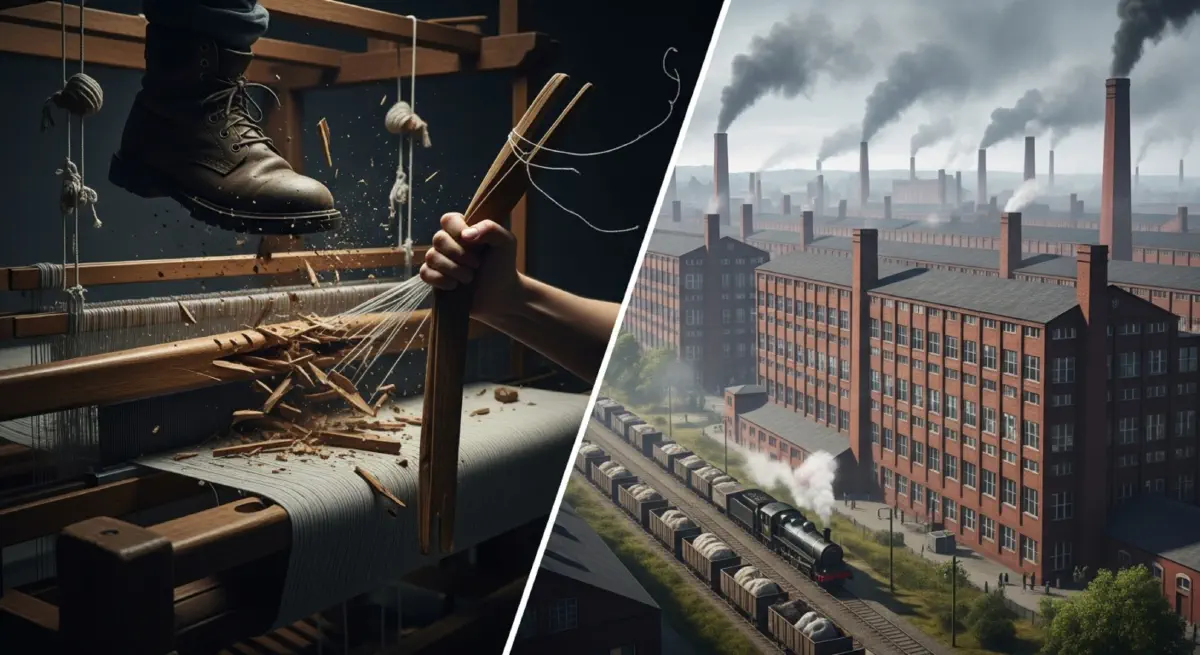
The disparity in duties was a deliberate tool of statecraft. In the early 19th century, Indian “nankeens” and silks were superior to anything Lancashire could produce. British manufacturers, unable to compete on quality or price, leveraged the power of the Parliament to shut the door. By the time machine-made British textiles had improved, the Indian weaving centers had already been decimated. The looms were dismantled not by better technology, but by a “Lancashire-imposed system of one-way tariffs”.
The Railway Trap#
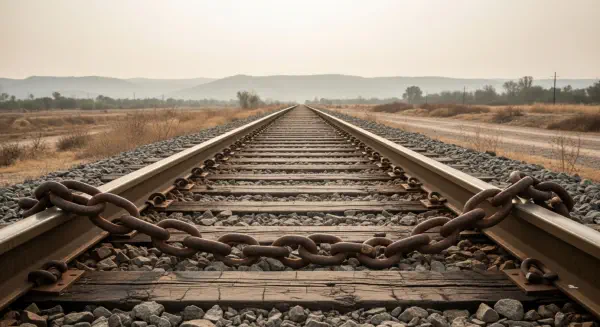
Railways are often cited as the great modernizer of the Indian economy. However, their primary fiscal function was to facilitate the penetration of British manufactures into the interior. By siting the network to connect the interior directly to the port cities, the British bypassed traditional internal trade routes. This “spatial reorganisation” ensured that raw cotton flowed out and finished Manchester cloth flowed in, crushing local artisans in the process.
The Opium-Cotton Link#
Perhaps the most ingenious part of this global circuit was the “triangular trade” involving China. India produced opium (a government monopoly) which was sold to China. The proceeds from this drug trade were then used to buy American cotton for Lancashire mills. In essence, the “drug transaction of the century” subsidized the very industrial revolution that was being used to destroy India’s own manufacturing base.
The Output Model#
To calculate the lost industrial potential, we must model the divergence in manufacturing shares. In 1750, India’s output was 13 times larger than the UK’s. By 1880, the UK’s share was 8 times larger than India’s. If India had maintained even half of its global share (12.5%) through the industrial revolution, its 1900 GDP would have been nearly 6 times higher than its actual recorded level.
| Global Manufacturing Shares (%) | 1750 | 1830 | 1880 | 1900 |
|---|---|---|---|---|
| India | 24.5 | 17.6 | 2.8 | 1.7 |
| United Kingdom | 1.9 | 9.5 | 22.9 | 18.5 |
| Rest of Tropics | 76.8 | 63.3 | 23.3 | 13.4 |
The Modernization of Poverty#
The consequences of this policy were a “triple evil”: loss of wealth, wisdom, and work. Indian weavers, once the “aristocracy of labor,” were pushed into the ranks of landless agricultural workers, increasing the pressure on a fragile and overtaxed farming sector. This “Modernization of Poverty” meant that while the elite in London celebrated the progress of the steam engine, the Indian peasant was being “whiplashed by long-distance economic perturbations” they could neither control nor understand.
The falsifiability of this post lies in the causes of the decline. If the collapse were purely technological, we would expect to see the same decline in Japan. Instead, Japan, which retained its fiscal autonomy, successfully modernized its own textile industry and began competing with the West by the 1890s. The difference was the ledger: the Indian loom was defeated by the British tax collector.