The Silent Accountant of the Subcontinent#
In the late 19th century, a Parsi scholar named Dadabhai Naoroji sat in a London library, obsessing over a paradox. India, described by every visiting dignitary as a land of infinite natural richness, was home to the most destitute population on Earth. While British officials celebrated the “blessings” of law and order, Naoroji pointed to the ledger. He observed that India was being “bled” through a series of subtle, administrative channels known as the “Home Charges”. These were not simple trade deficits; they were unrequited transfers of wealth for which India received no commercial equivalent.
Naoroji’s work shifted the conversation from morality to mathematics. He famously calculated that by 1880, the annual drain from India reached approximately £30,000,000. In today’s purchasing power, that single year’s extraction is equivalent to approximately £4.78 billion ($6.38 billion). He argued that this “bleeding” of the national capital prevented India from ever accumulating the surplus necessary for its own industrialization. The arithmetic of the British Raj, he claimed, made Indian poverty not an accident of nature, but an inevitable outcome of the system.
The Anatomy of the Imperial Account#
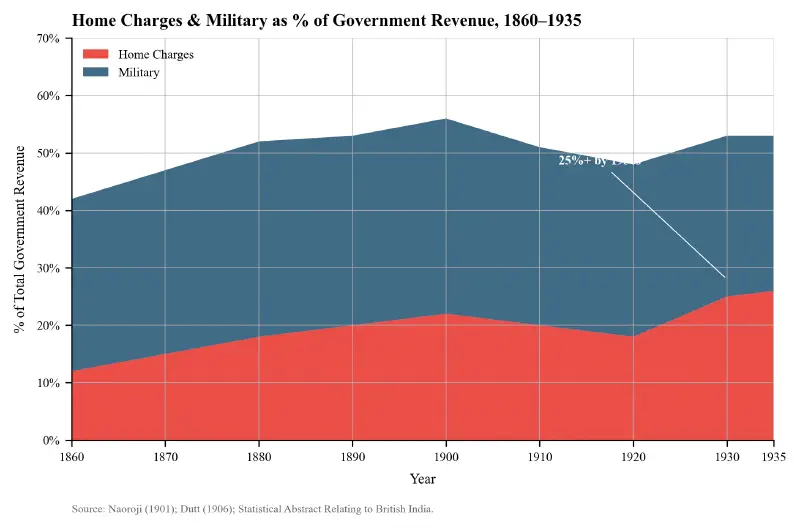
To understand Naoroji’s claim, one must look at the specific line items that constituted the “Home Charges.” These were the expenses of the Indian government incurred in Britain, paid for by the Indian taxpayer. They included interest on the public debt, pensions for retired British officials, and the cost of the India Office in London. By the 1930s, these charges accounted for more than 25% of the total revenue of the Government of India.
The Mechanism of Unrequited Transfer#
The genius of the system lay in its integration with the international exchange market. To pay these “Home Charges” in London, the Government of India did not ship physical bullion. Instead, they used the “Council Bill” system. The Secretary of State for India in London sold bills to British merchants who needed rupees to buy Indian goods like cotton or jute. The merchants paid sterling in London, which stayed in the British Treasury to pay the Home Charges. Meanwhile, the Indian government used tax revenue—the rupees collected from peasants—to pay the merchants in India. The result was that India’s merchandise surplus disappeared into the ether of administrative costs.
The Crucible of Colonial Overheads#
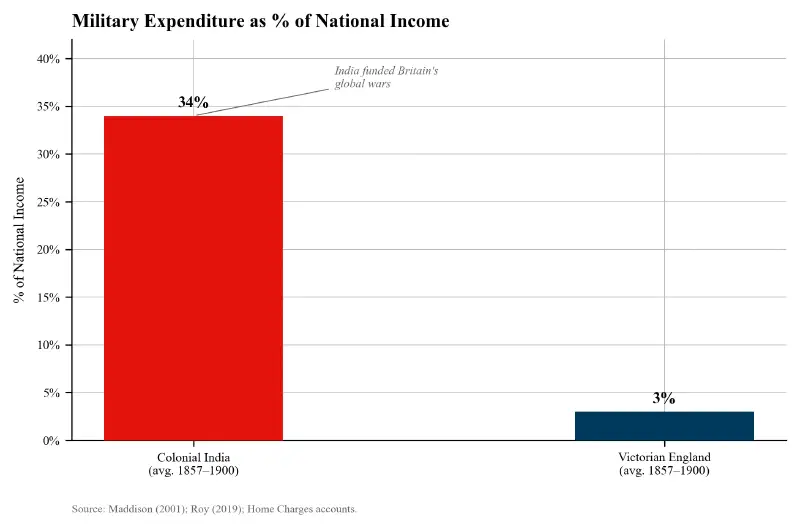
The burden was compounded by the fact that even Britain’s military adventures beyond India’s borders—from the invasion of Ethiopia in 1868 to the occupation of Egypt in 1882—were largely financed by the Indian taxpayer. Military expenditures typically consumed 34% of India’s annual budget. In contrast, Victorian England never spent more than 3% of its net national product on its own army and navy. This disparity created what historians call the “Military-Extraction Gap,” where the poorest subjects of the empire subsidized the global supremacy of its richest.
Tracing the Forward Compound#
If we take Naoroji’s 1880 drain estimate of £30 million and compound it forward to 1947, the figures become astronomical. Over the 90 years of direct Crown rule, the total extracted capital, if invested domestically at a conservative 4.5% real return, would have reached roughly £45 billion in 1947 currency. In today’s terms, this represents a lost development fund of approximately $7.18 trillion. This figure excludes the “moral drain”—the loss of knowledge and administration experience as officials retired to England.
The Arithmetic of Stagnation#
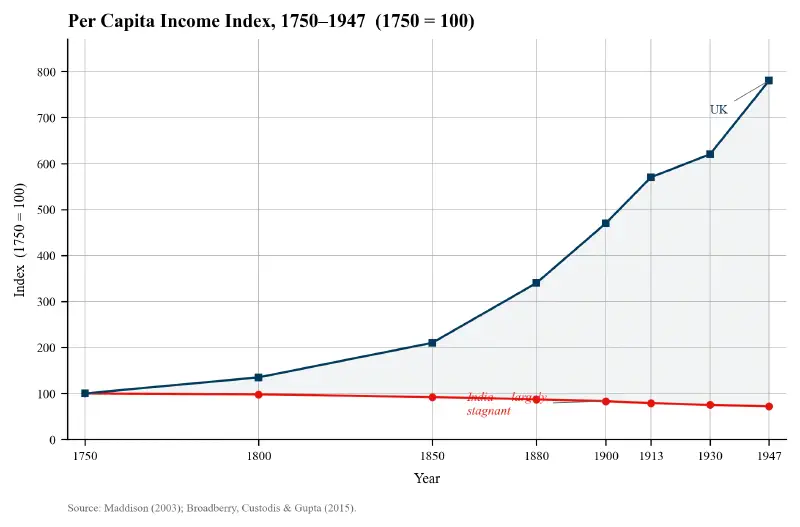
The falsifiability of the “Drain Theory” rests on whether these Home Charges were offset by equivalent value in technology and infrastructure. Critics argue that the railways and telegraphs provided a “civilizing” return. However, the data shows that the capital for these projects was borrowed at guaranteed rates, creating further debt obligations. If the economic value of the infrastructure had outweighed the interest and administrative drain, Indian per capita income should have risen. Instead, records show it remained virtually static from 1757 to 1947.
| Key Extraction Metrics (c. 1900) | Value (£ / Rs) | Today’s Value ($) |
|---|---|---|
| Annual Home Charges | £17.3M | $3.68 Billion |
| Total Government Sterling Debt | £177.1M | $37.69 Billion |
| Per Capita Income (1880) | Rs 20 (~27s.) | $287.30 |
| Drain as % of National Income | 4% | – |
The Ledger of Foregone Futures#
The “Drain Theory” provides the analytical vocabulary for the entire series because it explains why India remained a “sink” for silver while its wealth flowed to the “centre”. It was a system where the “veins of national industry” were drained without any introduction of “nourishment” to restore them. By turning the Indian government into a “docile instrument of British monetary policy,” the Raj ensured that the arithmetic of empire always favored the London market.
Naoroji’s ledger was more than a complaint; it was an autopsy of a systemic extraction. He recognized that while a few pounds might not burden an elephant, they would “crush a child”. For an Indian population living on a “scanty subsistence,” the removal of even 4% of national income every year meant the difference between resilience and ruin. As we explore the specific mechanisms of this extraction in the coming posts, the Home Charges remain the framing reality of the colonial era.