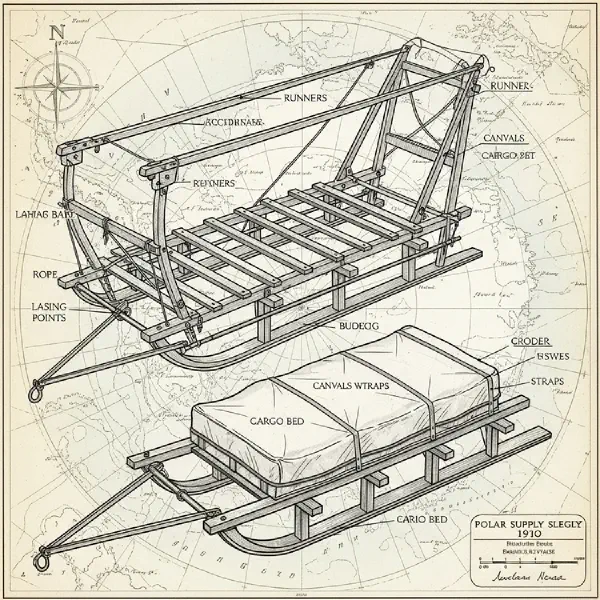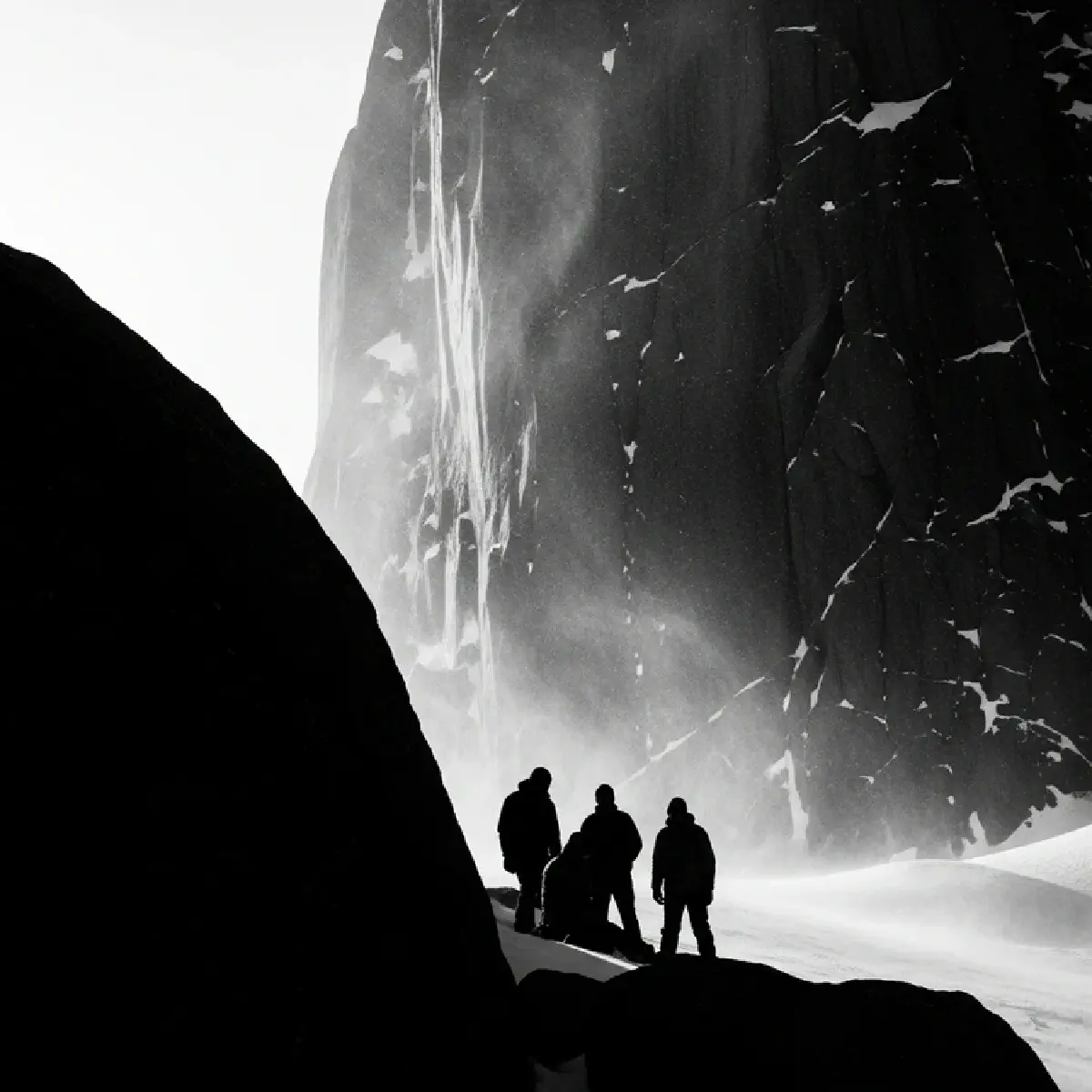
In July 1911, Edward Wilson, Henry Bowers, and Apsley Cherry-Garrard initiated the “Winter Journey” to Cape Crozier. This 130-mile [209.2 km] round trip was undertaken in total darkness to collect Emperor penguin embryos. The temperature dropped to a minimum of -77.5°F [-60.8°C], which remains one of the lowest temperatures ever recorded by a sledging party. The men pulled a total weight of 757 lbs [343.3 kg], or 252 lbs [114.3 kg] per man.
The party sought the embryos to test the theory that penguins are the most primitive birds in existence. They believed these specimens would provide a missing link to reptilian ancestors. This mission was the most dangerous undertaking of the entire expedition. It required the men to navigate a maze of pressure ridges and crevasses without the aid of daylight.
The Stone Igloo and the Hurricane#
Upon reaching the Knoll at Cape Crozier, the men built a small stone igloo. They utilized rocks and hard snow blocks for the walls and used a canvas sheet for the roof. Their plan was to use a blubber stove to save their limited supply of paraffin oil. However, they were immediately struck by a blizzard of unprecedented force.
Foundation and Mechanism#
The thermal management of the party relied on reindeer-skin sleeping-bags and multi-layered wool clothing. During the march, their body heat thawed the ice in their clothes, which then refroze into rigid “armor-plate” once they stopped. Respiration inside the bags caused moisture to accumulate and freeze, eventually making the bags weigh twice their original mass. The men had to spend up to an hour each night simply levering themselves into these frozen containers.
The Crucible of Context#
The party’s survival was threatened by a mechanical failure of their shelter during a force 11 hurricane. The vacuum effect of the wind over the ridge sucked the canvas roof off the igloo, leaving the men exposed to the elements. Simultaneously, the wind blew away their only tent, which was their sole means of returning across the Barrier. They lay in their bags for 48 hours, buried under snow, with no food or hot water.
Cascade of Effects#
The recovery of the tent, found half a mile [0.8 km] away in a hollow, was a statistical improbability that saved their lives. Although they successfully obtained three Emperor penguin eggs, the physical cost was massive. The men returned to Cape Evans in a state of total physical collapse, having aged years in five weeks. This journey proved that man-hauling in such conditions was possible but required an unsustainable expenditure of vital energy.
The Legacy of the Embryos#
The scientific result of this journey was the acquisition of three preserved embryos. Later analysis by Professor Cossar Ewart indicated that feather development in penguins differs fundamentally from scale development in reptiles. This suggested that feathers were not merely modified scales, adding a complex layer to avian evolutionary theory.
The Winter Journey stands as an archetype of scientific devotion. It demonstrated the extremes to which the human spirit can go when driven by an intellectual objective. While the journey did not facilitate the conquest of the Pole, it solidified the team’s bond. They were now veterans of the most hostile environment on Earth.