
The Imperial Auditor#
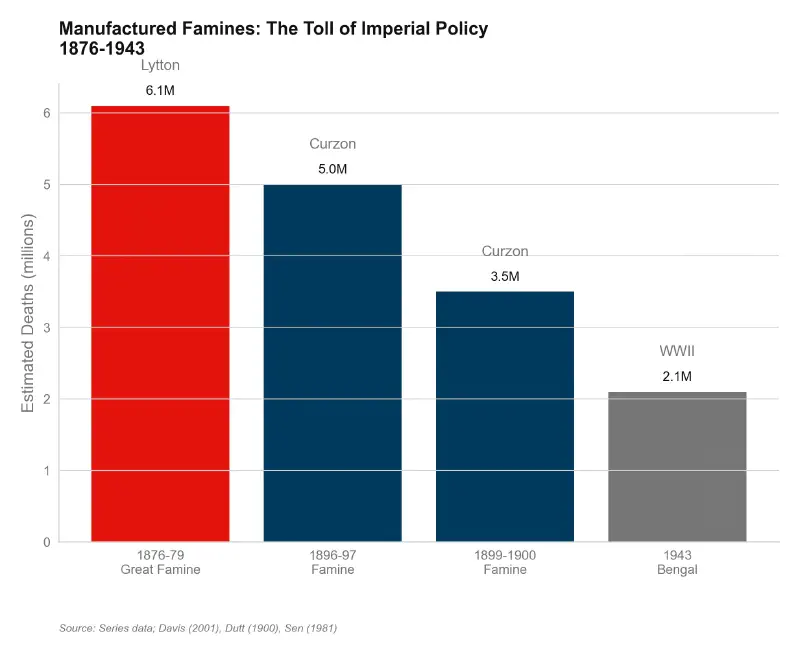
In 1899, as the “famine of the century” began its three-year siege of India, the new Tory Viceroy, Lord Curzon, made a declaration that would define his administration: “Any Government which imperilled the Financial position of India in the interests of prodigal philanthropy would be open to serious criticism”. Curzon, whose appetite for viceregal pomp surpassed even Lytton’s, viewed famine relief as a “public crime” if it weakened the “fibre and self-reliance” of the population. While spending millions on the construction of the hugely ornate Victoria Memorial Monument in Calcutta, he ordered his officials to attribute the crisis strictly to drought and to “Stellenbosh” (remove) any member of the government who raised the issue of over-taxation.
Curzon’s administration represented the “hardened apex” of imperial policy. He responded to the 1899 drought, which devastated 420,000 square miles of farmland, by reinstating the “Temple tests” and cutting back rations he characterized as “dangerously high”. In the Bombay Presidency alone, the government boasted that these deterrents had turned away 1 million people from relief. For Curzon, the biological survival of 85 million drought victims was a secondary concern to the “Indian obligation” to help pay for the Boer War in South Africa. He even took the unprecedented step of deporting refugees who had fled into British India from native states, a move that functioned as a virtual death sentence for hundreds of thousands.
The Accounting of the “Golden Ransom”#
The “Architecture of Attrition” did not end with the turn of the century. In the interwar years, the mechanisms of extraction shifted from grain to gold. In 1926, the Hilton-Young Commission fixed the rupee at an overvalued rate of 18d., forcing a “money famine” that strangled Indian industry and agricultural credit [Post 5]. When the Great Depression hit in 1929, Indian agricultural incomes collapsed by 50%, while the nominal land tax remained fixed [Post 5]. To meet these “fixed obligations,” the Indian peasant was forced into “distress sales” of their ancestral gold ornaments [Post 5].
The Interwar Liquidation#
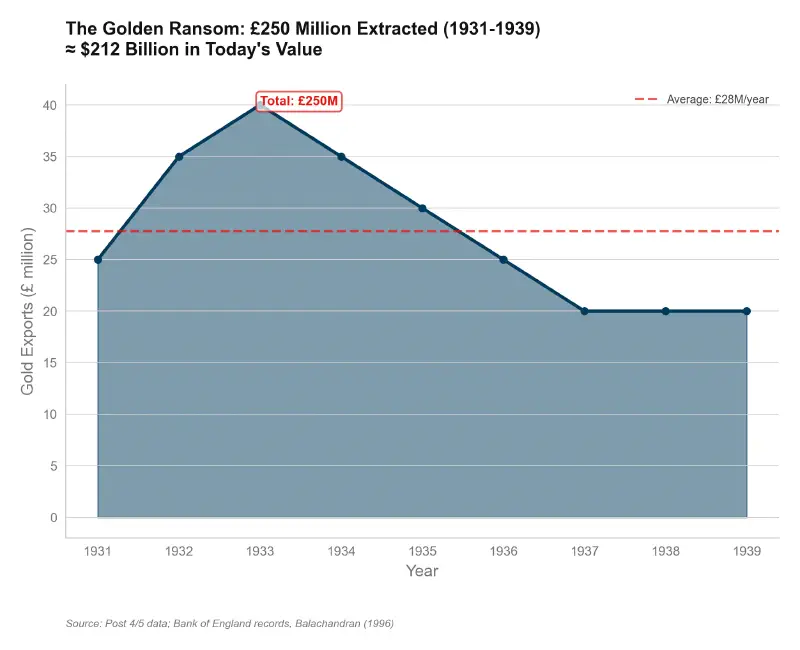
Between 1931 and 1939, a staggering £250,000,000 of gold was exported from India to London [Post 5]. In today’s terms, this represented a “Golden Ransom” of approximately $212.82 billion—liquidated national savings that the British Treasury celebrated as a “miracle” that allowed them to pay off their own war credits to the USA [Post 5]. This gold, which had for centuries been the “safeguard against famine” for millions of families, was shipped to the Bank of England to strengthen its reserves and aid Britain’s recovery from the Depression, while India was subjected to “orthodox deflationary policies” [Post 5]. The removal of this “superfluous hoard” left the Indian countryside defenseless against the total collapse that would follow in 1943 [180, Post 5].
The Erosion of Biological Capital#
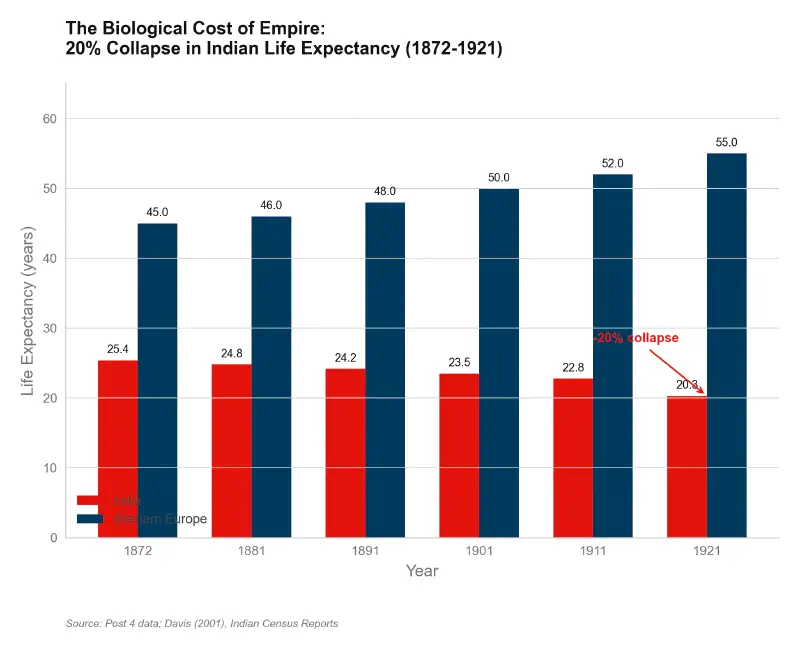
The ultimate accounting of the British Raj is found in the physical deterioration of its subjects. Between 1872 and 1921, the life expectancy of ordinary Indians fell by a staggering 20%. This collapse in human health was without precedent in the subcontinent’s history and occurred during the same half-century when peacetime famine permanently disappeared from Western Europe. The “peculiar amalgam of modernization and underdevelopment”—railroads that spread plague fleas and a grain trade that prioritized export over calories—ensured that mortality remained high even between major famine episodes. By the 1920s, the demographic engine of India had ground to a near halt, with many districts showing a population less than that of 1872.
The Legacy of the “Sowkar’s Serf”#
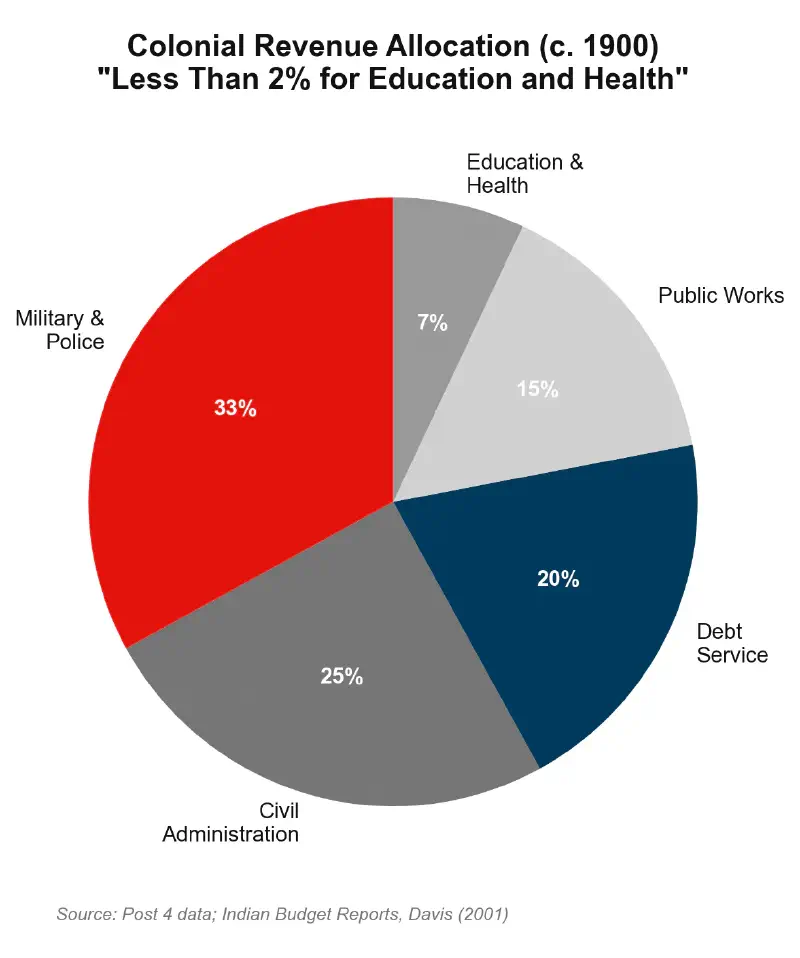
By the end of the colonial period, the “modernization” of agriculture had resulted in a system where 75% of peasant households in Bengal and Madras farmed too little land to achieve self-sufficiency. The “triangular trade” involving opium and cotton had dismantled the Indian manufacturing base, leaving 70% of the workforce trapped in a low-productivity agrarian sector. The colonial state had spent less than 2% of its revenue on education and public health, while dedicating a full third to the military and police. The result was an “underdeveloped economy with underdeveloped institutions to match,” where the only legacy of two centuries of rule was a “stagnated equilibrium” between managerial exploitation and small-peasant ruin.
The Final Verdict of Colonialism#
The “Architecture of Attrition” proves that the famines of British India were not “climatic accidents” but the logical conclusion of an imperial case study in greed and indifference. The British administration, from Lytton to Curzon, treated India as a “revenue plantation,” where the biological survival of the population was always secondary to the remittance of the Home Charges and the protection of the City of London’s interest rates. They replaced the “laws of leather”—the flexible, patrimonial welfare of the Moguls—with the “laws of iron” of a mechanical bureaucracy that viewed death as a salutary cure for overpopulation.
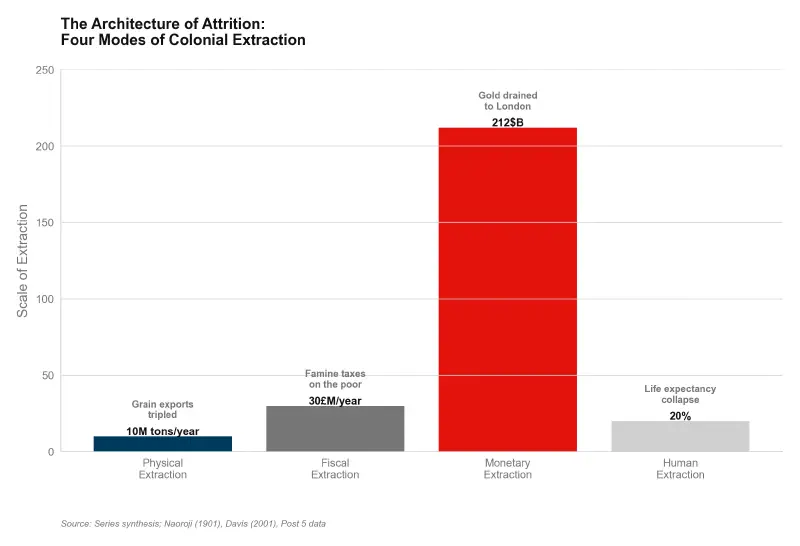
The series has demonstrated that the “bleeding” of India was a multifaceted operation:
- The Physical Extraction: Tripling grain exports while 30 million people starved.
- The Fiscal Extractions: Levying famine taxes on the poor to pay for wars in Afghanistan and Africa.
- The Monetary Extraction: Liquidating $212 billion in household gold to bail out the sterling system [Post 5].
- The Human Extraction: A 20% collapse in life expectancy and the creation of the “sowkar’s serf”.
The history of these manufactured famines reminds us that “Millions die” is ultimately a policy choice. The British Raj did not just “fail” to save the Indian people; it actively organized their decimation through the theological application of market dogma and the relentless pursuit of imperial profit. As we look at the modern “Third World,” we see not a collection of “lands of famine” stalled in the backwaters of history, but the permanent monuments of a Victorian “new world order” that was paved with the bodies of the poor.