The Profiteers of the funeral Pyre#
During the winter of 1891, as famine prices began to “torment” the Punjab, a European firm named Messrs. Ralley Brothers & Co. made a series of “forward” purchases of standing wheat crops for export to Europe. While local villagers desperately attempted to hold onto their grain, agents of the company coerced them into fulfilling these contracts, effectively stripping the province of its food reserves before the harvest was even gathered. This was the “greed of the global circuit” in action: a system where a drought in the American wheat belt could trigger a “price famine” in northern India, enriching London speculators while Indian peasants were “ground to bits”.
The manufactured famines of the late Victorian era were not merely the result of climate; they were facilitated by a complex web of complicity involving British colonial employees, international trading cartels, and a rising class of “corrupt Indian elites”. In Kashmir, British officials openly blamed the “greed of the Maharaja and his officials,” who bought up all grain stores to sell at extravagant prices, for the starvation of one-third of the valley’s population. In the Central Provinces, the “sowkars” (moneylenders) and “malguzars” (landowners) discovered that it was far more profitable to speculate on grain and practice usury than to invest in productive agriculture. This was the “modernization of poverty,” where the integration of India into the world market created a windfall for the few at the cost of the biological survival of the many.
The Anatomy of the Grain Siphon#
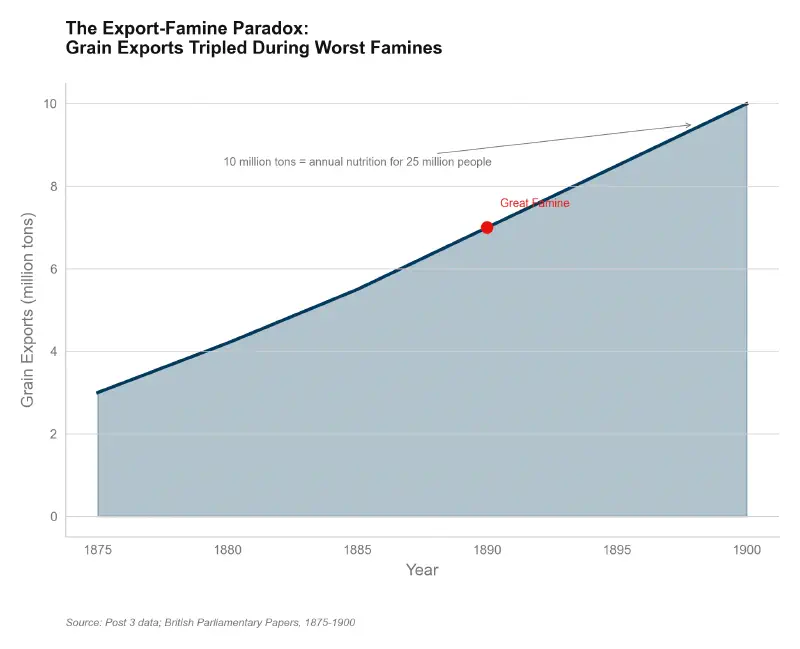
The British administration maintained a “one-way free trade” system that turned India into the “greatest captive market in world history”. This policy ensured that India functioned as a “buffer at the base of the world economy,” absorbing depreciating silver while exporting its real production—wheat, rice, and cotton—at stable gold prices for the benefit of British consumers. Between 1875 and 1900, the years of the most devastating famines, annual grain exports from India actually tripled, rising from 3 million to 10 million tons. This quantity was equivalent to the annual nutrition of 25 million people.
The Speculative Accelerator#
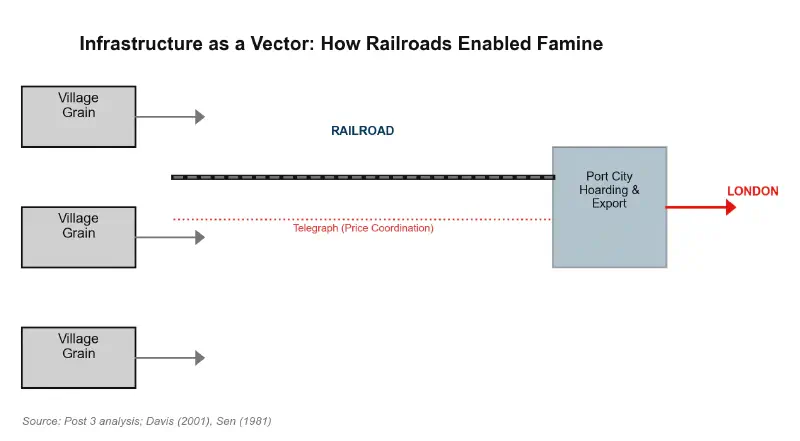
The introduction of the telegraph and the railroad did not “solve” famine as imperial apologists claimed; it globalized speculation. The telegraph allowed grain merchants to coordinate price hikes in a thousand towns simultaneously, while the railroads provided the means to “flush out” local grain reserves to port cities for shipment to London. In many districts, the mere prospect of government purchases for relief led to speculative hoarding by traders, pushing prices to famine levels even when grain was physically present. In Nagpur, while the Lancashire Regiment was sent in to suppress grain riots, local merchants outraged the public by selling adulterated grain at “fantastic prices,” with the complicity of local officials who refused to open fair-price shops.
The Rise of the “Sowkar’s Serf”#
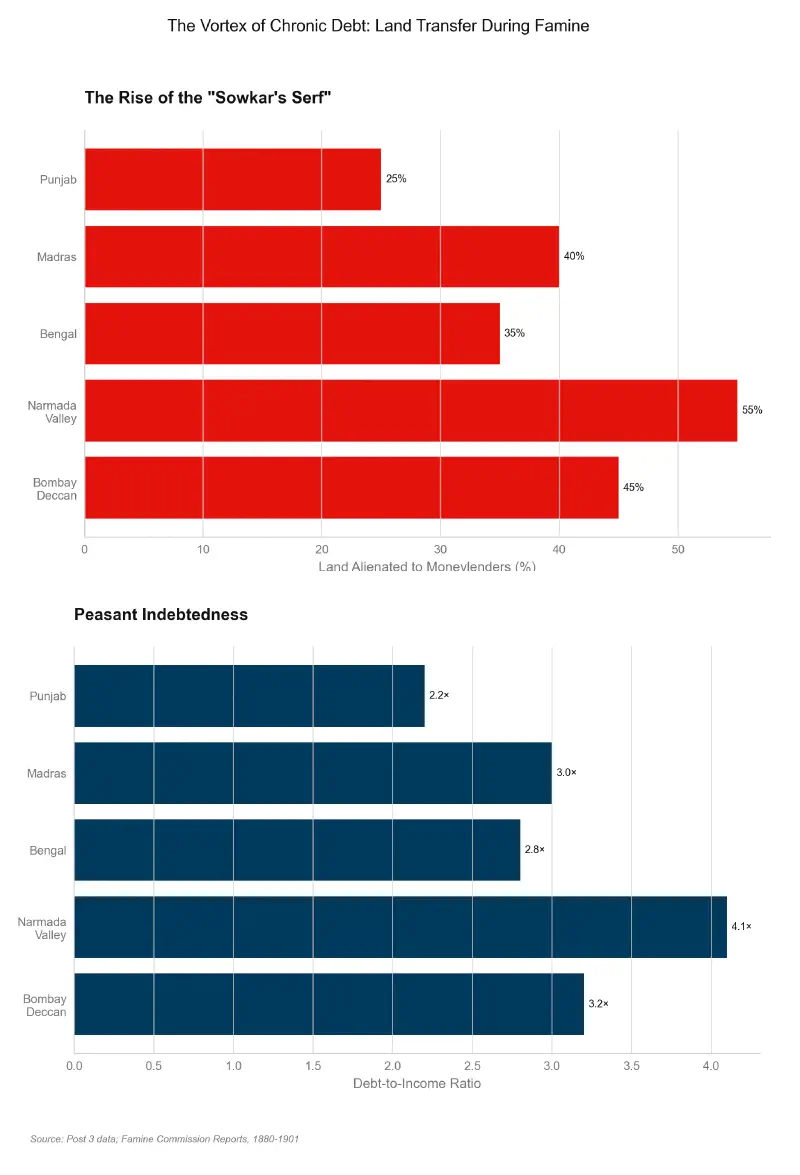
The colonial state’s land and revenue settlements were the primary engines of peasant dispossession. By fixing high revenue demands in cash and enforcing them with “ruthless vigilance” during droughts, the British forced the peasantry into the arms of the moneylenders. In the late-Victorian Bombay Deccan, revenue collection began with the impounding of grain in village yards; to eat, the ryot had to borrow money at 38% interest to pay their taxes. This created a “vortex of chronic debt” where the creditor-debtor relationship was quickly transformed into one of master and serf. By 1901, the Famine Commission admitted that instead of the “capitalist cultivator” the British had expected, they had produced the “sowkar’s serf”—a peasant who had lost all title to their land and worked solely for the benefit of the usurer.
The “Drought Industry” and Land Alienation#
The great droughts were not just mortality events; they were “strategic elements in the process of accumulation”. For the “magnate class” of Indian elites—the inamdars and malguzars—famine was a business opportunity. They used the crisis to buy cattle cheap and mortgage the lands of their ruined neighbors. In the Narmada Valley, by 1889, more than half of the land had passed into the hands of moneylending castes who had no interest in “improving” the land, only in extracting rent. These “apprentice despots” abandoned the direct organization of production to squeeze profit out of “unpaid family labour,” forcing the peasantry to work longer and harder for nothing.
The Ledger of Extractions#
The British “stores policy” and the monopoly of agency houses ensured that the profits of the Indian export boom never returned to the village level. The “Military-Extraction Gap” meant that while India supplied one-sixth of the UK’s finished cotton market, its own people were “virtually unclothed by poverty,” with per-capita textile consumption plummeting as raw cotton exports soared. The wealth of the subcontinent was drained to pay the “interest charges and capital repayments in London,” leaving the Indian subject as the “fuel” for a guaranteed 5% return to British railroad investors [1165, Post 4].
| The Speculator’s Windfall (c. 1900) | Value (£ / Rs) | Today’s Value ($) |
|---|---|---|
| Annual Home Charges | £17.3M | $3.68 Billion |
| Export of Gold (Interwar) | £250M | $53.2 Billion |
| Increase in Rural Debt (1929-39) | Rs 6,500M | – |
| Wheat Exports to UK (1877) | 1.4M Quarters | – |
The “Merchants of Dearth” were the essential mechanics of the colonial system. They turned climate instability into a “permanent violence” where the survival of the peasant was secondary to the stability of the Liverpool exchange. The complicity of Indian elites in this extraction was not an accident but a “manufactured dependency,” where the colonial state rewarded those who facilitated the siphon of wealth. As we conclude the series in the final post, we will examine the terminal accounting of this system under Lord Curzon and the “Golden Ransom” that marked the end of British rule.