
The Scientist of Starvation#
In early 1877, as the Great Famine accelerated across the Deccan, Lord Lytton found his perfect “enforcer” in Sir Richard Temple. Temple was a man whose career was defined by a desperate desire to retrieve a reputation for “extravagance”. Three years earlier, during a famine in Bihar, he had imported half a million tons of rice and effectively forestalled mass mortality, resulting in only twenty-three recorded deaths. For this success, he was lambasted by The Economist for encouraging Indians to believe it was the “duty of the Government to keep them alive” and was denounced by London officials for “pure Fourierism”—spending money to save “a lot of black fellows”. Chastened and ambitious, Temple returned to the famine districts of Madras in 1877 with a new mandate: to make relief as repugnant and ineffective as possible.
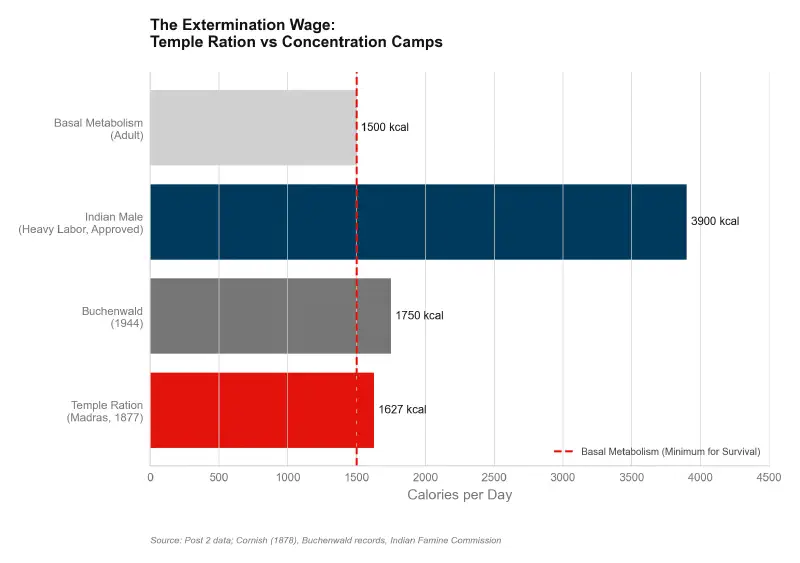
Temple became the architect of a Benthamite “experiment” that eerily prefigured the nutritional research conducted in Nazi concentration camps. He argued that everything must be subordinated to the financial consideration of disbursing the smallest sum of money consistent with the preservation of life. His tool was the “Temple Wage”: a ration of one pound of rice per day for men performing heavy manual labor in work camps. This ration provided only 1,627 calories—less than the 1,750 calories provided to inmates at the Buchenwald concentration camp in 1944. While medical officers like Dr. Cornish protested that this ration was a sentence to “slow, but certain starvation,” Temple dismissed their concerns as “irresponsible”. He viewed the starving peasants not as victims, but as “refractory children” who needed to be disciplined by the logic of the ledger.
The Mechanics of the Work Camp#
The “Temple Wage” was only one component of a broader system designed to discourage the poor from seeking aid. The British administration militarized relief, creating a regime of deterrents that prioritized labor output over human survival. Relief was no longer a right; it was a transaction where the “animated skeletons” of the peasantry were required to break stone or dig canals for a wage that could not sustain their basal metabolism. This system was enforced by a bureaucracy that viewed any sign of “fatness” in relief camps with suspicion and patrician contempt.
The Torture of the Distance Test#
To ensure that only the truly destitute received aid, Temple enforced the “Distance Test”. Starving applicants were refused work within a ten-mile radius of their homes and were forced to travel to dormitory camps far from their localities. This requirement served multiple imperial purposes: it broke the social fabric of the village, separated families, and ensured that many of the weakest—the aged, the infirm, and the very young—died on the trek. The Poona Sarvajanik Sabha warned that this policy would doom thousands, particularly children who were “cast out” from relief if their parents could not carry them to distant camps. For those who survived the journey, the camps were not sanctuaries but “Government charnel houses” characterized by dreadful sanitation and heavy labor.
The Arithmetic of Camp Mortality#
The combination of the starvation wage and the grueling labor requirements punctually produced lethal results. By May 1877, relief officials in Madras reported that more than half of the camp inmates were too weakened to perform any labor whatsoever. As the sanitary commissioner Dr. Cornish pointed out, the monthly mortality in these camps was equivalent to an annual death rate of 94%. Post-mortem examinations revealed that the chief cause of death was “extreme wasting of tissue”—textbook starvation—with full-grown men reduced to under sixty pounds in weight. In many cases, the work camps became crucibles for cholera and malaria, as immune-suppressed populations were huddled together in filthy environments. One official described a relief road project that “bore the appearance of a battlefield, its sides being strewn with the dead”.
The Divergence of Penal and Famine Logic#
A cruel irony of the Temple system was that Indian jails became the only “institutional sanctuaries” for the poor. While a famine laborer received one pound of rice, a common felon was traditionally entitled to two pounds. American missionaries recounted stories of weavers begging to be arrested for contract non-fulfillment just to secure jail rations: “If you will only send us to jail we shall get something to eat”. This disparity highlighted the “punitive” nature of famine relief; the state was more concerned with feeding those who had broken its laws than those whose only “crime” was their inability to survive the market perturbations of the Empire.
The Theology of the “Idleness”#
Temple’s response to the mass mortality in his camps was to blame the victims. He claimed the “bone and sinew” of the country—the cultivating yeomanry—did not die; rather, the dead were parasitic mendicants who had committed a form of suicide through their “infatuation with eating the bread of idleness”. He argued that many were not “inclined to grieve much for the fate which they brought upon themselves”. This rhetoric served to sanitize the genocide, transforming a policy-induced holocaust into a moral failing of the Indian people. Temple even imposed the Anti-Charitable Contributions Act of 1877, which prohibited private relief donations under threat of imprisonment, fearing that “indiscriminate alms-giving” would interfere with the market-fixing of grain prices.
| Subsistence Arithmetic (1877) | Value (Calories) | Comparison |
|---|---|---|
| Temple Ration (Madras) | 1,627 | Heavy Manual Labor |
| Buchenwald Ration (1944) | 1,750 | Forced Labor |
| Indian Male (Approved Diet) | 3,900 | Heavy Labor |
| Basal Metabolism (Adult) | 1,500 | No Activity |
The “Biology of the Ledger” was a system where the caloric intake of a human being was calculated not to sustain life, but to minimize expenditure. Sir Richard Temple proved that with sufficient “pliability” of character, a colonial official could oversee the disappearance of one-fourth of a district’s population and still proclaim the famine to be “under control”. The Temple Wage was the physical manifestation of the imperial belief that the Indian subject was a resource to be “mined” until exhausted. As we turn to the third post, we will explore how this administrative indifference allowed for the “greed of the middleman” to turn mass mortality into a speculative windfall for both British and Indian elites.