
The Sound of the Trumpet and the Silence of the Grave#
In late 1876, the Indian subcontinent was a land of two dissonant sounds. In Delhi, the air vibrated with the brassy fanfares of the Imperial Assemblage, a week-long feast for 68,000 officials, satraps, and maharajas convened to proclaim Queen Victoria “Empress of India”. It was the most colossal and expensive meal in world history, a pageant of Arabian fiction designed to hide the “nakedness of the sword” upon which British rule relied. Meanwhile, in the Ceded Districts of Madras and the scorched plains of the Deccan, a different sound prevailed: the silent withering of the kharif crop and the desperate cries of millions who had already begun to flee a dying countryside. While the Viceroy, Lord Lytton, presided over a spectacular “Nero-like” durbar, an estimated 100,000 of the Queen-Empress’s subjects starved to death in the immediate vicinity of his celebrations.
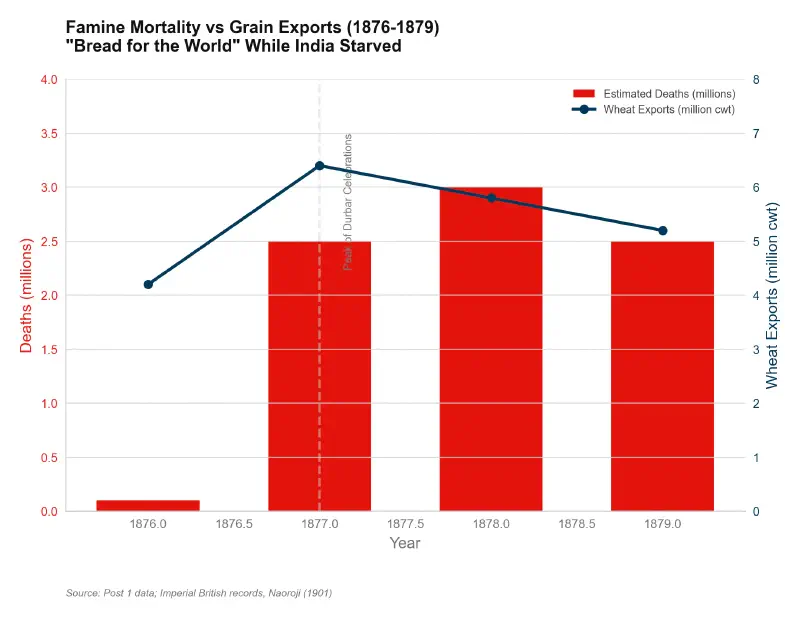
This was not a tragedy of absolute scarcity. As the life-giving southwest monsoon failed southern India, grain surpluses in the Punjab and Bengal were abundant. Yet, these reserves did not flow to the starving; they flowed to London. During the height of the 1877 famine, grain merchants exported a record 6.4 million hundredweight (cwt) of wheat—the equivalent of approximately 320,000 tons—to Europe. The paradox of India supplying “bread for the world” while her own people ate roots is the central mystery of the Victorian era. It was a mystery solved not by nature, but by the “theology” of a colonial administration that viewed the biological survival of its subjects as a “tiresome distraction” from the Great Game of geopolitics and the sacred principles of the unfettered market.
The Mandate of Misrule: Ideology as Weaponry#
The 44-year-old Lord Lytton, a poet who wrote under the pseudonym Owen Meredith, was a man whose judgment was widely suspected to be addled by opium and megalomania. Yet, in his adoption of a strict Laissez-faire approach to famine, he was the perfectly disciplined student of Adam Smith and Thomas Malthus. He believed that high grain prices were the “natural saviours of the situation” because they limited consumption and stimulated imports—ignoring the reality that the poor had no money to purchase the grain that sat in the markets. Lytton issued “semi-theological” orders that there was to be no government interference with the price of food, denouncing the desire to save lives as “humanitarian hysterics”. To the colonial administration, the Indian people were a Utilitarian laboratory where the costs of human life were balanced against the solvency of the Indian Treasury.
The Mechanism of Marketized Starvation#
The British administration transformed the traditional Indian economy into a captive export sector. The infrastructure meant to safeguard against famine—the railroads and the telegraph—became the very instruments that accelerated it. Railroads were used by merchants to ship grain away from drought-stricken districts to central hoards or for export to England, where prices were more attractive. The telegraph allowed price hikes to be coordinated across a thousand towns simultaneously, regardless of local supply. This ensured that food prices skyrocketed out of reach for outcaste laborers, weavers, and poor peasants. In some districts, while people died on the steps of grain depots, the taxes used to finance these “modernizing” railroads continued to crush the remaining cultivators.
The Crucible of the Famine Insurance Fund#
Following the 1876 catastrophe, the British established a “Famine Insurance Fund” intended to ensure that future droughts could be managed without fiscal risk. However, the management of this fund became a masterpiece of administrative cynicism. Lord Lytton and his budgetary adviser, Sir John Strachey, ensured that the funding for this insurance was entirely regressive. They rejected income taxes on European officials and wealthy elites, choosing instead to levy a “famine tax” on the potential famine victims themselves through land cesses and brutal hikes in salt duties. In Madras and Bombay, the cost of salt was raised from 2 to 40 annas per maund—an extraction equivalent to taxing the very breath of the poor. Worse still, large portions of this fund were periodically looted by the government to pay for aggressive military adventures along the Afghan border.
The Cascade of Imperial Indifference#
The human toll of Lytton’s administration is estimated between 6.1 million and 10.3 million deaths for the 1876-79 period alone. This carnage was the foreseeable result of a policy that prioritized the “Home Charges”—the annual transfer of wealth to England—above all else. By 1880, this “drain” was calculated at £30,000,000 per year. In today’s money, this represents an annual extraction of $6,384,600,000 from a population where the average laborer earned two to three pence a day. Every farthing spent on relief was viewed as a “pure loss” by officials who believed that preventing the death of the “redundant” poor would only enhance the evils of overpopulation. This “Malthusian overtoning” turned the British Raj into an engine of extraction that functioned most efficiently during the peak of human collapse.
The Ledger of Moral Bankruptcy#
The first phase of the Victorian famines illustrates that the “Architecture of Attrition” was built on a foundation of deliberate policy choices. The refusal to remit taxes during crop failures forced peasants to sell their “bullocks, field implements, the thatch of the roofs, and the frames of their doors and windows” just to survive the first year of drought. By the second year, they were destitute and unable to plant, leading to a “mortality shadow” that claimed millions more in 1878 and 1879. The British administration, meanwhile, kept its “serenity and cheerfulness unimpaired,” threatening to degrade any civilian official who opened relief works at their own expense or countenanced the “pretense” that the natives were dying of hunger.
The legacy of Lytton’s viceroyalty was not the proclamation of an Empress, but the transformation of the Indian landscape into a “hideous record of human suffering”. As the Parsi scholar Dadabhai Naoroji pointed out, the British were the “main cause of the destruction that ensues from droughts” because their systemic drain of wealth left the population with no reserves to survive the slightest climate perturbation. The sound of the trumpets in Delhi in 1877 did not herald a new age of prosperity; it signaled the beginning of a half-century of manufactured dearth where the “laws of iron” of the British bureaucracy were tested against the biological limits of the Indian peasant. As we move to the next post, we will see how these ideological foundations were translated into the brutal “biology of the ledger” through the pseudo-scientific experiments of Sir Richard Temple.