Ideology as an Exterminant: Laissez-faire dogma and Malthusianism were used to justify the “Temple Wage”—a ration lower than that of Buchenwald—labeling mass mortality as a “natural correction” for overpopulation.
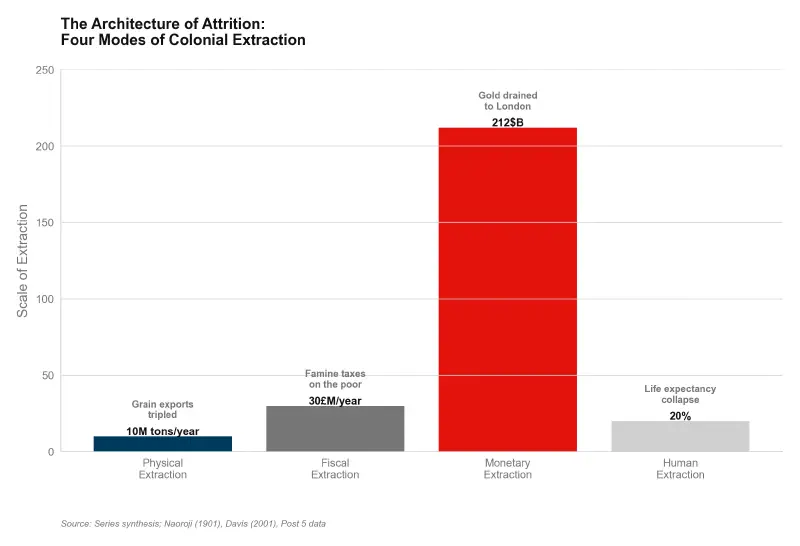
The Export-Famine Paradox: Between 1875 and 1900, annual grain exports tripled while the worst famines in history occurred, proving that mortality was an entitlement failure, not a food supply failure.
Infrastructure as a Vector: Railroads and the telegraph, marketed as relief tools, actually globalized speculation and facilitated the removal of grain from drought-stricken villages to London markets.
Elite Complicity: The colonial system rewarded a “magnate class” of Indian moneylenders and landowners who profited from famine by mortgage-stripping neighbors and practicing usury, creating the “sowkar’s serf.”
The Interwar Gold Drain: The liquidation of £250 million ($212B today) in ancestral gold ornaments during the 1930s was the final “miracle” of extraction that saved the sterling system at the cost of Indian resilience.
Systemic Deterioration: Colonialism resulted in a 20% decline in life expectancy (1872-1921), demonstrating that the “drain of wealth” was fundamentally a drain of biological capital from the Indian people.