
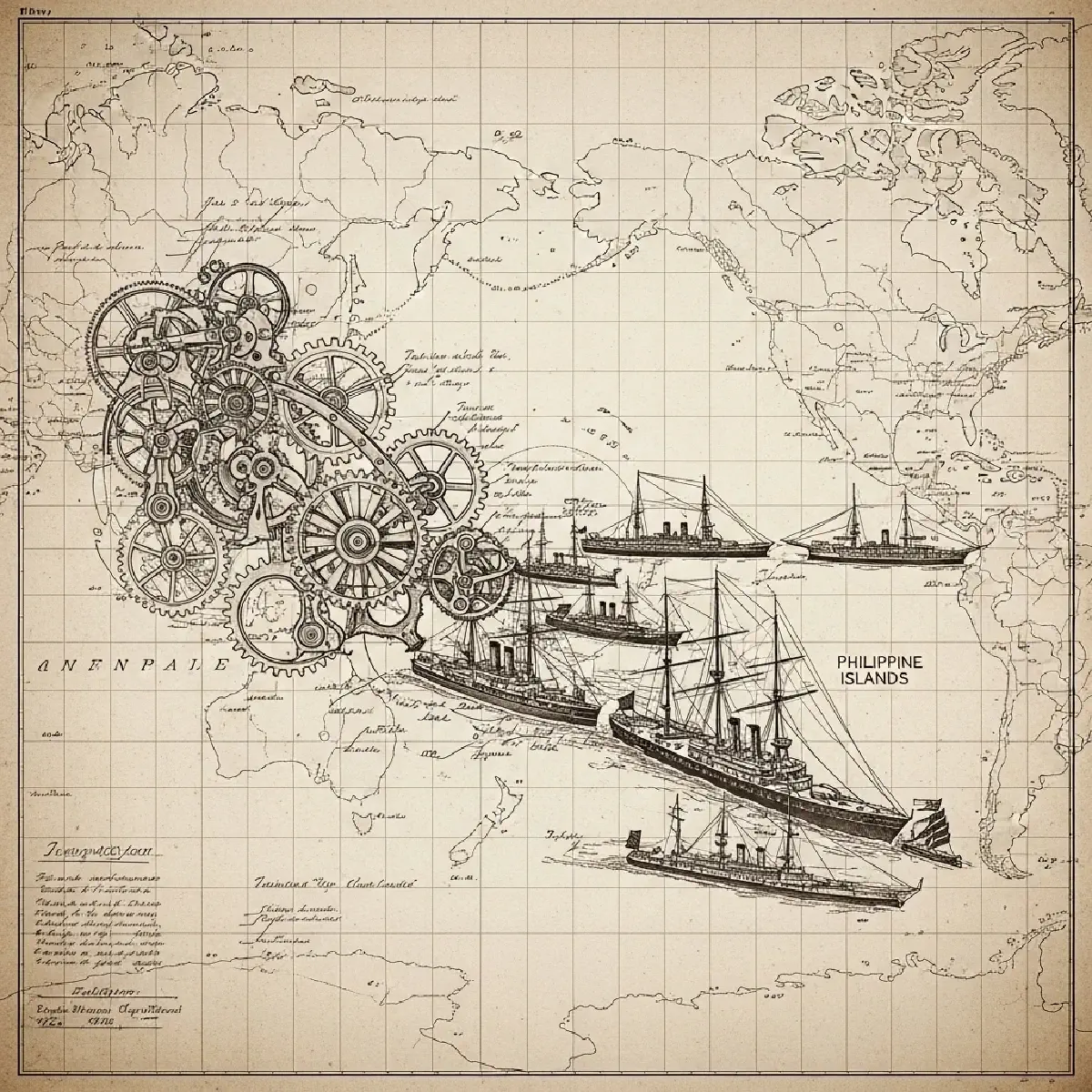
The closure of the continental frontier triggered a systemic crisis. The ideological and economic machinery built for westward expansion—the belief in righteous growth, the capital markets for railroads and land, the military structures for Indian removal—faced a surplus of energy with nowhere to go. The system required a new output. The solution, engineered by a cohort of politicians, naval strategists, and businessmen, was to redirect the machinery overseas. They provided the technical and doctrinal blueprints that transformed an insular “city” into a global power.
Alfred Thayer Mahan, president of the Naval War College, supplied the strategic logic. In his 1890 book, The Influence of Sea Power Upon History, he argued that national greatness was not born from moral example but from controlling sea lanes and establishing coaling stations and colonies. Great powers needed navies, and navies needed global bases. Mahan’s theory was a technical manual for empire, eagerly read in Washington, London, and Berlin. It provided a “scientific” rationale for what manifest destiny had justified by faith. Meanwhile, the ideology adapted. Proponents like Senator Albert Beveridge framed expansion as the “White Man’s Burden,” a duty to lift “backward” peoples. Racism, once a justification for clearing a continent, was now exported as a rationale for civilizing islands.
The Spanish-American War of 1898 was the system’s first major overseas test. The casus belli was quintessentially American: a righteous crusade to liberate Cubans from Spanish brutality, catalyzed by the sinking of the USS Maine. The war was short and decisive. And here, the machinery revealed its true function. The U.S. liberated Cuba only to control its politics via the Platt Amendment. It “liberated” the Philippines, Puerto Rico, and Guam, then annexed them. When Filipino leader Emilio Aguinaldo declared independence, the United States fought a bloody three-year war to suppress it. An estimated 200,000 to 300,000 Filipino civilians died from violence, famine, and disease. The “savage” was no longer a Plains warrior but a Southeast Asian insurgent, and the counter-insurgency tactics—reconcentration camps, torture, wholesale destruction of villages—were brutal. The savior had become the sovereign. The “city upon a hill” was now a distant garrison.