The Evolution of the “City upon a Hill”: The concept evolved from a Puritan ideal of moral isolation into a secular mandate for continental and global expansion, justifying territorial growth as a “manifest destiny.”
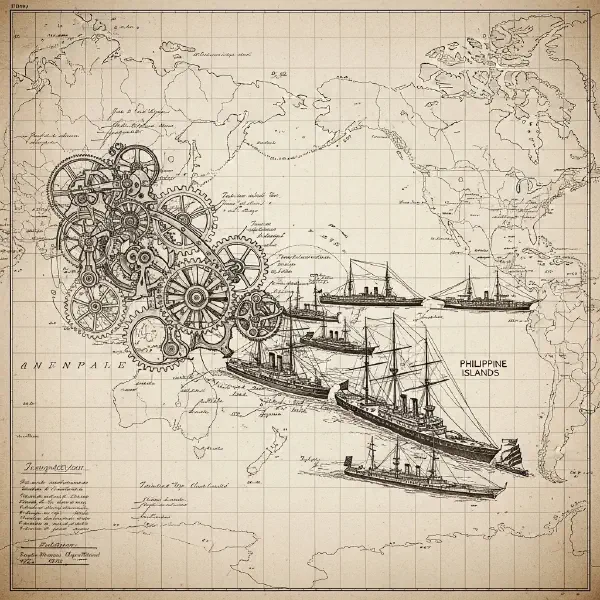
The Machinery of Doctrine: American expansionism redirected its continental energies overseas using strategic logic (Mahan) and moral crusades, transforming the nation from a savior to a global sovereign.
The Sanctified Security State: The Cold War normalized a permanent national security apparatus that used the Manichean struggle between “freedom” and “slavery” to justify covert interventions and proxy conflicts.
The Investigative Mirror: Fearless journalism, exemplified by Seymour Hersh, acts as a vital forensic counter-narrative, exposing the brutal distance between official ideals and operational realities.
The Enduring Paradox: The tension between America’s exemplary identity and its imperial actions is sustained by a system that uses internal critique to reaffirm its central moral purpose.
Hersh, S. M. (1970). My Lai 4: A Report on the Massacre and Its Aftermath. Random House.
Immerman, R. H. (1982). The CIA in Guatemala: The Foreign Policy of Intervention. University of Texas Press.
Kinzer, S. (2006). Overthrow: America’s Century of Regime Change from Hawaii to Iraq. Times Books.
Kramer, P. A. (2006). The Blood of Government: Race, Empire, the United States, and the Philippines. University of North Carolina Press.
Mahan, A. T. (1890). The Influence of Sea Power Upon History, 1660–1783. Little, Brown and Company.
McCoy, A. W. (2009). Policing America’s Empire: The United States, the Philippines, and the Rise of the Surveillance State. University of Wisconsin Press.
O’Sullivan, J. L. (1845). Annexation. United States Magazine and Democratic Review, 17(1), 5–10.
Williams, W. A. (1959). The Tragedy of American Diplomacy. W. W. Norton & Company.
Winthrop, J. (1630). A Model of Christian Charity. Sermon delivered aboard the Arbella.
Zinn, H. (1980). A People’s History of the United States. Harper & Row.