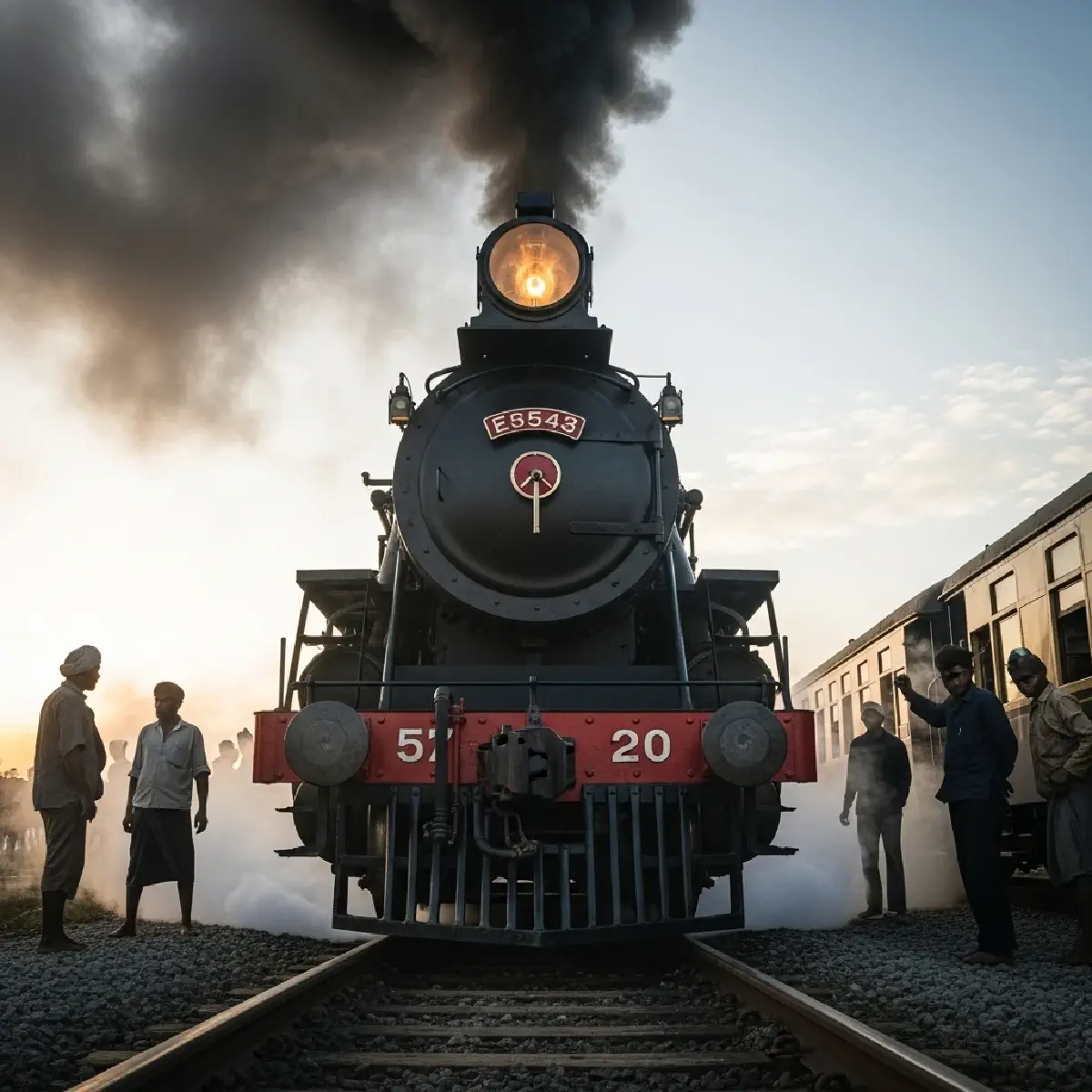
In May 1857, Indian sepoys rebelled against the East India Company in Meerut. The news reached London via telegraph in a matter of hours. Troops were dispatched not on slow, wind-dependent sailing ships, but on steam-powered vessels that could ignore the seasons. They disembarked at Indian ports linked by a new, growing network of railways, allowing them to be rushed inland to suppress the revolt with shocking speed. The rebellion was crushed not just by soldiers, but by the infrastructure of the Industrial Revolution. Technology had completed the imperial project, transforming it from a network of coastal holds into a continent-spanning system of total control.
The first wave of empire was built on sails, ledgers, and muskets. The second was forged from iron, coal, and steam. The Industrial Revolution, born in Britain’s damp Midlands, provided the material means to tighten its imperial grip to an unbearable degree. It solved the final, great constraints of empire: time and the friction of distance. The railway, the steamship, and the telegraph did not merely improve the empire; they redefined its very logic, enabling a shift from opportunistic plunder to scientific, systemic extraction. The colony was no longer just a possession; it was an integrated component in a global industrial machine.
The Annihilation of Distance#
The steamship revolutionized the connective tissue of empire. The SS Great Eastern, launched in 1858, could carry 4,000 troops or 10,000 tons of cargo from Britain to India via the Suez Canal in under a month, independent of the monsoon winds that had governed Asian trade for millennia. This regularity turned colonies from distant, uncertain ventures into predictable economic inputs. Perishable goods could be shipped; administrators and troops rotated on schedules; news and orders flowed continuously.
On land, the railway was the ultimate tool of penetration and control. The first passenger rail line in India opened in 1853, from Bombay to Thane. By 1900, India had the world’s fourth-largest rail network, over 25,000 miles of track. Its purpose was explicitly dual: commercial and strategic. As Governor-General Lord Dalhousie’s 1853 railway minute stated, it would allow “the commercial and social advantages of united territories” while enabling “the rapid movement of troops.”
The effects were transformative. Cotton from the Deccan could reach Bombay’s mills in days, feeding Lancashire’s hunger for raw materials. Wheat from the Punjab could be shipped to deficit regions or exported, often exacerbating local famines when food was diverted. Most critically, the railway allowed a tiny British administrative class—perhaps 1,000 civil servants ruling 300 million Indians—to project power instantly. A rebellion in one district could be met by troops from hundreds of miles away within a day, making widespread, coordinated revolt nearly impossible.
The Telegraph: The Imperial Nervous System#
If railways were the empire’s arteries, the telegraph was its central nervous system. The first successful submarine cable linked Britain and India in 1865. Suddenly, the lag between event and command, which had been six months round-trip, collapsed to minutes. The Viceroy in Calcutta could now be micromanaged from the India Office in London. Global strategy could be coordinated in real-time.
This centralized command eroded the autonomy of “men on the spot”—the Clive-like figures who had built the empire through local initiative. Imperial governance became more systematic, more bureaucratic, and more responsive to metropolitan political and economic winds. The telegraph turned the sprawling, diverse empire into a single, manageable, if sluggish, organism. Information, the substance of power, now flowed at the speed of electricity, and its hub was irrevocably fixed in London.
The Ecology of Extraction#
Industrial technology also enabled a deeper, more ecological form of extraction. Steam-powered dredges and pumps allowed for massive mining operations for gold in South Africa, tin in Malaya, and copper in Zambia. Plantation agriculture was industrialized, with trains moving harvests and processing machinery increasing scale. The empire systematically reshaped colonial landscapes to feed metropolitan industry.
This created devastating new vulnerabilities for colonized societies. Local economies were re-engineered as monoculture exporters. When the global price of jute or rubber fell, entire regions faced immediate destitution, as they no longer grew their own food. The infamous Irish Potato Famine (1845-52) and the Indian famines of the late 19th century were tragedies where colonial economic policies—exporting food via rail and ship while locals starved—were enabled and amplified by the very infrastructure that was meant to signify progress.
Furthermore, industrial tools enabled staggering environmental transformation. Vast forests in India and Burma were cleared for railway sleepers and tea plantations. Rivers were re-routed for irrigation canals feeding cash-crop cotton fields. The empire acted as a geological force, moving mountains of ore and continents of soil to fuel the engine of British industry.
The Completion of a System#
By the late 19th century, the British Empire was a fully integrated, techno-political system. British capital financed the railways. British engineers designed and built them, often using British-made iron rails. They transported raw materials to British-controlled ports, where British steamships carried them to British factories. The finished goods were then sold back to colonial markets, often tariff-free, stifling local industry. The loop was closed, perfect, and incredibly difficult to break.
The Industrial Revolution did not just give Britain more tools; it locked in its structural dominance. It raised the entry cost for rival empires to a staggering level. The era of empire-by-sail was over. Now, it was empire-by-rail-and-cable, a system only an industrial superpower could operate. This technological vise cemented a global hierarchy for a century, proving that the ultimate form of control is not merely occupation, but the irreversible integration of a territory’s economy, landscape, and communications into a system whose control panel lies an ocean away. The age of coal and iron had forged the first truly global system of power, and Britain sat at its throttle.