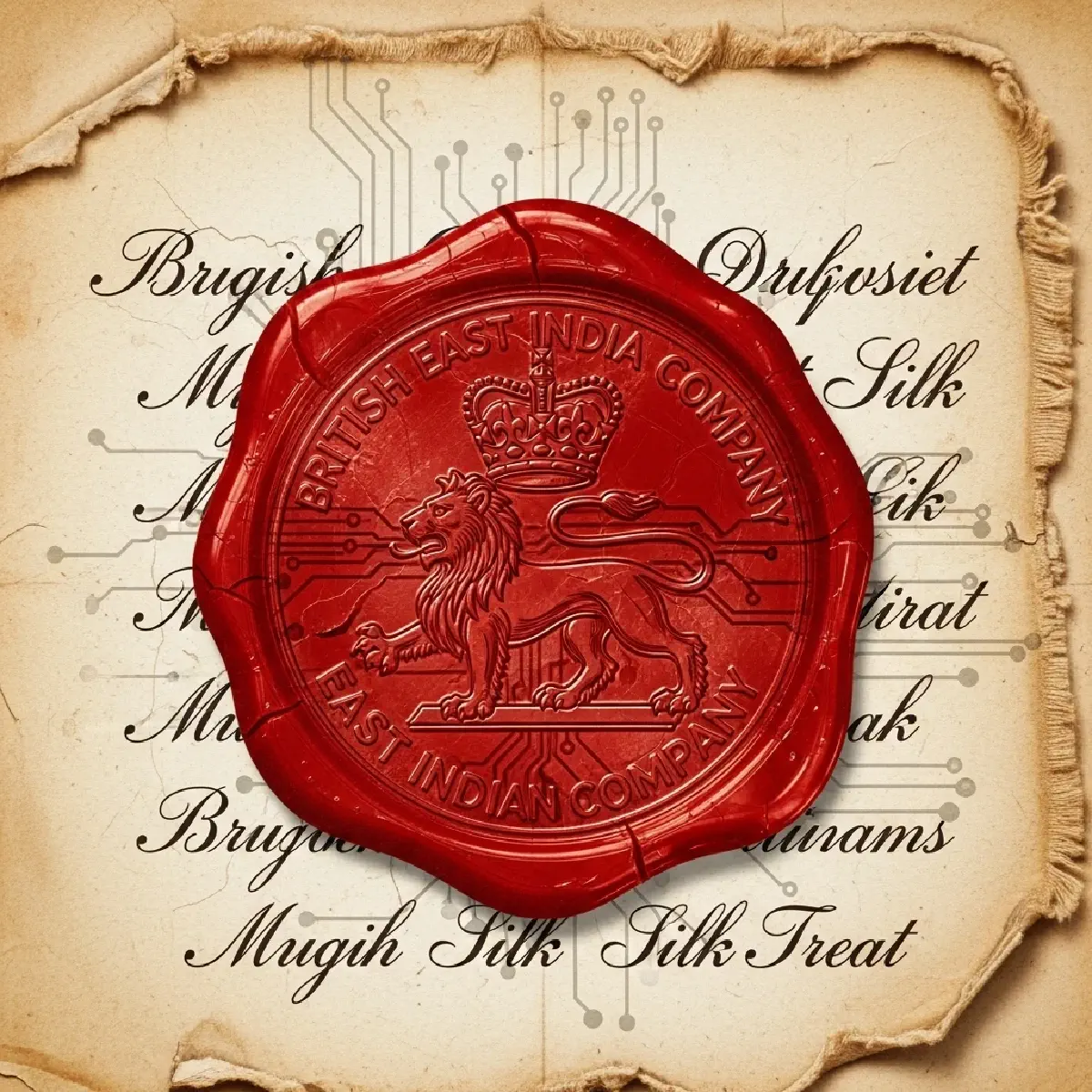
On August 24, 1608, the ship Hector arrived at the Indian port of Surat. Its captain presented a formal permit from King James I of England, granting the “Governor and Company of Merchants of London trading into the East Indies” the exclusive right to trade east of the Cape of Good Hope. The local Mughal officials were likely unimpressed by the parchment from a distant, minor king. They could not fathom that this piece of paper represented a new form of power: the sovereign corporation. It was a legal fiction that would raise armies larger than England’s, administer territories vaster than Britain, and orchestrate famines that killed millions—all in pursuit of shareholder dividend.
The British East India Company was not a business in the modern sense. It was a corporate-state hybrid, a technological innovation in governance as consequential as the steam engine. It externalized the immense risk and cost of empire away from the royal treasury and onto private investors. It provided “plausible deniability” for acts of violence a state could not openly sanction. And it operated with a focused, profit-driven brutality that no government bureaucracy could sustain. The EIC did not just serve the British Empire; for a crucial century, it was the British Empire in Asia.
A Monopoly with Muskets#
The Company’s royal charter granted it a monopoly on English trade, but its true power came from three unprecedented rights: to wage war, to make treaties, and to govern territory. It could mint its own coins, command its own legal courts, and hold its own subjects. In essence, it was a licensed sovereign. This structure solved a core dilemma for a cash-strapped island nation: how to project power 12,000 miles away without bankrupting the state.
The EIC raised capital by selling shares to aristocrats, merchants, and even the monarch. This pooled wealth financed the creation of a private security force that evolved into a professional standing army. By 1800, the Company’s army numbered 260,000 men—twice the size of the British Army. It was this force, not red-coated British regulars, that defeated the Nawab of Bengal at Plassey, toppled the Mughal Empire’s remnants, and fought the Marathas. Shareholders in London, receiving their quarterly dividends, were funding a perpetual, shareholder-owned war machine.
The Company’s governance was a study in profit-maximizing extraction. After securing the diwani (right to collect taxes) in Bengal in 1765, it transformed from a trading concern into a territorial tax-collecting state. Its administrators, like the infamous Robert Clive, focused on maximizing short-term revenue to buoy the Company’s stock price and finance its wars. The result was a fiscal regime of staggering cruelty. Tax demands were fixed in cash and collected relentantly, even during droughts.
The Calculus of Catastrophe#
This systemic pressure contributed directly to the Great Bengal Famine of 1770, which killed an estimated 10 million people—one-third of the region’s population. While a natural drought triggered the crisis, the Company’s policies turned it into a cataclysm. It enforced tax collections, hoarded rice for its own warehouses and armies, and prohibited private grain trade. The famine’s horror was not an accident of nature; it was a logical outcome of a corporate structure that prioritized remittances to London over the stability of its own tax base.
The EIC’s financial maneuvers were as innovative as its violence. To get looted treasure and tax revenue back to London, it pioneered complex financial instruments like bills of exchange and treasury bonds, deepening London’s capital markets. It also created a sprawling patronage network, where Company wealth bought political influence in Parliament to protect its monopoly. The line between state and corporation became dangerously blurred. When the Company’s rapacity finally led to a liquidity crisis and a massive bailout by the British government in 1773, it marked a turning point: the state began to reclaim sovereignty from its corporate avatar.
The Corporate Template for Global Power#
The EIC’s true legacy is the template it created. It demonstrated that sovereignty—the very essence of state power—could be unbundled, franchised, and operated for profit. It proved that a well-capitalized entity with a legal charter could govern millions more efficiently (for its purposes) than a traditional monarchy concerned with legitimacy and dynasty.
This model was replicated and adapted. The Hudson’s Bay Company administered a territory larger than Europe in North America. The Royal African Company held a monopoly on the British slave trade. In the 19th and 20th centuries, chartered companies would carve out spheres of influence in Africa, like Cecil Rhodes’s British South Africa Company. The modern multinational corporation, with its private security contractors, complex offshore legal structures, and influence over trade policy, is a direct descendant of this East India Company model.
The EIC was eventually dissolved in 1874, its powers absorbed by the British Crown following the trauma of the 1857 Indian Rebellion. But the genie was out of the bottle. It had shown that the most effective engine for global expansion was not a crown, but a corporate boardroom armed with a state’s authority. It transformed empire from a national project into a shareholder venture, where human suffering was an externality and profit was the sole metric of success. In the Company’s ruthless ledger, we see the cold, algorithmic heart of modern capitalism and the blueprint for how abstracted, financialized power would continue to shape the world long after the trading posts were gone.