Why brilliant military strategists like Samori Ture and Menelik II could not save a continent from disunity#
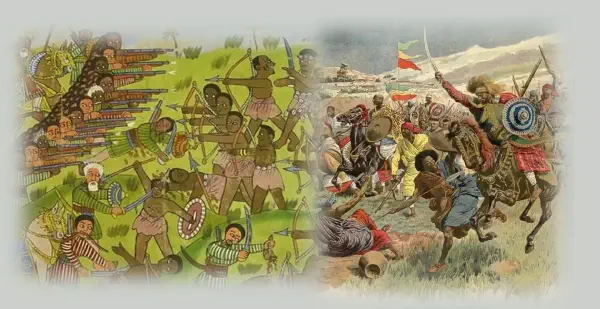
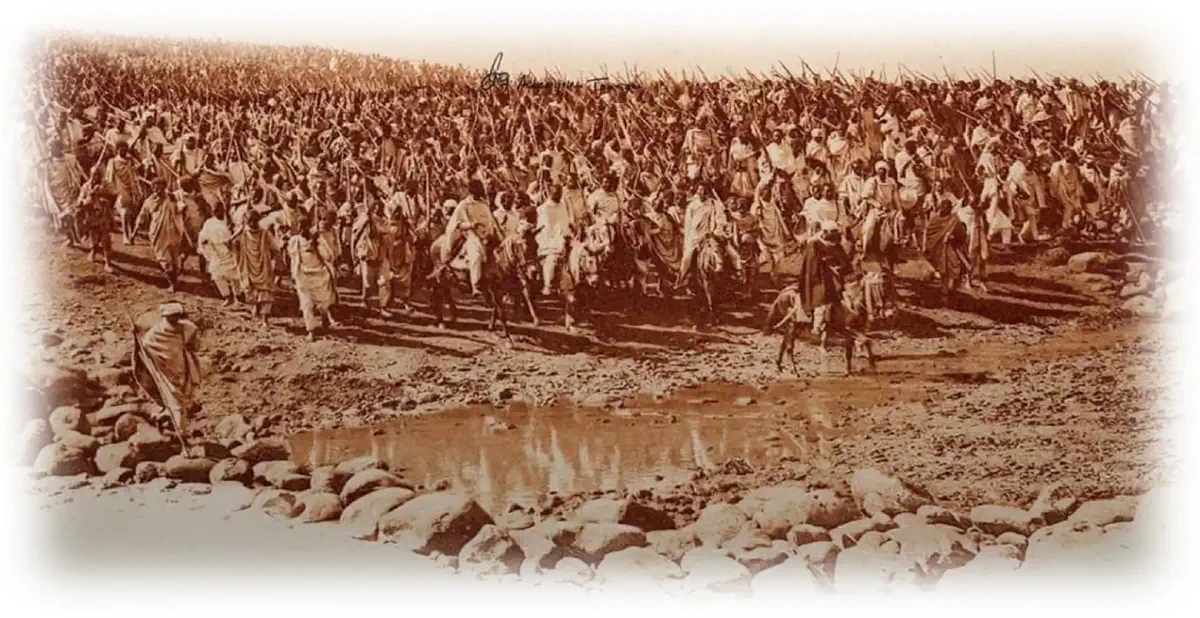
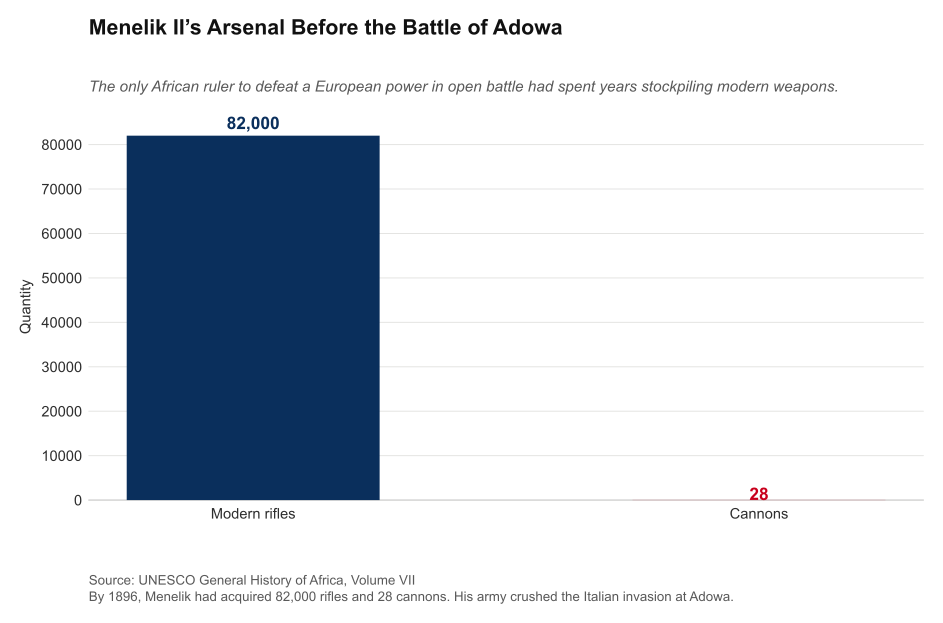
At dawn on 1 March 1896, an Italian expeditionary force of 17,000 men began its advance across the highlands of Tigre toward the town of Adowa. The army was confident, well-supplied, and commanded by officers who had studied the campaigns of Napoleon. Facing them was an Ethiopian host of perhaps 100,000, mobilized by Emperor Menelik II over the preceding months. The Italians had modern rifles and fifty-six pieces of artillery. The Ethiopians had modern rifles too, 82,000 of them, and twenty-eight field guns, largely of French and Russian manufacture. When the battle ended that afternoon, the Italian dead numbered more than 6,000, including 261 officers. The Ethiopian army had not merely won. It had annihilated a European force in open field, something no other African army had achieved. The victory secured Ethiopian sovereignty for the next four decades and made Menelik a hero across the black world. It was also entirely exceptional, the product of a singular convergence of shrewd diplomacy, patient military modernization, and the good fortune of a ruler who grasped the nature of the European threat before it was too late. The tragedy of Africa’s conquest is not that there were no African Caesars. It is that they fought, for the most part, alone, and that their lonely brilliance was no match for a European machinery that could isolate, disarm, and overwhelm each African state in turn.
The lonely genius of Samori Ture#
Samori Ture was born around 1830 into a family of Dyula traders in what is now Guinea. Over three decades, he built an empire that stretched from the upper Niger to the edge of the Ivory Coast forest, a realm of perhaps 250,000 square kilometres. He was not a hereditary monarch but a self-made conqueror, whose authority rested on a standing army that was, by the standards of nineteenth-century Africa, revolutionary. By 1887, Samori’s infantry numbered between 30,000 and 35,000 men, divided into permanent units of ten to twenty soldiers, each commanded by a kuntigi. Ten such units formed a bolo, a fighting arm that could manoeuvre independently. A cavalry wing of 3,000 horsemen provided mobility. It was a professional force, drilled in European tactics, and armed, crucially, with modern breech-loading rifles that Samori acquired through a network of traders in Freetown, Sierra Leone.
Samori’s genius lay as much in logistics as in strategy. He was the only West African ruler who systematically studied the weapons available on the world market and selected those best suited to his environment. When he discovered that the Gras rifle’s large cartridges rotted in the humid forest, he switched to the Kropatschek, a lighter repeating rifle. He trained a corps of blacksmiths to manufacture spare parts and even to copy the weapons. At the peak of his power, he had stockpiled 6,000 quick-firing rifles. He never, however, acquired artillery, a deficiency that would prove fatal.
When the French advanced from the Senegal River in the early 1880s, Samori fought them to a standstill. At the battle of Wenyako in April 1882, his brother Kémé-Brema routed a French column, though a smaller force later turned the tide. Samori’s response was not to seek a decisive confrontation but to pursue a strategy of diplomatic manoeuvre, attempting to secure British protection and, failing that, signing a treaty with the French in 1887 that he used to buy time. When the French broke the treaty and invaded his heartland in 1891, Samori executed one of the most audacious strategic retreats in African history. Abandoning his capital at Bissandugu, he marched his entire state apparatus, civilian population and all, hundreds of kilometres eastward, burning the country behind him in a scorched-earth campaign. In the hinterland of the Ivory Coast, he carved out a new empire, conquering the Abron kingdom and the western reaches of Gonja. He fought on for another seven years, harassing French columns at every turn.
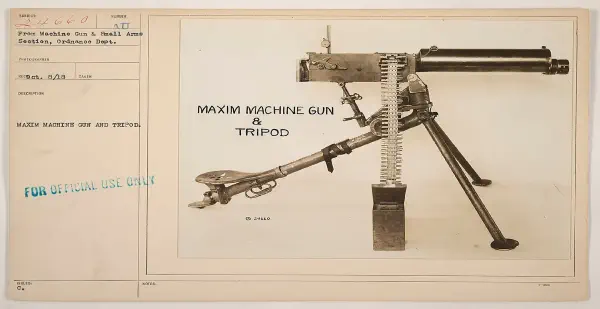
He was finally captured in September 1898, not in battle but in a surprise raid on his camp by a small French detachment. His resistance had lasted sixteen years. It is difficult to think of a contemporary European commander who sustained so prolonged a campaign against such overwhelming odds. Yet Samori’s defeat was, in the end, overdetermined. He fought the French without allies, surrounded by African states that regarded his empire with suspicion or outright hostility. The French, by contrast, could draw on the resources of their entire West African federation and could call on African auxiliaries recruited from the very populations Samori had conquered. The arms embargo imposed by the Brussels Convention of 1890 progressively choked his ammunition supply. When his last route to the coast, through Liberia, was cut in 1894, his army was reduced to hand-loading cartridges and repairing old muskets. The Maxim gun was not the only weapon that defeated him; the embargo was equally lethal.
The calculus of alliance in a fractured continent#
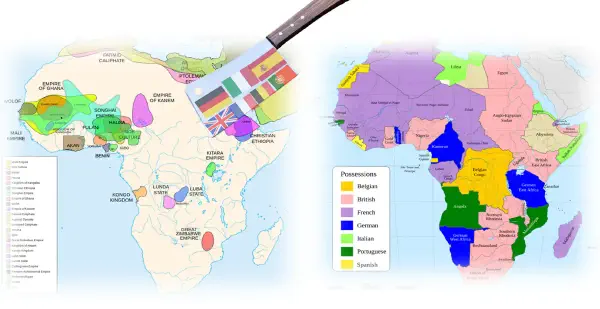
Samori’s isolation was not unique. It was the normal condition of African resistance in the era of the Scramble. The continent was not a single political entity but a patchwork of states, empires, and stateless societies, many of them locked in long-standing rivalries that predated the European arrival by generations. The jihads of the nineteenth century had created new, aggressive theocratic states in the Sudanic belt—the Sokoto Caliphate, the Tukulor empire, the Mandinka state—that were resented by their non-Muslim subjects. The Mfecane in southern Africa had scattered populations and generated new, militarized kingdoms that lived by raiding their neighbours. The Yao and Nyamwezi traders of East Africa competed with Swahili and Arab merchants for control of the ivory and slave routes. These internal fractures were a standing invitation to any power that could exploit them.
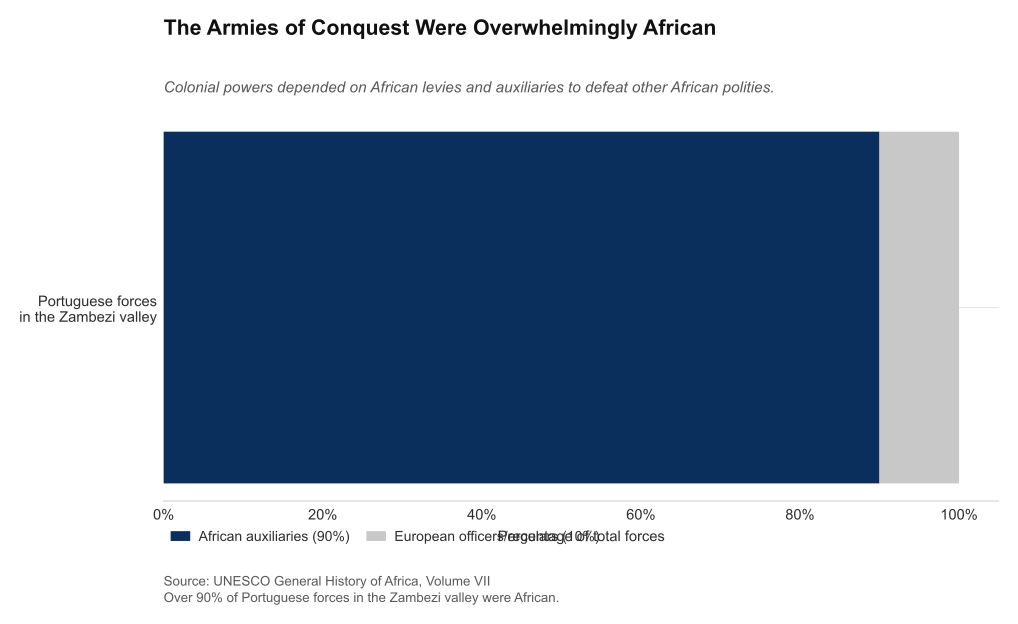
European commanders, far from being the blundering amateurs of colonial mythology, were often acute students of African politics. They knew which kingdoms had tributaries that yearned for liberation, which chiefs resented their overlords, and which factions at a royal court might be persuaded to betray their monarch for a promise of recognition. Harry Johnston, the British consul in the Oil Rivers, played the Delta states against one another with the dexterity of a Renaissance diplomat. Frederick Lugard, for all his private cynicism about the treaties he negotiated, understood perfectly the value of a local ally who could deliver porters, spies, and auxiliary troops. The French in the Western Sudan recruited thousands of Bambara warriors who detested their Tukulor masters. The Portuguese in the Zambezi valley enrolled entire armies of Tonga and Sena levies who had no love for the Barue or the Shangaan. The General History of Africa estimates that more than 90 per cent of the Portuguese forces that conquered the Zambezi were African. The conquest of Africa was, in many theatres, a civil war by proxy, fought by Africans who believed, often mistakenly, that a European alliance would settle old scores and secure their own autonomy.
This pattern has often been described as collaboration, a term that carries a weight of moral condemnation imported from the European experience of the Second World War. The General History rejects that label as both inaccurate and anachronistic. The fundamental issue at stake for every African ruler was sovereignty. Those who chose to ally with the Europeans did so not out of a disloyalty to some imagined African nation—no such nation existed—but because they calculated that a European alliance offered the best chance of preserving their own autonomy, or of regaining autonomy lost to a more powerful African neighbour. Tofa, the king of the Gun kingdom of Porto Novo, is a textbook example. At the moment of the French arrival on the coast in the 1880s, Tofa was encircled by hostile powers: the Yoruba to the north-east, the expansionist Fon kingdom of Dahomey to the north, and the British to the west. He saw the French as a providential ally, a counterweight to the enemies who threatened to swallow his small state. He did not surrender his sovereignty; he attempted to use France to protect it. The French, of course, had other plans. Within a decade, Porto Novo was absorbed into the colony of Dahomey, and Tofa’s independence was extinguished. But his initial choice was rational, not treasonous.
The same calculus confronted rulers in every region of the continent. The Baganda allied with the British against the Banyoro, their historic rivals. The Sotho and Tswana sought British protection against the Ndebele and the Boers. The Lozi of the upper Zambezi signed a treaty with the British South Africa Company because their king, Lewanika, feared a Ndebele invasion more than he feared a distant chartered corporation. In each case, the African ruler was attempting to navigate a world of extraordinary danger with the diplomatic tools available to him. In each case, the European partner used the alliance to establish a foothold and then, gradually, inexorably, absorbed the ally into the colonial administrative grid. The tragedy of these alliances was not that they were made; it was that they were made with powers whose ultimate intentions could not be known until it was too late to reverse course.
The one who broke the mould#
If Samori exemplifies the futility of solitary brilliance, Menelik II demonstrates what was possible when an African ruler grasped the rules of the new game in time. Menelik’s rise to power was itself a product of the Scramble. As king of Shoa, he had spent the 1880s expanding southward and eastward into Oromo and Somali territories, using Italian-supplied firearms to build an empire that more than doubled the size of the Ethiopian state. He maintained cordial relations with Italy even as he watched the Italian encroachment on the Red Sea coast with growing alarm. The Treaty of Wuchale, signed with Count Antonelli in 1889, was meant to secure Italian recognition of Menelik’s imperial title in exchange for the cession of the Eritrean highlands. It contained, however, a fatal ambiguity in Article XVII. The Amharic text stated that Menelik could avail himself of Italian diplomatic services for communications with other powers; the Italian text made this obligatory. On this slender linguistic discrepancy, Italy claimed a protectorate over Ethiopia.
Menelik’s response was a masterclass in diplomatic defiance. He wrote to the European powers in 1893 declaring bluntly that “Ethiopia has need of no one; she stretches out her hands unto God.” He repudiated the treaty and began to prepare for war. The preparation was methodical and expensive. Menelik had learned from the Egyptian and Mahdist wars that modern firearms were the sine qua non of survival. He imported rifles and artillery from France, Russia, and even, indirectly, from Italy itself, using the revenues from his newly conquered provinces to pay for them. By 1895, when he issued his mobilization proclamation, he had assembled an arsenal of 82,000 modern rifles and 28 cannon. His soldiers were not a feudal rabble; they were, for the most part, equipped with weapons that were the equal of anything the Italians carried. The battle of Adowa, when it came, was not a miracle. It was the logical outcome of a decade of ruthless military modernization.
Adowa was the greatest African victory over a European army since Hannibal. It saved Ethiopia from colonization and made Menelik an international figure, courted by envoys from France, Britain, Russia, and the Ottoman Empire. Yet even Adowa could not reverse the broader logic of the Scramble. Menelik did not attempt to liberate Eritrea, which remained under Italian rule. He did not form an anti-colonial alliance with the Mahdist state in Sudan, which was destroyed by Kitchener two years later. He did not supply arms to the Somali resistance led by Sayyid Muhammad Abdulle Hassan, whose long jihad against the British and Italians in the Horn would have benefited enormously from Ethiopian support. Menelik was, in the end, an Ethiopian emperor, not a pan-African liberator. His victory preserved his own throne, but it did nothing to halt the partition of the rest of the continent. Adowa was a solitary peak, not a watershed.
The arms embargo as an instrument of continental disarmament#
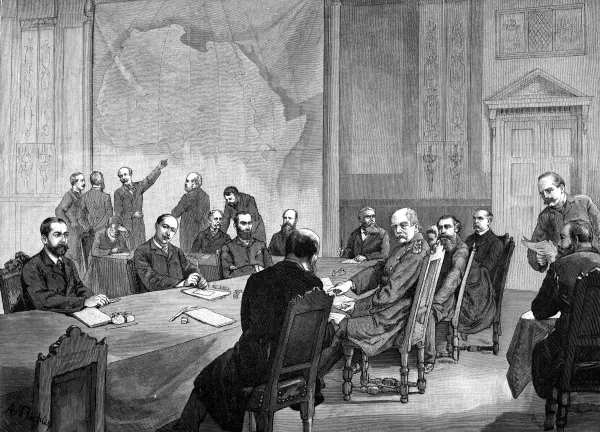
The Brussels Convention of 1890 is one of the least celebrated but most consequential documents of the colonial era. Signed by all the major European powers, it bound the signatories to prohibit the sale of modern firearms to Africans. It was justified in the language of humanitarianism, as a measure to suppress the slave trade and internecine warfare. Its real effect was to freeze the military balance of power at the precise moment when the technological gap between European and African armies had become unbridgeable. The Maxim gun was entering service. Breech-loading rifles, which fired ten times faster than the old muzzle-loaders that constituted the bulk of African arsenals, were becoming standard issue. The embargo ensured that African states could not close this gap. They could buy what they could smuggle, but they could never acquire the artillery, the machine guns, or the ammunition supplies necessary to sustain a prolonged campaign against a determined European enemy.
Samori Ture acquired his rifles before the embargo tightened. Menelik purchased his arsenal during the brief window when powers competing for Ethiopian favour were willing to supply him. No other African ruler was so fortunate. The Zulu, who had terrified the British in 1879, fought the 1906 rebellion with spears and a handful of antique rifles. The Majï Majï rebels of Tanganyika went into battle with water blessed by their prophets, believing it would turn German bullets to water; they were mown down in their thousands. The Herero and Nama of South West Africa, who had once possessed firearms, had been largely disarmed before their uprisings and were left to face German machine guns with nothing but courage. The embargo did not create the technological gap, but it ensured that the gap would widen for decades, until the colonized had no military option left at all.
The sequence of isolated defeats#
The British conquest of what is now Nigeria illustrates the logic of sequential isolation with textbook clarity. The Sokoto Caliphate, the sprawling Islamic state founded by Usman dan Fodio in the early nineteenth century, was the largest and most powerful polity in West Africa at the time of the Scramble. It was not conquered in a single campaign. It was dismantled piece by piece, over the course of a decade, while its constituent emirates looked on, often with indifference or even satisfaction, as their neighbours fell. Nupe and Ilorin were invaded in 1897 by the Royal Niger Company. Kontagora fell in 1900, Adamawa in 1901, Bauchi in 1902. The great emirates of Kano and Sokoto itself were invaded in 1903, and each was defeated in isolation. There was no grand coalition of the faithful against the infidel. The Sultan of Sokoto wrote to Lugard in 1902, “Between us and you there are no dealings except as between Moslems and unbelievers... War, as God Almighty has enjoined on us.” But he issued this declaration alone, and he perished alone.
The same pattern obtained in southern Africa. The Zulu kingdom was conquered in 1879, the Ndebele in 1893, the Shona and Ndebele rising of 1896–97 crushed the following year, the Venda and Pedi subdued shortly thereafter. In West Africa, the Asante confederation was invaded and occupied in 1896, its king deported to the Seychelles, its sacred Golden Stool demanded as a trophy for the British governor. The Baule of Ivory Coast resisted until 1911, the last of the great resisters in that theatre. In East Africa, the Hehe under Mkwawa fought the Germans to a standstill in 1891, inflicting 290 casualties on a German column. Mkwawa held out until 1898, when, cornered and facing capture, he shot himself. His head was sent to Germany, where it remained in a museum until its repatriation in 1954.
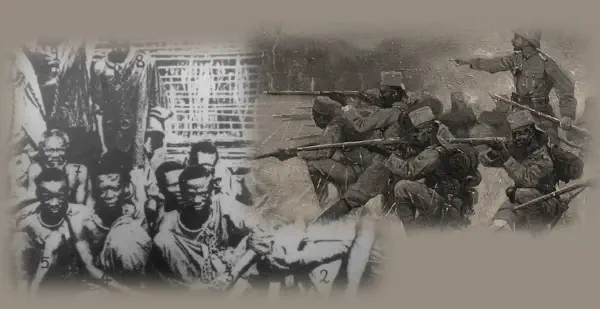
None of these resisters fought together. None coordinated their campaigns. None could draw on the resources of a continental alliance. The European conquest of Africa was not a war against a continent. It was a series of small wars against isolated opponents, each of whom could be brought to battle on ground of the invader’s choosing, at a time of the invader’s choosing, with forces that the invader could mass for the occasion and then disperse. The General History notes that “on no occasion was an African state assisted by one European power against another.” The European solidarity that this observation implies was, of course, strategic and self-interested. The powers were competing furiously for territory, but they never allowed their competition to reach the point of open war over African spoils. The solidarity of the colonial powers was one of the great unforced errors of African diplomacy. By playing the French against the British, the British against the Germans, a few shrewd rulers—Menelik in Ethiopia, the emirs of Borno—extracted concessions and delayed the inevitable. But they could not play a game in which the house held all the cards and the rules were rewritten whenever a player seemed to be winning.
The legacies of solitary resistance#
The resisters of the Scramble have been celebrated, in the nationalist historiographies of post-colonial Africa, as the founding fathers of anti-colonial struggle. Samori Ture, Lat Dior, Mkwawa, Bai Bureh, Nehanda, Mapondera: their names are inscribed on monuments and repeated in school textbooks. The celebration is just. Their courage was real, and their refusal to submit was an assertion of human dignity in the face of overwhelming force. But the celebration has also, perhaps inevitably, obscured the deeper tragedy of their position. They were not defeated because they lacked courage or skill. They were defeated because the structural conditions of their world made defeat, in the long run, all but inevitable.
Those structural conditions included the absence of any pan-African consciousness. There was no sense of shared identity that could overcome the dynastic rivalries, ethnic suspicions, and religious divisions that the European invaders exploited so ruthlessly. There was no diplomatic framework within which an African coalition could be assembled, no equivalent of the Congress of Vienna or the League of Nations, no institutional memory of joint military action. There was, above all, no access to the industrial base that produced the Maxim gun, the repeating rifle, the shell-firing cannon, and the steamships and railways that could deliver them to the battlefield. Africa’s rulers fought with the tools of the pre-industrial age, and those tools, however brilliantly wielded, were no match for the products of the factory system.
The post-colonial world has inherited the boundaries that the paper partition created and the economic structures that the extractive colonial state imposed. It has not inherited the unity that might have prevented those boundaries and those structures from coming into being. The African Caesars fought alone, and they fell alone. Their monuments stand as testimony to what might have been, had the cards not been so comprehensively stacked against them. But the history they made was, in the end, a history of solitary heroism rather than collective victory. The conquest of Africa was a triumph of European organization over African disunity, and the echoes of that disunity are still audible in the politics of the continent today.