The brutal economic logic of conquest, from chartered company armies to the hut tax that coerced a continent into labour#
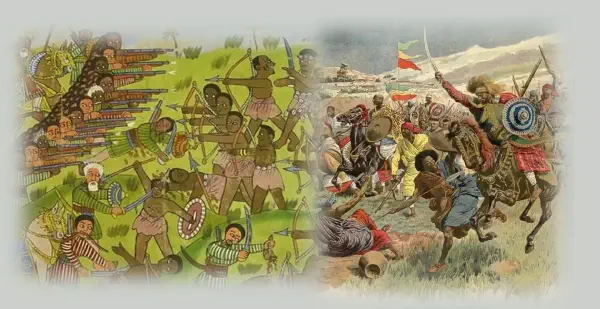
In January 1897, a flotilla of eleven gunboats churned up the Niger River toward the emirates of Nupe and Ilorin. On board were 507 African soldiers in khaki, a handful of European officers, and the managing director of the Royal Niger Company, Sir George Goldie. The company's infantry landed, drove the cavalry charges of the Nupe army back with volleys from breech-loading rifles, and brought up a seven-pounder cannon to blast open the walls of the capital. Within weeks, both emirates had been subdued. The Royal Niger Company was not a government. It was a private corporation, chartered in London, answerable to shareholders. Its business was palm oil. Its methods were indistinguishable from those of an invading state.
The military campaigns that delivered Africa to Europe between 1880 and 1914 are typically narrated as national enterprises: the French conquest of the Western Sudan, the British occupation of Nigeria, the German suppression of the Majï Majï rebellion. The reality was more peculiar and more revealing. Much of the conquest was outsourced to limited-liability companies whose directors sat in boardrooms in the City of London, the Bourse, and the Brussels Bourse. These companies raised their own armies, signed their own treaties, collected their own taxes, and dispensed their own justice. They were, in effect, sovereign states in miniature, driven by a single imperative: to make the conquest pay for itself, and then return a profit. The marauding army was a line item on a balance sheet. The human cost was an externality that no auditor bothered to count.
This fusion of corporate and military power was the defining feature of the Scramble. The chartered company was the preferred instrument of conquest precisely because it shifted the financial risk from the metropolitan treasury to the private investor. If the venture succeeded, the government could step in later, buy out the company's administrative rights, and inherit a functioning colonial state. If it failed, the shareholders bore the loss. The model had been road-tested by the East India Company in the eighteenth century. In Africa, it was applied with a brutality unconstrained by the older traditions of Mughal diplomacy. The conquest of the continent was, at its core, a business proposition, and its logic was as unforgiving as the Maxim gun that enforced it.
The Company as State#
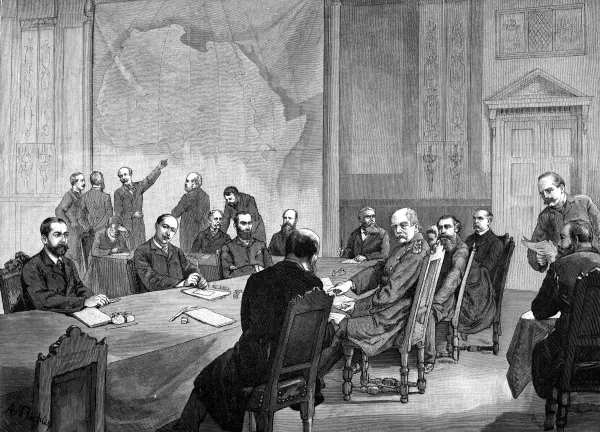
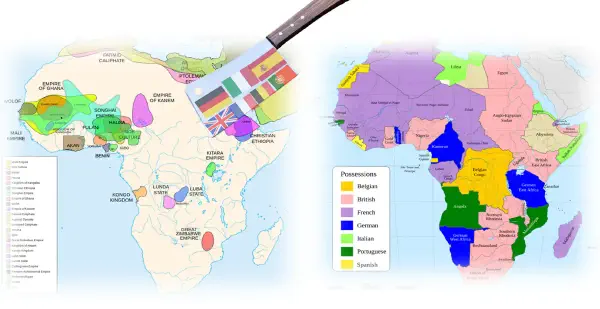
The Berlin West Africa Conference of 1884–85, for all its diplomatic refinement, had established that colonies would no longer be treated as simple commercial outposts. To be recognized by other powers, a claim required "effective occupation": a physical presence, an administrative apparatus, and the capacity to maintain order. Yet no European government was willing to foot the bill for such an enterprise across the vast, unmapped interior of Africa. The solution was to resurrect the moribund institution of the chartered company, a relic of mercantilism that had fallen out of fashion by the mid-nineteenth century but proved perfectly adapted to the conditions of the Scramble.
George Goldie's Royal Niger Company was the most successful of these hybrid entities. Founded in 1886, it inherited the treaties and trading posts of the National African Company, which Goldie had used to squeeze out French and German competitors from the lower Niger. The company's royal charter authorized it to administer justice, levy customs duties, and maintain a constabulary over the vast territories of the Niger basin. It did so with a ruthlessness that government officials could not have matched without provoking questions in parliament. When the emir of Nupe attempted to enforce his own trade regulations, Goldie dispatched the company's armed steamer, the Empire, supported by a force that included five Maxim guns and two breech-loading cannon. The emir was deposed. A more pliable successor was installed. The company's trade in palm oil continued unimpeded.
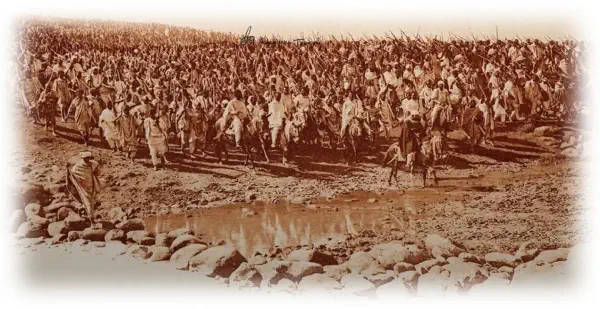
Goldie's counterpart in southern Africa was Cecil Rhodes, whose British South Africa Company received its charter in 1889. The company's writ ran over the territories that would become Southern and Northern Rhodesia, an area of more than a million square kilometers. Like the Royal Niger Company, it was empowered to maintain a police force, grant land concessions, and extract minerals. Unlike Goldie, Rhodes faced a formidable African adversary in the Ndebele kingdom under Lobengula. The company's initial conquest of Matabeleland in 1893 was carried out by a force of 1,200 white volunteers and 1,000 African auxiliaries, supported by Maxim guns that Lobengula's impis could not withstand. After the king's death and the expropriation of 280,000 head of cattle, the company proceeded to impose a hut tax, evict Africans from the most fertile lands, and establish the reserves that would define the racial geography of Rhodesia for the next century.
The most infamous of the chartered entities was, however, a state disguised as a humanitarian association. King Leopold II of the Belgians had no desire to share his Congo venture with pesky shareholders. His International African Association, reconstituted as the Congo Free State, was recognized as a sovereign government by the other European powers at Berlin. Leopold was its absolute monarch. The territory he ruled was not a colony in the traditional sense; it was a private estate of 2.3 million square kilometers, administered by a network of concessionary companies to which Leopold granted monopolies over rubber, ivory, and other products. The state's army, the Force Publique, was composed of African levies under white officers. Its task was not to defend borders but to enforce rubber quotas. The consequences were among the worst demographic catastrophes of the modern era.
The Logic of the Maxim Gun#
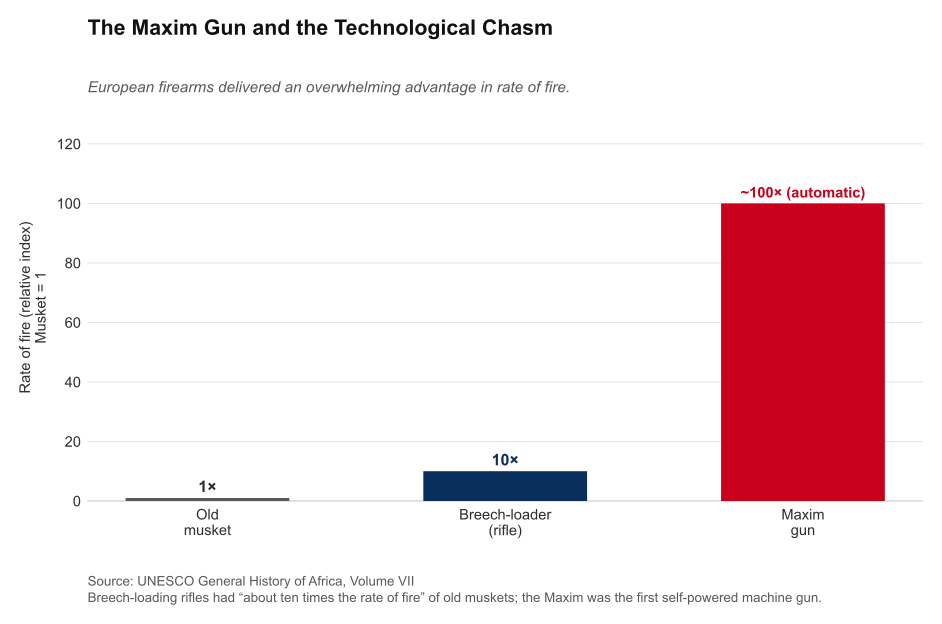
The weapon that made the chartered-company state possible was not the cannon or the rifle but the Maxim gun, the first truly automatic firearm. Its inventor, Hiram Maxim, had demonstrated the weapon to the British Army in 1885. By 1888, it was in use in Africa. The Maxim operated on a simple principle: the recoil from each shot ejected the spent cartridge and loaded the next, allowing a continuous rate of fire of up to 600 rounds per minute, so long as the ammunition belt held out. Against an enemy armed with single-shot muskets or spears, the psychological and physical effect was devastating.
The General History of Africa records that African armies were overwhelmingly equipped with muzzle-loading muskets, many of them obsolete European models that traders had dumped on the coast for decades. These weapons were slow to reload, inaccurate beyond a hundred meters, and useless in wet conditions. The new breech-loading rifles deployed by European forces, by contrast, fired ten times faster and could be reloaded lying down, behind cover. The Maxim gun multiplied this advantage by an order of magnitude. At the Shangani River in 1893, a detachment of 34 British South Africa Company troopers with four Maxims held off an estimated 5,000 Ndebele warriors, killing several hundred while suffering only four casualties.
The famous couplet by Hilaire Belloc has been quoted so often as to lose its sting, but it was a perfectly accurate summary of the military reality: "Whatever happens, we have got / The Maxim gun, and they have not." African armies were not technically incompetent; many, such as Samori Ture's Mandinka infantry and the Zulu impis, were highly disciplined, tactically sophisticated, and often better led than their European counterparts. But they could not close the gap between a spear and a belt-fed machine gun. The few African rulers who recognized this and attempted to modernize their arsenals found themselves systematically blocked. The Brussels Convention of 1890, to which all the colonial powers were signatories, prohibited the sale of modern firearms to Africans. The embargo was not perfectly enforced—Samori managed to smuggle Gras repeaters and Kropatschek rifles through Sierra Leone—but it was effective enough to ensure that no African army could match the firepower of even a modest European expeditionary force.
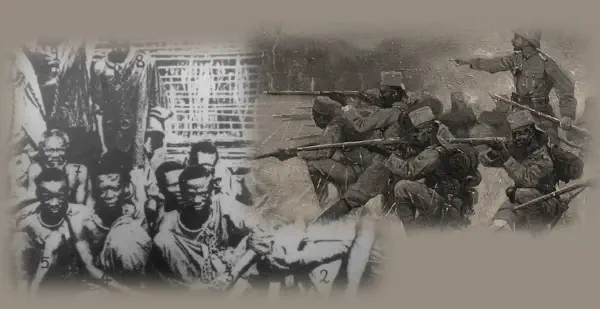
The human consequences of this technological asymmetry are almost impossible to exaggerate. At the battle of Omdurman in 1898, Kitchener's Anglo-Egyptian force, armed with Maxims and modern artillery, killed an estimated 11,000 Mahdist soldiers in five hours, losing 48 of their own men. At the German suppression of the Majï Majï rebellion in Tanganyika between 1905 and 1907, a scorched-earth policy combined with systematic machine-gunning of villages killed an estimated 250,000 to 300,000 people, mostly through starvation. The conquest was not a series of fair fights. It was a slaughter, executed by men who regarded their opponents less as soldiers than as obstacles to the extraction of value.
The Demographic Ledger#
The demographic data that survive from the early colonial period are fragmentary and often contested. Yet the broad trends are unmistakable. In every region where chartered companies or concessionary regimes imposed systematic forced labour, population numbers collapsed. The General History of Africa provides images/africa-lost-sovereignty that, even when treated with appropriate caution, reveal a human catastrophe of extraordinary scale.
In the Congo Free State, the population is estimated to have been halved during the first four decades of colonial rule. The causes were compound: outright murder, punitive expeditions, the breakup of families as men fled to the forest to escape the rubber collectors, the collapse of subsistence agriculture as labour was diverted, and the spread of epidemic disease, particularly sleeping sickness, which was itself exacerbated by population movements. The Belgian government, when it finally took over the Congo from Leopold in 1908, inherited a demographic wasteland.
In German South West Africa, the Herero uprising of 1904 was met with an order of extermination from General Lothar von Trotha. "Within the German boundaries," he proclaimed, "every Herero, whether armed or unarmed, with or without cattle, will be shot." The Herero were driven into the Omaheke desert, where the German forces poisoned waterholes and patrolled the perimeter to prevent escape. Of an estimated pre-war population of 60,000 to 80,000, between 75 and 80 percent perished. The survivors, including the paramount chief Samuel Maherero, fled across the Kalahari into Bechuanaland. The Nama people, who also rose against the Germans, suffered comparable losses. No German officer was ever prosecuted for these actions.
In the Ivory Coast, the Baule resisted French penetration for nearly two decades after the first military posts were established in the 1890s. The French governor, Louis-Gabriel Angoulvant, who took command in 1908, adopted a deliberate strategy of terror, burning villages, destroying crops, and summarily executing prisoners. When the last Baule resistance was crushed in 1911, the population of the Baule country had fallen from an estimated 1.5 million to roughly 260,000. The French colonial archive records these events in the language of pacification. The demographic ledger tells a different story.

Taxation as a Weapon#
If the Maxim gun provided the muscle of early colonialism, the hut tax was its sinews. The imposition of a monetary tax on every adult male—and in some colonies, on every hut—was not primarily a revenue-raising measure. It was a mechanism for forcing Africans out of the subsistence economy and into the labour market. The colonial state needed workers for European mines, plantations, and infrastructure projects. African peasants, who could feed themselves from their own land, had little incentive to work for the low wages on offer. The tax changed that calculus overnight. Every household now required cash to avoid imprisonment, the seizure of property, or the burning of its huts. The only reliable way to obtain cash was to sell one's labour.
The governor of Kenya, Sir Percy Girouard, stated the logic with brutal frankness in 1913: "We consider that taxation is the only possible method of compelling the native to leave his reserve for the purpose of seeking work. Only in this way can the cost of living be increased for the native... it is on this that the supply of labour and the price of labour depend. To raise the rate of wages would not increase, but would diminish the supply of labour." This was not a stray remark. It was an explicit statement of the economic philosophy that underpinned colonial labour policy from the Cape to the Gold Coast. Wages were to be kept low, and Africans were to be compelled to accept them. The invisible hand of the market was supplemented by the very visible fist of the tax collector.
The tax was collected with an efficiency that other arms of the colonial state seldom matched. In French West Africa, the head tax was the single largest source of colonial revenue, accounting for roughly a quarter of the budget. In the Belgian Congo, the per capita tax increased fourfold between 1917 and 1924. In the Portuguese colonies, the tax was officially payable in labour, at a rate of three months' work per year, a system that differed from slavery only in its legal nomenclature. Tax defaulters were flogged, their property confiscated, and their families taken as hostages. The system was administered by African chiefs and headmen who were themselves coerced into compliance, their own positions and stipends dependent on the quotas they delivered.
The tax did not, however, go unopposed. The Hut Tax rebellion that erupted in Sierra Leone in 1898 was a direct response to the imposition of a five-shilling levy on every two-roomed house. The Temne and Mende peoples, who had previously tolerated the British presence as a trading partner, rose up under the leadership of Bai Bureh, a Temne chief. The rebels attacked trading stations, killed British officials, and advanced to within forty kilometers of Freetown before the colonial army, reinforced by troops from Lagos, crushed the uprising. In Natal, the Bambata rebellion of 1906 was triggered by a new poll tax. The Zulu, already dispossessed of their land and squeezed onto reserves, responded with a guerrilla campaign that took the better part of two years to suppress. Bambata himself was killed in battle, and his body was dismembered—his head reportedly displayed as a warning.
These rebellions were crushed, as all such rebellions were crushed, by the same technological asymmetry that had enabled the initial conquest. The tax, however, was not repealed. It remained in place, an annual reminder that the colonial state was, at its heart, an apparatus for the extraction of African labour and African wealth.
Building Empire on Bones#
The infrastructure that colonial regimes constructed—the railways, the ports, the administrative buildings—is often cited by apologists as evidence of the developmental benefits of empire. The railways, in particular, are held up as transformative investments that opened the continent to world trade. What is less often mentioned is how those railways were built, and at what cost.
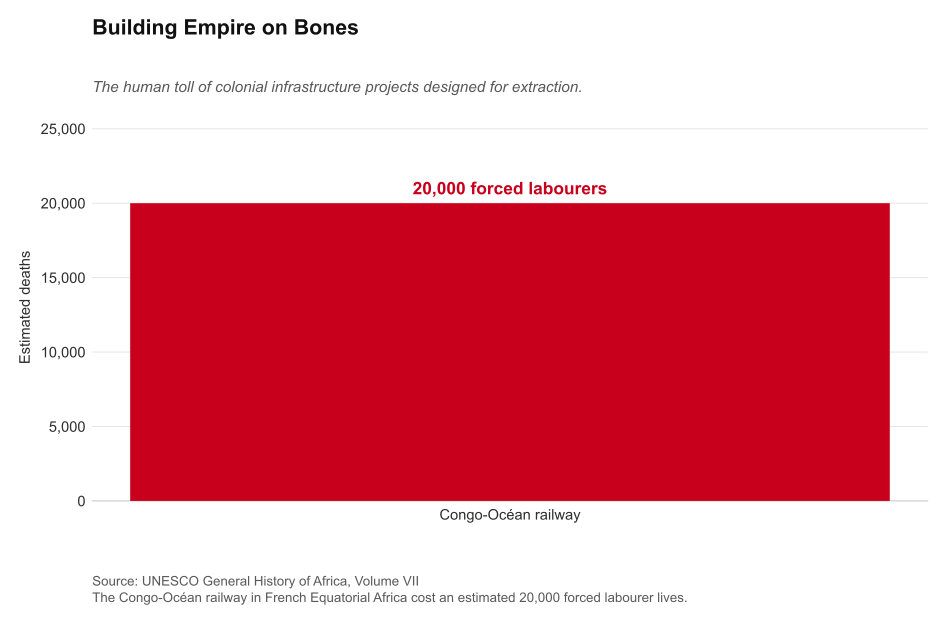
The construction of the Congo-Océan railway in French Equatorial Africa is a case in point. The line was conceived in 1913 as a means of giving France's equatorial colonies access to the Atlantic without having to route their exports through the Belgian Congo. The project was massively delayed by the First World War, and construction did not begin in earnest until 1921. The route ran through some of the most inhospitable terrain in Central Africa: dense equatorial forest, swamps, and the rugged Mayombe escarpment. French engineers, lacking access to voluntary labour on the scale required, turned to the colonial administration's power of requisition.
Between 1921 and 1932, the administration conscripted an estimated 127,250 men from the colonies of Moyen-Congo and Oubangui-Chari. They were housed in makeshift camps, fed inadequate rations, and subjected to brutal discipline. The work was backbreaking. The death rate was catastrophic. The best estimate is that some 20,000 labourers died during the construction of the 500-kilometer line. The railway, when it opened in 1934, was hailed as a triumph of French engineering. Its foundations were laid on the bones of African conscripts.
The Uganda Railway, built by the British between 1896 and 1901, was similarly deadly. The line was constructed, famously, by Indian indentured labourers—some 32,000 of them—of whom roughly 2,500 died during the project. The "lunatic line," as it was called, was intended to connect the coast at Mombasa with Lake Victoria, securing British access to the headwaters of the Nile. Its economic rationale was secondary to its strategic purpose. The railway did, eventually, facilitate the export of coffee and cotton from Uganda and the settlement of white farmers in the Kenya highlands. But its construction, like that of the Congo-Océan, was an act of imperial violence dressed in the language of progress.
The pattern was repeated across the continent. The Dakar-Saint-Louis line in Senegal, the Lagos railway in Nigeria, the Benguela railway in Angola, the German central line in Tanganyika: all were built under regimes of forced or semi-forced labour, all were financed by taxes levied on the very populations whose labour built them, and all were designed to move commodities from the interior to the coast for export to Europe. They were not intended to create an integrated continental market. They were not intended to benefit Africans. They were the steel sinews of an extractive machine, and they were paid for in blood.
The Economic Legacy#
The economic logic that drove the conquest did not end with the conquest. It defined the entire colonial period. The chartered companies were eventually wound up or bought out, but the structures they had established—the land concessions, the monopolies over export crops, the systems of taxation and forced labour—were taken over and perfected by the successor colonial states. The private armies became government police forces. The company tribunals became native courts. The rubber quotas became cotton cultivation campaigns.
By the inter-war period, Africa had been locked into a pattern of economic dependence from which it has yet fully to escape. Each colony specialized in a narrow range of primary commodities: groundnuts in Senegal, cocoa in the Gold Coast, coffee and cotton in Uganda, copper in Northern Rhodesia, gold in South Africa. Processing and manufacturing were deliberately suppressed. When Tanganyikan sisal growers set up a rope-making factory in 1932, the British colonial office intervened to shut it down, explicitly reaffirming the principle that colonies were to produce raw materials, not finished goods. The French pursued the same policy in their West African federation, blocking the construction of groundnut-crushing mills that might compete with the oil presses of Marseille.
The Great Depression of the 1930s exposed the fragility of this extractive model with brutal clarity. Commodity prices collapsed. Peasants who had been forced into cash-crop production found themselves unable to buy the imported foodstuffs on which they had been made dependent. Colonial governments, their revenues decimated, responded by increasing taxes and intensifying forced cultivation, driving rural populations deeper into debt and malnutrition. In Niger, the famine of 1931 killed an estimated half of the population in some districts. In Ruanda-Urundi, the Belgian administration's "coffee programme" forced every chief to cultivate a half-hectare of coffee, regardless of soil quality or subsistence needs, at the very moment when world coffee prices were plummeting.
The colonial economy was not a development project that went wrong. It was an extraction project that went right, for its intended beneficiaries. The African peasant, miner, and railway labourer laboured to enrich shareholders in London, Paris, and Brussels. The colonial state, far from acting as a neutral umpire between competing interests, was an active participant in this transfer of wealth. Its taxes, its labour laws, its infrastructure investments, and its repression of African collective action were all directed toward a single end: the maximization of European profit from African resources and African labour. The Maxim gun and the tax collector were the twin pillars of an economic order whose consequences have proved far more durable than the empires that built it.
Conclusion#
The conquest of Africa was an act of violence on a continental scale. It was planned in boardrooms, executed by corporate armies, and paid for by the labour of the conquered. The Royal Niger Company that invaded Nupe in 1897, the Congo Free State that halved the population of its territory, the German forces that exterminated the Herero, the French engineers whose railway consumed 20,000 conscripted lives: these were not aberrations. They were the logical expression of an economic system that treated African sovereignty, African labour, and African life as obstacles to be overcome in the pursuit of profit.
The chartered company has long since vanished from the African landscape, but its legacy endures. The borders drawn to secure its concessions are now national frontiers. The infrastructure built to extract its commodities remains the skeleton of the transport network. The tax systems designed to coerce African labour into the money economy have been inherited, in modified form, by independent governments. The patterns of monoculture and dependency established under colonial rule have proven remarkably resistant to reform. The Maxim gun is silent, but the economic logic it enforced has not been entirely dismantled. The tax collector still waits at the end of the road, though he now wears a different uniform. The conquest, it seems, is never quite finished.