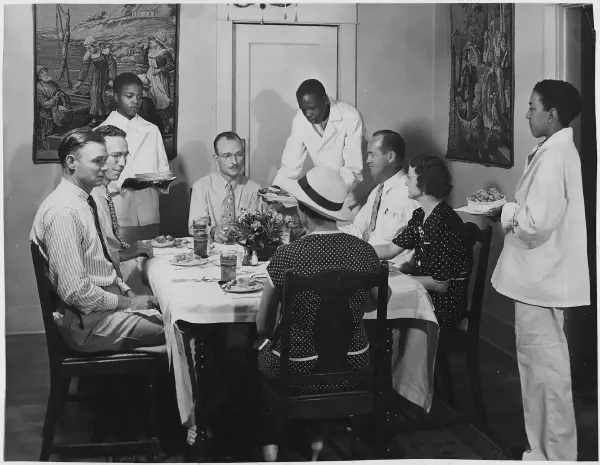
A scene from the Dutch East Indies, photographed during the colonial era and now held in the Tropenmuseum collection. European colonizers dine while local staff serve them: a mundane tableau that encodes the entire social architecture of colonial rule — racial hierarchy, enforced servitude, and the casual confidence of those who had redesigned a society around their own comfort.
This archive is arranged as a reading sequence, not a catalogue. Begin with the historical record: what happened, where, and at what scale. Then follow the logic: why empires were structurally necessary, how they extracted wealth through six distinct mechanisms, who built them, what they did in specific places, what they did to human minds, what survived decolonization, and how the same extraction logic operates today through critical minerals and the green transition. Each section is designed to deepen the one before it.
Part I — Orientation: The Shape of the World They Made#
Before mechanisms or actors, the reader needs a map. These pieces establish the factual ground: duration, geography, scale, and the world that existed before European expansion erased it.
The Pre-Colonial World
9th Century
The world before European dominance
The world Europe would colonize was not waiting to be discovered. Al-Jahiz's 9th-century account of Basra's trade networks documents a world of sophisticated commerce, intellectual production, and political order. European expansion did not find that world primitive; it made it so.
The Age of European Expansion Begins
1415 – 1600
Portugal, Spain, and the first colonial wave
Portuguese seizure of Ceuta (1415) opens the African coast. Spain reaches the Americas (1492). The Tordesillas line divides the world between two crowns. The first colonial template is established: papal authorization, military force, and commercial extraction as a single doctrine.
The Corporate Empire Era
1600 – 1800
VOC, EIC, and sovereign capital
The Dutch East India Company (1602) and English East India Company (1600) pioneer the most consequential institutional innovation of the colonial era: the joint-stock company with rights to wage war, sign treaties, and govern territory. Colonialism becomes a capital market instrument.
The Scramble for Africa
1884 – 1914
Partition and formal empire at its peak
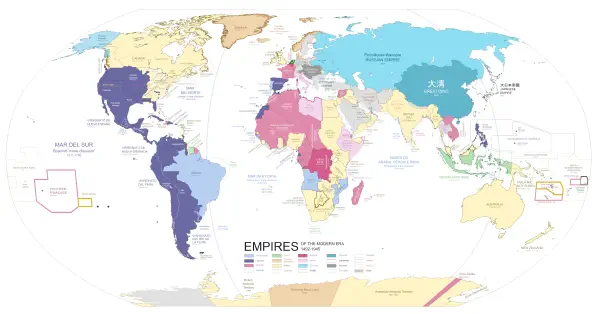
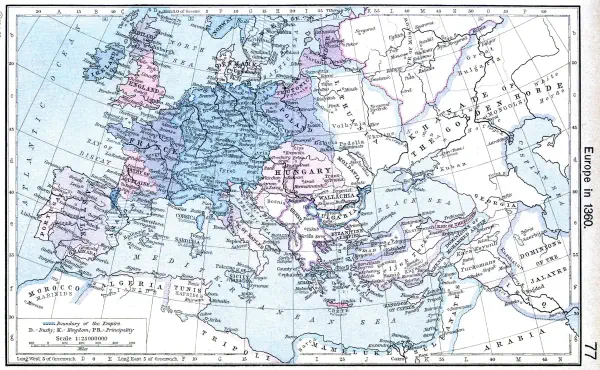
The Berlin Conference (1884) formalizes the partition of Africa among European powers. By 1914, European states control 84% of the Earth's land surface. Colonial rule reaches its maximum geographic extent, and plants the borders, dependencies, and ethnic fault lines that postcolonial states would spend the next century trying to govern.
The Decolonization Era
1945 – 1975
Independence without sovereignty
Formal independence arrives across Asia, Africa, and the Caribbean. The flags change. The debt structures, commodity dependencies, monetary systems, and intellectual frameworks do not. Colonialism redesigns itself as development economics.
Al-Jahiz's 9th-century treatise on trade reveals a world where merchants verified authenticity through taste, touch, and smell — a forensic economy that predates modern supply chains by a millennium.
This series explores how 9th-century merchants used sensory analysis, geographic status, and human judgment to verify the authenticity of global commodities in a world without modern supply chains.
Part II — The Structural Logic: Why Empires Exist#
Colonialism was not greed at scale. It was the logical output of specific political and economic systems. These pieces explain why empires were structurally necessary — not chosen, but produced.
A structural analysis of imperialism as the operating logic of the modern global economy — tracing how the state-capital nexus drives territorial expansion, enforces peripheral dependency through debt and military force, and reproduces extraction across formal and informal empire alike.
A structural analysis of imperialism as the operating logic of the modern global economy — tracing how the state-capital nexus drives territorial expansion, enforces peripheral dependency through debt and military force, and reproduces extraction across formal and informal empire alike.
A critical analysis of how Europe's competitive fragmentation and imperial innovations created the modern global system of power, finance, and inequality.
A critical analysis of how Europe's competitive fragmentation and imperial innovations created the modern global system of power, finance, and inequality.
The intellectual core of this archive. Colonialism operated through precise, replicable mechanisms, six in total, each examining a different dimension of how extraction was built, enforced, and normalized.
A. Biology of Power · B. Fiscal & Monetary Extraction · C. Violence Mechanics · D. Ideological Scaffolding · E. Agricultural Extraction · F. Infrastructure as Control
A mega-series using biological parasitism as a precise analytical framework for strategies of asymmetric control. Each entry examines one distinct colonial "playbook" — from neurological hijack to proxy armies to engineered despair.
Read this series in sequence. Each entry builds on the last. PG-1 establishes the analytical framework; PG-9 applies it as a comparative taxonomy of empires. Skipping ahead will cost you the explanatory power of the model.
A deep dive into the Cordyceps fungal strategy as a model for ideological conquest, examining the Spanish colonization of the Philippines through the lens of biological hijack.
PG-3 — The Sacculina Strategy: Institutional Castration
Exploring the Sacculina parasite's strategy of host castration and resource diversion as a model for the Dutch East India Company's brutal monopoly in the Banda Islands.
A historical exploration of how parasitic mechanisms in biology mirror geopolitical strategies of engineering despair through addiction and economic manipulation.
PG-6 — The Dicrocoelium Design: Multi-Host Manipulation
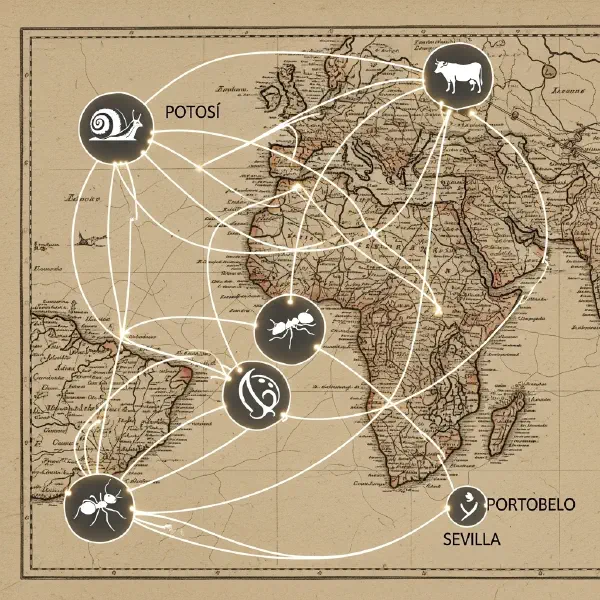
A historical exploration of how parasitic mechanisms in biology mirror geopolitical strategies of controlling complex supply chains through intermediary hosts.
A deep dive into the Epomis beetle's strategy of baiting predators into traps as a model for imperial entrapment, examining the British Subsidiary Alliances in India.
PG-8 — The Swarm Imperative: Decentralized Resistance
Exploring how decentralized, swarm-like networks provide resilience against centralized parasitic control, from ant colonies to modern digital activism.
For most of the nineteenth century, British politicians debated whether empire paid. The question was never cleanly resolved. This series applies cost-benefit analysis to the imperial project — not as a moral verdict, but as a fiscal one. Who bore the costs? Who captured the gains? The ledgers have answers that the speeches avoided.
For most of the nineteenth century, British politicians debated whether empire paid. The question was never cleanly resolved. This series applies cost-benefit analysis to the imperial project — not as a moral verdict, but as a fiscal one. Who bore the costs? Who captured the gains? The ledgers have answers that the speeches avoided.
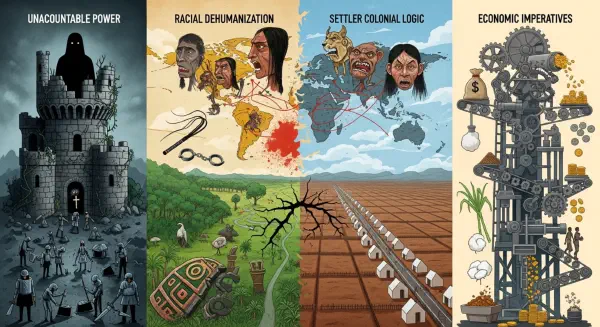
Extraction required violence. Not random violence — systematic, legally authorized, industrially scaled violence. These pieces dissect the four-factor architecture that made colonial atrocity not exceptional but structural.
A four-part examination of how unaccountable power, racial dehumanization, settler colonial logic, and economic imperatives combined to produce systematic violence across five centuries of colonial history.
A four-part examination of how unaccountable power, racial dehumanization, settler colonial logic, and economic imperatives combined to produce systematic violence across five centuries of colonial history.
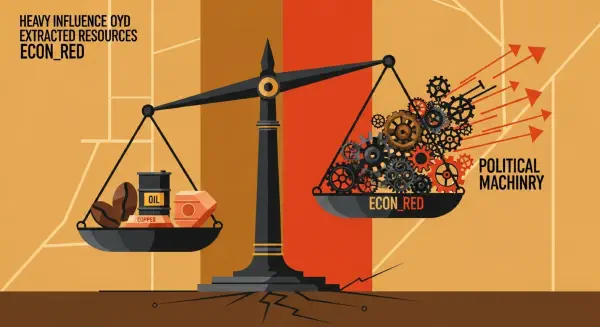
A five-part series examining why the countries best endowed with natural resources are so frequently the worst governed, and how the arithmetic of commodity dependence — not culture, not climate, not colonial history alone — explains the pattern.
A five-part series examining why the countries best endowed with natural resources are so frequently the worst governed, and how the arithmetic of commodity dependence — not culture, not climate, not colonial history alone — explains the pattern.
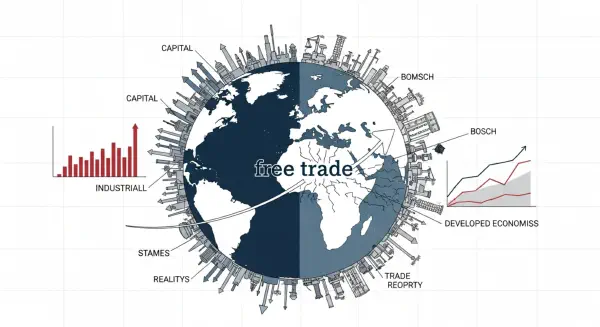
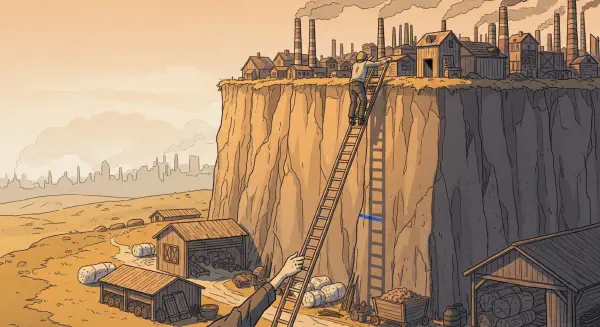
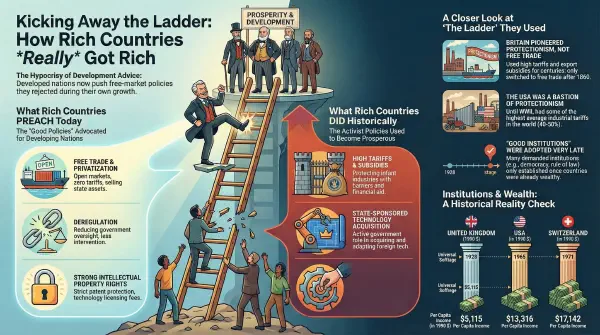
Empires needed an intellectual framework to justify their extraction as natural law. These pieces deconstruct it — showing how today's free-trade orthodoxy was built by nations that practiced its exact opposite during their own ascent.
An exploration of how today's rich nations built their wealth using policies they now deny to developing countries, revealing the tale of two histories.
An exploration of how today's rich nations built their wealth using policies they now deny to developing countries, revealing the tale of two histories.
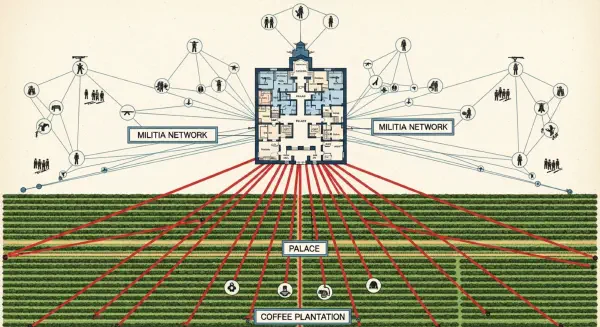
The cash crop system was not an agricultural policy. It was an extraction mechanism. Colonial powers restructured the food systems of entire continents to produce exportable commodities rather than feed local populations: land, labor, and water redirected toward European markets while the people who worked the land went hungry.
Exploring how inequality, colonialism, and corporate control have engineered hunger despite global abundance. A critical examination of why the world's poor starve in a world of plenty.
Exploring how inequality, colonialism, and corporate control have engineered hunger despite global abundance. A critical examination of why the world's poor starve in a world of plenty.
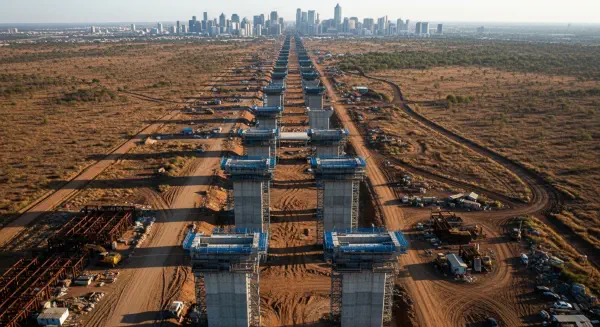
Empires did not merely extract resources; they built the systems that made extraction permanent. Roads, ports, railways, telegraph cables, maritime routes: every infrastructure investment by a colonial power was also a mechanism of control. The network connected the metropole to its colonies and made the colony dependent on the metropole to function. Whoever owned the network decided what moved, where, and at what price.
Abstract mechanisms become concrete when studied through the institutions and states that deployed them. The Dutch invented sovereign corporate violence. The British scaled it. The Americans reinvented it without flags.
How and why did Europe conquer the world? These pieces trace the specific institutional and ideological innovations that made European colonialism possible, and the particular ways it was implemented by each of the major colonial powers.
In 900 AD, western Europe was poorer, more violent, and more backward than China, India, or the Muslim Middle East. By 1914, Europeans controlled 84 percent of the world's land surface.
A seven-article series arguing that Europe's global dominance from 900 to 1914 was driven by a tournament of military innovation, enabled by unique political conditions and resulting in profound consequences for the world.
The VOC was not a company that traded. It was a state that extracted — holding the right to wage war, sign treaties, build fortresses, and mint coin. Read these pieces as a single arc: how it worked, how it justified itself, and what it did to real people.
Read in sequence. The six pieces build a single argument: institutional design, ideological justification, the economics of control, the cost in human life, the spice trade's body count, and the internal fractures that eventually broke it. Each entry picks up where the last one ends.
A four-part investigation into the Dutch East India Company, separating popular legend from historical reality using economic history, systems analysis, and institutional critique.
A three-part analytical series tracing how commercial extraction, military force, and providential authorization fuse into a replicable coercion doctrine — from the VOC's nutmeg monopoly to the present.
A three-part analytical series tracing how commercial extraction, military force, and providential authorization fuse into a replicable coercion doctrine — from the VOC's nutmeg monopoly to the present.
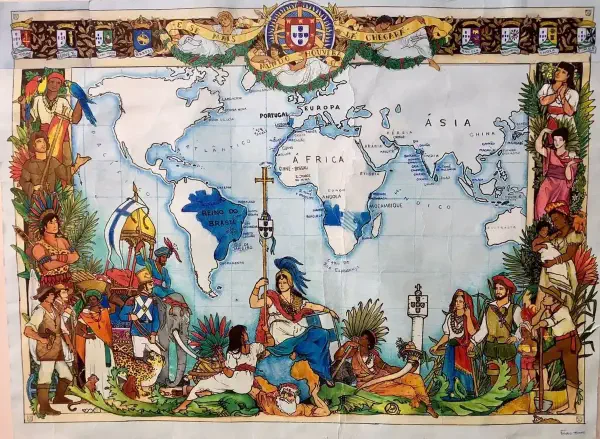
Portugal did not conquer territory in the conventional sense; it seized chokepoints. The Estado da India was a network of fortified trading posts controlling the Indian Ocean's key straits, not a territorial empire in the later European sense. Portuguese colonial logic was maritime monopoly: control the route, tax the trade, use the Church to legitimate the violence. It was the template every subsequent empire would adapt.
Where the Portuguese built a maritime trading empire, the Spanish built a territorial extraction machine. The encomienda system gave Spanish settlers legal claim over indigenous labor, institutionalizing forced work decades before the transatlantic slave trade reached industrial scale. Silver from Potosí funded the Spanish Crown's European wars and created the world's first global currency circuit. Spain demonstrated that a continent could be depopulated and its wealth transferred across an ocean within a single generation.
A deep dive into the complex systems that allowed Spain to conquer and rule a vast empire for over three centuries—and how those systems still shape the modern world.
A deep dive into the complex systems that allowed Spain to conquer and rule a vast empire for over three centuries—and how those systems still shape the modern world.
At its peak the British Empire covered a quarter of the Earth's surface. It did not begin as a state project: it began as a company. The East India Company governed populations, levied taxes, and waged wars for profit before the Crown formalized what commerce had already conquered. These pieces trace that arc from the improbable origins of English overseas ambition through the full machinery of British imperial administration.
A critical examination of how Europe's competitive fragmentation and British innovation created the world's largest empire, and how its structures persist in modern global systems.
A critical examination of how Europe's competitive fragmentation and British innovation created the world's largest empire, and how its structures persist in modern global systems.
An exploration of the fundamental mechanisms through which powerful entities—corporations, states, and institutions—maximize their interests. Drawing on historical examples and systemic analysis, it reveals how coercion, exchange, and deception operate as tools of power, how institutions often serve to legitimize predation rather than constrain it, and what effective resistance requires in the face of such dynamics.
A six‑part Orwellian dissection of the English East India Company, from royal charter to corporate ghost, tracing the mechanics of monopoly, conquest, and linguistic deceit that built the modern world.
A six‑part Orwellian dissection of the English East India Company, from royal charter to corporate ghost, tracing the mechanics of monopoly, conquest, and linguistic deceit that built the modern world.
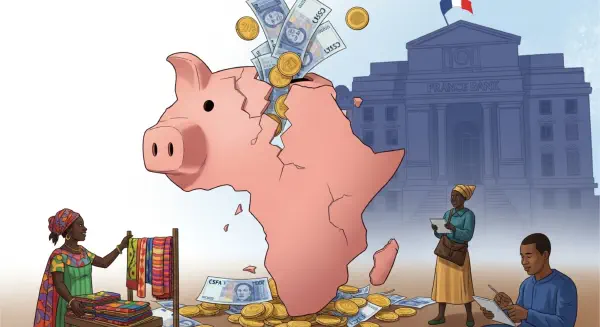
France distinguished itself through two mechanisms that proved more durable than territory: the CFA franc and the assimilation doctrine. The franc system, imposed on fourteen African states at independence and administered from Paris, kept monetary and fiscal sovereignty in French hands long after the flags changed. The assimilation doctrine framed colonial subjects as future Frenchmen, producing an educated elite whose intellectual formation bound them to the metropole. France designed its empire to survive decolonization.
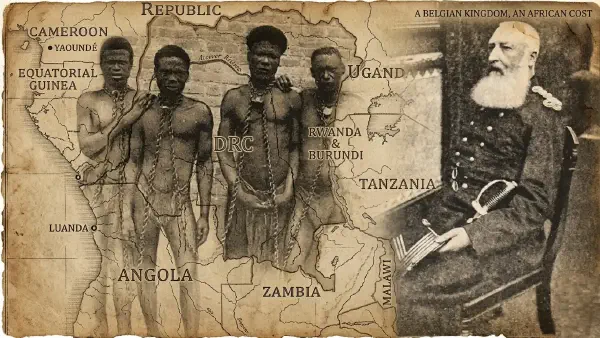
Leopold II ran the Congo Free State as a private extraction operation: rubber quotas enforced by systematic mutilation, a hostage system that held families until male laborers met their targets, and a private army responsible for between 5 and 10 million deaths in less than 25 years. When international pressure forced the Belgian state to take over in 1908, the infrastructure of terror remained; only the administration changed. The Congo is the most documented case of extraction-as-atrocity in the colonial record.
The United States did not build a colonial empire with flags and governors. It built one with dollars, debt, and doctrine. These pieces trace the continuity.
This three-part series examines how the United States turned democracy from a political principle into the moral packaging of imperial power. It traces the machinery beneath that language—institutions, law, finance, and force—and shows how these structures sustained hierarchy while preserving the image of universal order. It concludes by arguing that Trump did not create this contradiction, but exposed it by openly consuming the very myth America once sold to the world.
This three-part series examines how the United States turned democracy from a political principle into the moral packaging of imperial power. It traces the machinery beneath that language—institutions, law, finance, and force—and shows how these structures sustained hierarchy while preserving the image of universal order. It concludes by arguing that Trump did not create this contradiction, but exposed it by openly consuming the very myth America once sold to the world.
Abstract mechanisms become undeniable through specific national histories. These case studies show the colonial playbook executing in real time, against real people, with real numbers.
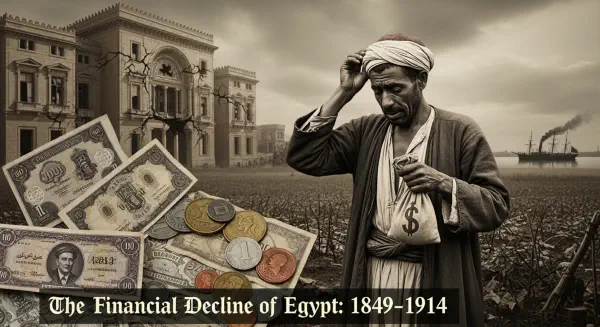
Follow the sequence. Egypt's path from the most powerful Arab state to British occupation in 77 years is the cleanest demonstration of colonial debt mechanics in the historical record. Each article in this section picks up exactly where the last one ends. Read them in order.
A historical analysis of Mohamed Ali Pasha's industrialization and state-building in Egypt, examining the human cost of his brutal 'New Order' and the systematic extraction of Upper Egypt.
A historical analysis of Mohamed Ali Pasha's industrialization and state-building in Egypt, examining the human cost of his brutal 'New Order' and the systematic extraction of Upper Egypt.
A four-part forensic examination of how the Suez Canal concession of 1854 set in motion a chain of financial, agricultural, and sovereign losses that culminated in British occupation. Anchored in primary sources and economic data.
A four-part forensic examination of how the Suez Canal concession of 1854 set in motion a chain of financial, agricultural, and sovereign losses that culminated in British occupation. Anchored in primary sources and economic data.
Explores how Egypt’s status as a wartime creditor to Britain became a mechanism of post-colonial wealth extraction, freezing capital that could have funded industrialization.
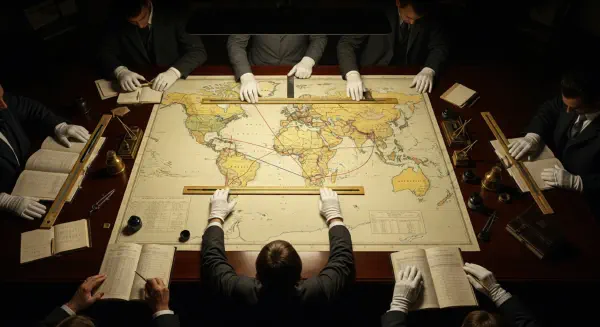
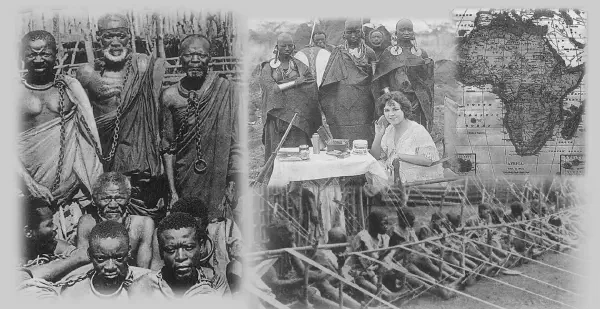
The Berlin Conference of 1884 divided a continent in a room. European diplomats drew lines across terrain most of them had never seen, partitioning Africa into administrative units calibrated to European logistics, not African geography, ethnicity, or political structure. The borders drawn in Berlin became the borders of today's African states, and the source of most of the conflicts within them.
Five posts tracing how colonial powers drew borders that ignored geographic logic — and how the resulting fractures still drive war, displacement, and the global age of walls.
Five posts tracing how colonial powers drew borders that ignored geographic logic — and how the resulting fractures still drive war, displacement, and the global age of walls.
The Scramble for Africa was a period of rapid colonization between 1884 and 1914, sparked by the Berlin Conference, where European powers partitioned the continent to secure raw materials and strategic territory. Driven by industrial competition and imperial ambition, nations like Britain, France, and Belgium drew artificial borders that ignored existing ethnic and cultural boundaries. By the start of World War I, nearly 90% of Africa was under European rule, leaving a lasting legacy of economic exploitation and political instability.
Explore the rapid conquest of Africa by European powers between 1880 and 1914, the brutal exploitation that followed, and the persistent legacies that continue to shape the continent.
This series explores the rapid conquest of Africa by European powers between 1880 and 1914, the brutal exploitation that followed, and the persistent legacies that continue to shape the continent.
India was the centerpiece of the British Empire and the most documented case of deliberate deindustrialization in the colonial record. Bengal's textile industry, which supplied European markets before colonization, was dismantled within a generation through tariff policy designed in London. By 1947, one of the world's most industrially sophisticated regions had been reduced to a raw-material exporter.
A comprehensive historical exploration of eight centuries of Islamic rule in India, from the Umayyad governors to the fall of the Mughal Empire, examining the cultural, political, and spiritual synthesis that created one of history's greatest civilizations.
A comprehensive historical exploration of eight centuries of Islamic rule in India, from the Umayyad governors to the fall of the Mughal Empire, examining the cultural, political, and spiritual synthesis that created one of history's greatest civilizations.
Rwanda 1994 was not a tribal explosion. It was the rational terminal event of a colonial commodity system that had been administered from Geneva for sixty years. Read the mechanism before the massacre.
A five-part series using Wintrobe's loyalty-repression model and Verwimp's commune-level data to show that the Rwandan genocide was not the explosion of ancient hatreds but the rational outcome of a budget constraint the dictator could no longer meet.
A five-part series using Wintrobe's loyalty-repression model and Verwimp's commune-level data to show that the Rwandan genocide was not the explosion of ancient hatreds but the rational outcome of a budget constraint the dictator could no longer meet.
Part VI — The Colonial Mind: What Was Done to Consciousness#
The most durable product of colonialism was not debt or borders — it was a restructured sense of self. These pieces examine the psychological and intellectual infrastructure that colonialism built inside the colonized, and which outlasts every flag.
A comprehensive five-part examination of how colonialism functions as an objective system that manufactures both colonizer and colonized, transcending individual morality or intent.
A comprehensive five-part examination of how colonialism functions as an objective system that manufactures both colonizer and colonized, transcending individual morality or intent.
A critical examination of how colonialism created permanent psychological and institutional structures that persist long after formal independence, trapping former colonies in cycles of intellectual and economic dependency.
A critical examination of how colonialism created permanent psychological and institutional structures that persist long after formal independence, trapping former colonies in cycles of intellectual and economic dependency.
A historical exploration of how colonization shaped not just territories but minds, examining the mechanisms of mental subjugation and the ongoing struggle for decolonization in a globalized world.
A historical exploration of how colonization shaped not just territories but minds, examining the mechanisms of mental subjugation and the ongoing struggle for decolonization in a globalized world.
A critical exploration of how intellectual captivity persists beyond formal decolonization, examining the pedagogical, ideological, technological, and globalization mechanisms that perpetuate Western dominance over the minds of formerly colonized nations.
A critical exploration of how intellectual captivity persists beyond formal decolonization, examining the pedagogical, ideological, technological, and globalization mechanisms that perpetuate Western dominance over the minds of formerly colonized nations.
How pressure from colonial dominant force causes three human behavioral patterns
How pressure from colonial dominant force causes three human behavioral patterns
Part VII — The Aftermath: What Survived Independence#
Decolonization lowered flags. It did not end extraction. The mechanisms redesigned themselves — through debt, dependency, development doctrine, and democratic ideology. These pieces show what colonialism became after 1945.
A structural analysis of how colonial extraction survived decolonisation by trading armies for financial institutions — and why a country's engineering capacity, not its legal status, determines whether it is truly free.
A structural analysis of how colonial extraction survived decolonisation by trading armies for financial institutions — and why a country's engineering capacity, not its legal status, determines whether it is truly free.
A five-part series examining how the arithmetic of dollar-denominated borrowing, a fragmented creditor landscape, and an international restructuring architecture designed for a different era combine to trap developing economies in a cycle of debt that systematically displaces spending on health and education.
A five-part series examining how the arithmetic of dollar-denominated borrowing, a fragmented creditor landscape, and an international restructuring architecture designed for a different era combine to trap developing economies in a cycle of debt that systematically displaces spending on health and education.
Deciphering the Architecture of Global Control, provides a critical investigation into how the concepts of development and globalization have been utilized as strategic tools for United States hegemony and world domination. Drawing from the analytical framework of Henry Veltmeyer, the series challenges the conventional narrative of global progress, framing it instead as a sophisticated system of imperial extraction and political containment
Deciphering the Architecture of Global Control, provides a critical investigation into how the concepts of development and globalization have been utilized as strategic tools for United States hegemony and world domination. Drawing from the analytical framework of Henry Veltmeyer, the series challenges the conventional narrative of global progress, framing it instead as a sophisticated system of imperial extraction and political containment
A historical-psychological post-mortem that traces neoliberalism to colonial rent-seeking in Madeira. It frames atomization as a neurobiological assault fueling authoritarian killer clowns and uses complexity theory to show deregulation turning networks into mutual incendiary devices. The answer, a politics of belonging built on commons and public luxury.
A historical-psychological post-mortem that traces neoliberalism to colonial rent-seeking in Madeira. It frames atomization as a neurobiological assault fueling authoritarian killer clowns and uses complexity theory to show deregulation turning networks into mutual incendiary devices. The answer, a politics of belonging built on commons and public luxury.
A systemic X-ray of neoliberalism, turning citizens into consumers, a tollbooth economy extracting rent from essentials, and shifting blame onto individuals. The fix, a restoration story built on cooperation, commons, and participatory democracy.
A systemic X-ray of neoliberalism, turning citizens into consumers, a tollbooth economy extracting rent from essentials, and shifting blame onto individuals. The fix, a restoration story built on cooperation, commons, and participatory democracy.
Foreign Direct Investment (FDI) is often celebrated as a shortcut to development. But for many developing countries, the reality resembles an old colonial plantation: foreign‑owned enclaves extract cheap labor, land, and tax breaks, while profits flow back to wealthy home countries. Local economies receive low‑wage jobs but little industrial deepening.
Foreign Direct Investment (FDI) is often celebrated as a shortcut to development. But for many developing countries, the reality resembles an old colonial plantation: foreign‑owned enclaves extract cheap labor, land, and tax breaks, while profits flow back to wealthy home countries. Local economies receive low‑wage jobs but little industrial deepening.
Exposing the uncomfortable truths about the billion foreign aid industry - why it persists, who benefits, and what might actually work.
Exposing the uncomfortable truths about the billion foreign aid industry - why it persists, who benefits, and what might actually work.
Projection and Resistance
*Post-colonial sovereignty requires more than political independence; it requires industrial capacity. These pieces examine how states reclaim the ability to produce rather than merely extract, and what happens when that capacity is instead deployed as a new instrument of geopolitical projection.*
An analysis of the efficiency gains and externalized costs of AI-assisted targeting in modern warfare, with a focus on the U.S. Department of Defense's Project Maven.
An analysis of the efficiency gains and externalized costs of AI-assisted targeting in modern warfare, with a focus on the U.S. Department of Defense's Project Maven.
Across the developing world, governments share a common ambition: to build a globally competitive automotive industry. The promise is immense—thousands of high-quality jobs, deep industrial linkages, technological spillovers, and a pathway to high-income status. Yet for every country that has succeeded, many more have failed. Worse, they have failed in ways that are systematic and predictable.
Across the developing world, governments share a common ambition: to build a globally competitive automotive industry. The promise is immense—thousands of high-quality jobs, deep industrial linkages, technological spillovers, and a pathway to high-income status. Yet for every country that has succeeded, many more have failed. Worse, they have failed in ways that are systematic and predictable.
Part VIII — The New Extraction Frontier: Critical Minerals and the Green Transition#
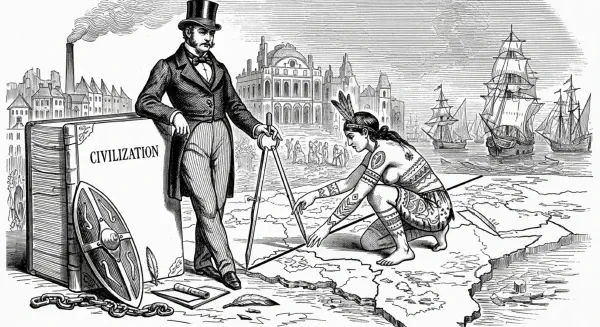
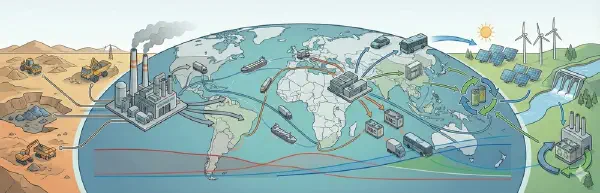
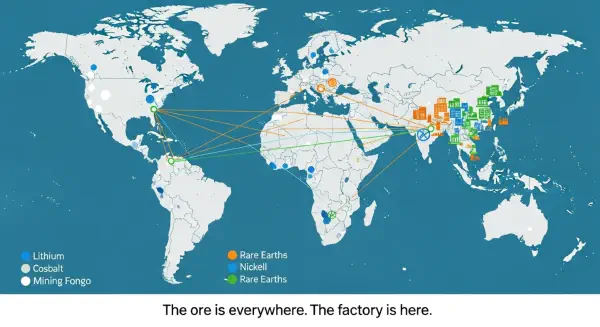
Formal colonialism ended. The extraction logic did not. The decarbonization transition has recreated the classical colonial structure in a new domain: critical minerals concentrated in the Global South, processed in a single state, and consumed in wealthy nations. The environmental cost falls on the communities at the mine. The strategic control rests with whoever owns the processing layer. The narrative of "clean energy" performs the same function that "free trade" and "civilization" performed in earlier eras: it makes extraction sound like progress.
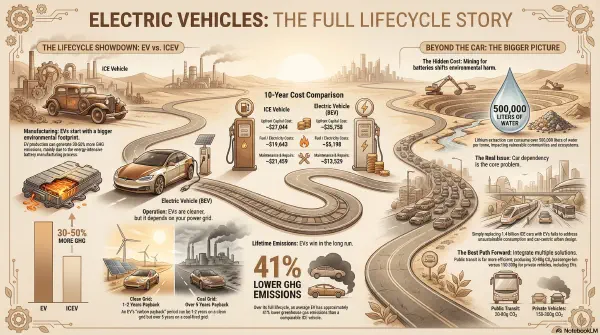
The EV transition does not eliminate emissions; it moves them. The tailpipe goes silent. The mine opens wider. These pieces follow the environmental burden from the road to the pit.
The electric vehicle revolution promises zero tailpipe emissions, but the true environmental cost lies in the global battery supply chain. This analysis reveals how mining, refining, and manufacturing shift carbon burdens to developing economies, and explores strategies for genuinely sustainable electric mobility.
The electric vehicle revolution promises zero tailpipe emissions, but the true environmental cost lies in the global battery supply chain. This analysis reveals how mining, refining, and manufacturing shift carbon burdens to developing economies, and explores strategies for genuinely sustainable electric mobility.
Critical mineral processing is more geographically concentrated than oil ever was. One state controls the refining layer for lithium, cobalt, and rare earths simultaneously. These pieces map the chokepoints and name the dependency structures being locked in.
The Rare Earth Gambit is a four-part series. Read it in sequence: the first entry establishes the Processing Concentration Index (PCI) and exposes the gap between mining-stage and processing-stage concentration. The subsequent parts map China's refining monopoly, the IRA's miscalibrated policy response, and the 7–12-year timeline before any supply-chain resilience measure reaches production scale.
A four-part forensic series introducing the Processing Concentration Index (PCI) to reveal that the critical mineral supply chain's true vulnerability sits in the processing layer — a chokepoint three times more concentrated than mining, and one that current mineral security policy was designed not to measure.
A four-part forensic series introducing the Processing Concentration Index (PCI) to reveal that the critical mineral supply chain's true vulnerability sits in the processing layer — a chokepoint three times more concentrated than mining, and one that current mineral security policy was designed not to measure.
A critical exploration of the green energy transition's hidden costs, examining how lithium mining perpetuates colonial extraction while claiming sustainability.
A critical exploration of the green energy transition's hidden costs, examining how lithium mining perpetuates colonial extraction while claiming sustainability.
A critical analysis of how the green energy transition is creating new forms of concentrated power across minerals, technology, capital, geopolitics, and social inequality.
A critical analysis of how the green energy transition is creating new forms of concentrated power across minerals, technology, capital, geopolitics, and social inequality.