Explore how the Second Law of Thermodynamics imposes an inescapable efficiency ceiling on all energy conversion processes, forcing engineers to battle against irreversible heat waste in power generation.
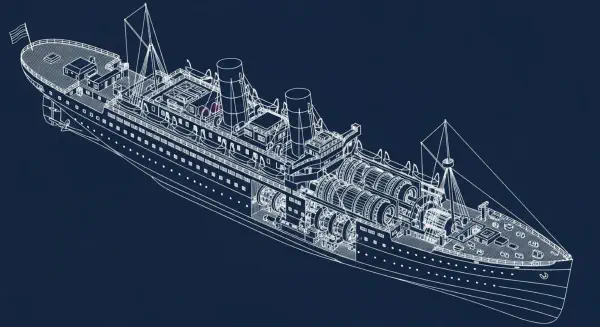
The early 20th-century steamship was a transitional industrial organism that achieved transoceanic scale by integrating high-density manual labor with a sophisticated 'closed-loop' thermodynamic system. Quantitative analysis reveals a critical dependence on thermal recycling, where steam volume expanded sixteen-hundredfold to drive quadruple-expansion engines before being condensed to prevent the catastrophic loss of fresh water. The structural mechanism of this integration was a steam-based nervous system that synchronized propulsion, navigation, and life support across a five-hundred-foot riveted steel hull. This analysis requires one post to synthesize the ship's mechanical and logistical unity.
Examining frameworks and movements that reintroduce margin, durability, and regeneration into systems design, from biomimicry to circular economics to epistemic humility.
Exploring how the pursuit of frictionless efficiency in logistics, labor, and governance creates societies that are optimized for performance but fragile under stress.
How social media platforms and digital services use sophisticated algorithmic optimization to maximize engagement and extract human attention as a commodity.
A critical exploration of how optimization—from product design to platforms to labor—has shifted from serving human flourishing to extracting it, and how a doctrine of necessary margin offers a way forward.