
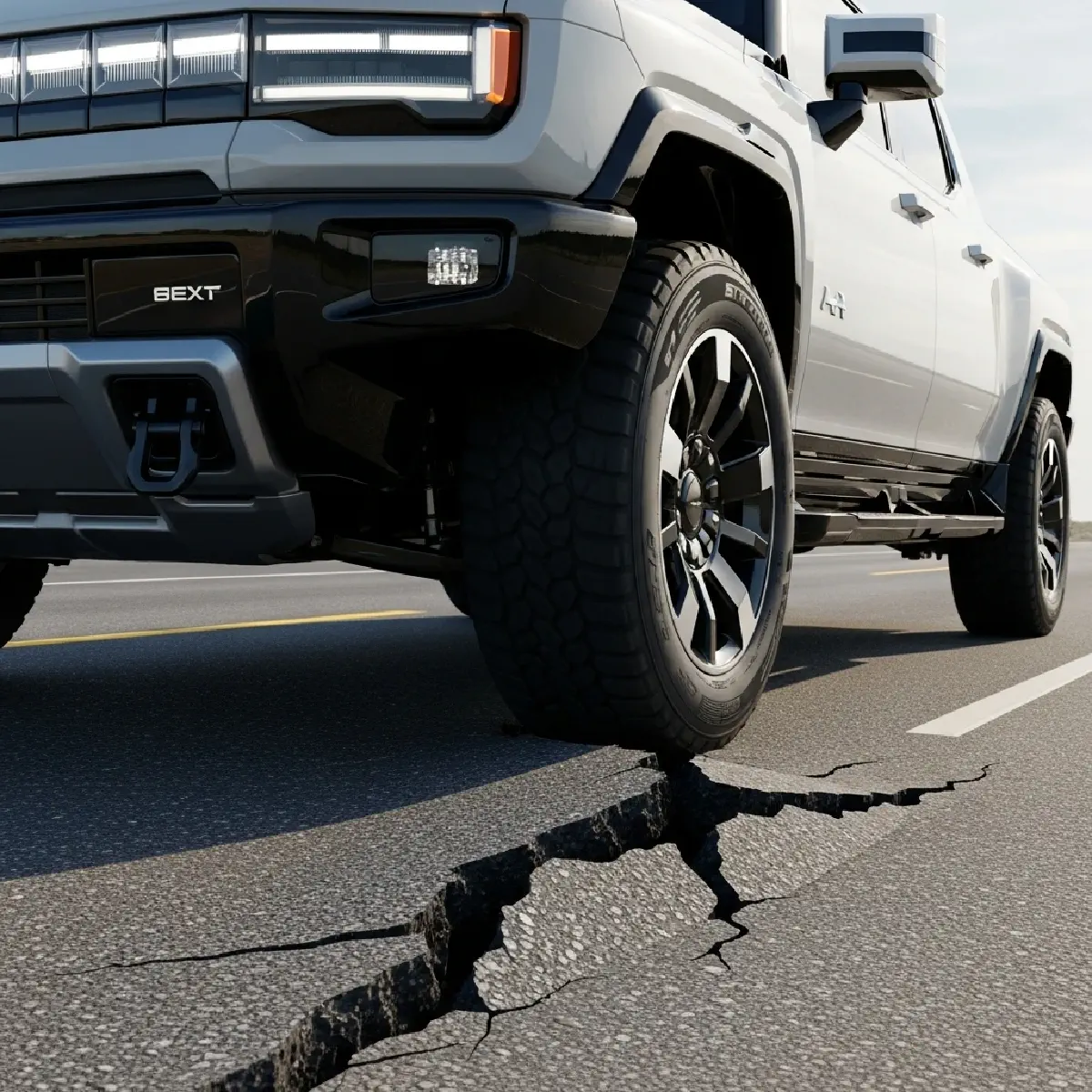
The burden of the Armored Age is not carried by vehicles alone. It is transferred directly to the infrastructure beneath them. The relationship between vehicle weight and road wear is not linear; it is exponential. The damaging effect of an axle on pavement scales to the fourth power of its weight. This means that doubling the weight on an axle does 16 times the damage. A single 6,000-pound SUV causes exponentially more wear than a 3,000-pound sedan.
This is a massive, socialized externality. The cost of repairing potholes, cracked foundations, and worn-out bridge surfaces is paid by all taxpayers through gas taxes and municipal budgets, not solely by the drivers of the heaviest vehicles. The American Society of Civil Engineers consistently gives U.S. infrastructure a grade near D+, citing a multi-trillion-dollar funding gap. The unaccounted-for contribution of soaring vehicle weights to this decay is a hidden accelerant in a slow-burning crisis.
The strain extends to parking and urban design. A standard parking space in the 1970s was about 8.5 feet wide. Today, many lots are redesigned with stalls over 9 feet wide, and still, modern trucks and SUVs overflow their lines. This reduces the total number of parking spaces, increases land consumption, and contributes to urban sprawl. Garages in newer homes are built larger to accommodate these vehicles, increasing construction costs and material use. Our built environment is physically reshaping itself, at great expense, to accommodate the automotive bulk we have incentivized.
The Electric Acceleration#
The transition to electric vehicles presents a critical inflection point. It was an opportunity to rethink vehicle size and efficiency. Instead, the industry has largely used electrification to double down on mass and power. Electric pickups and SUVs are among the heaviest passenger vehicles ever put into mass production. The GMC Hummer EV weighs over 9,000 pounds—roughly three Honda Civics. The Ford F-150 Lightning is about 1,600 pounds heavier than its gasoline counterpart.
This weight penalty comes from the battery pack, which can weigh over 1,500 pounds itself. While EVs eliminate tailpipe emissions, they exacerbate all the other problems of mass: tire wear pollution (a major source of microplastics), infrastructure damage, and safety incompatibility. Furthermore, their immense weight demands more energy to move, undermining efficiency gains and requiring even larger batteries—another vicious cycle of mass compounding, now powered by lithium instead of gasoline.
The environmental promise of electrification is thus partially offset by this shadow impact of mass. Cleaner air is traded for more aggressive road wear, greater resource extraction for batteries, and increased particulate matter from tires. It is a staggering case of problem displacement, where solving one environmental crisis (emissions) intensifies several others.
The Path to a Mass-Lite Future?#
Reversing this trend requires dismantling the perverse incentives that created it. Policy is the primary lever. Reforming CAFE to eliminate the footprint loophole and setting standards based on absolute weight or efficiency, rather than vehicle size, would be a start. Some European countries already tax vehicles based on weight, directly internalizing this externality.
Engineering innovation must also be redirected. The goal should be “light-weighting” without compromise. This means using advanced materials and smarter design to reduce mass while maintaining safety—a philosophy that prioritizes intelligent crash energy management over sheer bulk. The safety regulatory framework must evolve to rigorously test and penalize vehicle designs that are overly aggressive to others on the road, promoting compatibility.
Ultimately, the weight epidemic is a story of misaligned systems. Policy, profit, consumer psychology, and engineering have conspired to create vehicles that are destructive by design. The cost of this path is measured in crumbling roads, rising deaths, and an environmental footprint that remains stubbornly large even as it goes electric. The weight of our vehicles is a physical manifestation of a deeper imbalance of power—one that favors individual size over collective resilience. Building a sustainable mobility future isn’t just about changing the energy source; it’s about confronting the cult of mass and choosing a lighter, more rational path forward.