
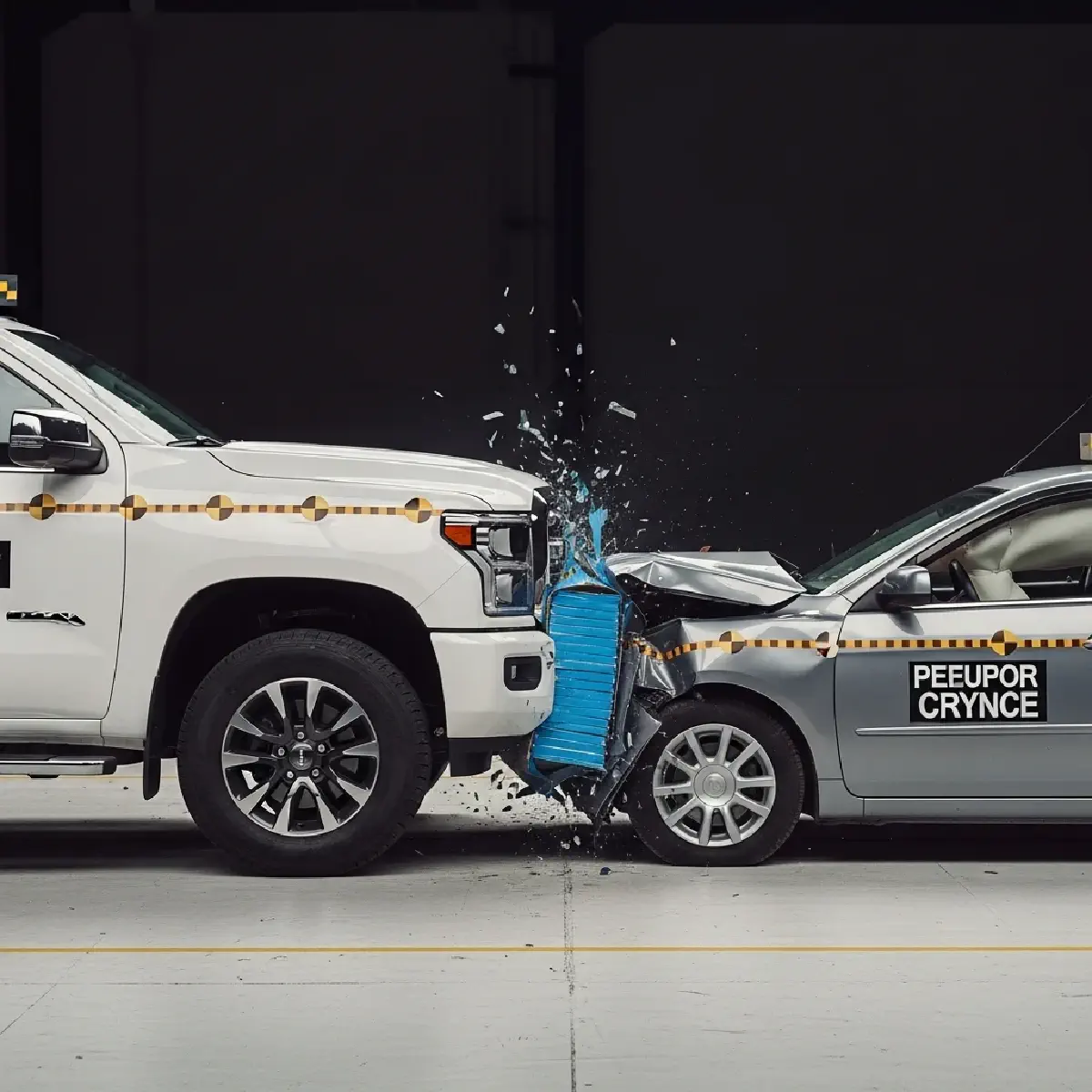
The marketing language is unequivocal: a “command driving position,” a “protective safety cage,” a “confidence-inspiring stance.” Modern automotive advertising sells safety through mass and intimidation. This narrative taps into a powerful, visceral psychology—the belief that in a conflict between two objects, the larger, heavier one will prevail. Automakers have weaponized this intuition, creating an arms race on the asphalt where individual perceptions of safety collectively degrade the safety of all.
This arms race is rooted in a deadly physics problem: vehicle incompatibility. In a crash between two objects of mismatched mass, height, and stiffness, the laws of physics are not kind to the smaller, lower one. The heavier vehicle’s momentum dominates the collision dynamics. The taller vehicle’s front end, or “grille line,” can override the lower car’s carefully engineered crumple zones, intruding directly into the passenger compartment. This is not a minor effect. The Insurance Institute for Highway Safety (IIHS) states that for every 1,000-pound increase in the weight of a striking vehicle, the risk of death for occupants in the struck car increases by approximately 45-50%.
The shift from sedans to SUVs and trucks has thus created a perverse redistribution of risk. Those who can afford newer, larger vehicles gain a measurable, though not absolute, safety benefit. Those who cannot—drivers of older, smaller cars, along with pedestrians and cyclists—bear a dramatically increased burden of risk. Safety is no longer a common good to be optimized across the system; it has become a private commodity purchased through bulk.
The Pedestrian Crisis#
The consequences of this shift are most starkly lethal outside the vehicle. Pedestrian fatalities in the United States hit a 40-year high in 2022, with over 7,500 deaths. This crisis is directly correlated with the rise of heavy, tall-fronted vehicles. The design of a modern truck or large SUV creates a triple threat to pedestrians.
First, the high, blunt front end is more likely to strike a pedestrian’s torso or head rather than their legs, leading to more severe injuries. Second, the increased mass delivers significantly more traumatic force. Third, the tall hood creates a massive front blind zone. A 2023 study by Consumer Reports found that some full-size pickups had front blind spots so long that they could obscure a circle of 11 children standing directly ahead of the vehicle. This isn’t an oversight; it is a direct outcome of prioritizing an aggressive, upright stance for styling and aerodynamic space for a large engine.
Automotive design, once shaped by wind tunnels and ergonomics, is now shaped by a safety paradox. The very features sold as protective to those inside the vehicle—mass, height, and rigid frames—are inherently aggressive to everyone else on the road. We have engineered not for collective safety, but for a form of mobile fortification, where one person’s security actively undermines another’s.
The Illusion of Absolute Safety#
The focus on vehicle mass as a safety tool also obscures a critical truth: size does not guarantee survival. The high ground clearance and stiff truck-frame construction that help in override crashes also make these vehicles more prone to rollover accidents, which have a higher fatality rate than other crash types. Electronic stability control has mitigated this, but the fundamental physics remain.
Furthermore, the perceived invulnerability can lead to risk-compensating behavior. Studies have suggested that drivers of larger vehicles may feel more protected and thus drive more aggressively or with less attention. This creates a feedback loop: more danger on the roads encourages the purchase of larger vehicles, which in turn contributes to more danger.
The result is a transportation system locked in a self-reinforcing cycle of escalation. We have traded the manageable, predictable dynamics of a fleet of similarly sized passenger cars for a chaotic battlefield of mismatched vehicles, where the dominant strategy is to be the heaviest actor on the road. The automotive landscape has become an arena of asymmetric warfare, and the casualties are counted not in showrooms, but in emergency rooms and morgues. The armored age promises security but delivers a more dangerous world for everyone.